Describe what happens to a cell that is placed in a hypertonic solution and draw a...
Describe what happens to a cell that is placed in a hypertonic solution and draw a diagram to demonstrate the
flow of water into or out of the cell.
Homework Answers

Add Answer to:
Describe what happens to a cell that is placed in a hypertonic
solution and draw a...
15. Placed in a hypertonic solution. Which of the following describe the resulting osmosis? • There...
15. Placed in a hypertonic solution. Which of the following describe the resulting osmosis? • There is no flow of water. • There is a net flow of water out of the cell. • There net flow of water into and out of the cell is zero. • There is a net flow of water into the cell. Which of the equation pH = -log[H+] = 10^-9 M has a pH of which of the following? 9 10 1 5...
1) Draw (using dots to represent solute) a hypertonic, hypotonic, and isotonic relationship across a membrane....
1) Draw (using dots to represent solute) a hypertonic, hypotonic, and isotonic relationship across a membrane. Which way is water moving in each relationship? 2) Draw plant cells in hypertonic, hypotonic, and isotonic solutions. What happens to each plant cell when placed in each solution? 3) Draw animal red blood cells in hypertonic, hypotonic, and isotonic solutions. What happens to each plant cell when placed in each solution? Thank You!
13) Distinguish between hypertonic, and isotenic solution and explain what happens to animal cell and plant...
13) Distinguish between hypertonic, and isotenic solution and explain what happens to animal cell and plant cell in those solutions.
Describe what will occur in each of the following situations, include what the cell will look...
Describe what will occur in each of the following situations, include what the cell will look like, and state which way the water moves (into cell, out of cell, both in and out, or neither): An animal cell is placed in a solution that is 10 times more concentrated than an isotonic solution (is this solution hypotonic, isotonic, or hypertonic compared to inside the cell?). An animal cell is placed in a solution that is 10 times more dilute than...
QUESTION 9 In a hypertonic solution, water leaves the red blood cell, causing it to shrink....
 QUESTION 9 In a hypertonic solution, water leaves the red blood cell, causing it to shrink. What happens to the cell is known as: Crenation Hemolysis Hypotonic
If red blood cells are taken from the body and placed in a hypertonic solution, what...
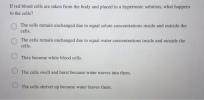 If red blood cells are taken from the body and placed in a hypertonic solution, what happens to the cells? The cells remain unchanged due to equal solute concentrations inside and outside the cells. The cells remain unchanged due to equal water concentrations inside and outside the cells. They become white blood cells. The cells swell and burst because water moves into them. The cells shrivel up because water leaves them.
The scientific term for animal red blood cells placed in a hypertonic solution is----- The scientific...
The scientific term for animal red blood cells placed in a hypertonic solution is----- The scientific term for a plant cell placed in a hypertonic solution is------
IS THE CELL (A) ISOTONIC, (B) HYPOTONIC, (C) HYPERTONIC, TO THE SOLUTION? 35% sugar in a...
IS THE CELL (A) ISOTONIC, (B) HYPOTONIC, (C) HYPERTONIC, TO THE SOLUTION? 35% sugar in a cell in 25% NaCl solution 20% NaCl in a cell, in pure water 10% salt in a cell in 90% water 10% salt in a cell in 15% sugar solution
7) An animal cell placed in a hypertonic environment of water and salt would most likely:...
 7) An animal cell placed in a hypertonic environment of water and salt would most likely: a. Jump out to escape the salty water b. Expand as sodium enters via the sodium-potassium pump C. Shrink as water leaves the cell via osmosis d. Develop a cell wall 8) Using the periodic table, figure out the number of subatomic particles a molecule of livermorium (Lv) has. 116 Protons Neutrons Lv Electrons 293 9) In the reaction below, which element is being...
1. Describe the changes in your potato sample when placed in distilled water. Based on these...
 1. Describe the changes in your potato sample when placed in distilled water. Based on these changes, was the water hypertonic, isotonic, or hypotonic compared to the cells of the potato? Explain your reasoning in terms of the flow of water into or out of the potato cells. 2, Describe the changes in your potato sample when placed in 0.9% NaCl solution. Based on these changes, was the 0.9% NaCl hypertonic, isotonic, or hypotonic compared to the cells of the...
 QUESTION 9 In a hypertonic solution, water leaves the red blood cell, causing it to shrink. What happens to the cell is known as: Crenation Hemolysis Hypotonic
 If red blood cells are taken from the body and placed in a hypertonic solution, what happens to the cells? The cells remain unchanged due to equal solute concentrations inside and outside the cells. The cells remain unchanged due to equal water concentrations inside and outside the cells. They become white blood cells. The cells swell and burst because water moves into them. The cells shrivel up because water leaves them.
 7) An animal cell placed in a hypertonic environment of water and salt would most likely: a. Jump out to escape the salty water b. Expand as sodium enters via the sodium-potassium pump C. Shrink as water leaves the cell via osmosis d. Develop a cell wall 8) Using the periodic table, figure out the number of subatomic particles a molecule of livermorium (Lv) has. 116 Protons Neutrons Lv Electrons 293 9) In the reaction below, which element is being...
 1. Describe the changes in your potato sample when placed in distilled water. Based on these changes, was the water hypertonic, isotonic, or hypotonic compared to the cells of the potato? Explain your reasoning in terms of the flow of water into or out of the potato cells. 2, Describe the changes in your potato sample when placed in 0.9% NaCl solution. Based on these changes, was the 0.9% NaCl hypertonic, isotonic, or hypotonic compared to the cells of the...
Most questions answered within 3 hours.
-
Where is the error in this code sequence?
String s1 = "Hello";
String s2 = "ello";...
asked 10 months ago -
Financial data for Joel de Paris, Inc., for last year
follow:
Joel de Paris, Inc.
Balance...
asked 10 months ago -
Consider this reaction:
Al2(SO4)3 (aq)+ BaCl3
(aq) Al2Cl6 (aq)- +
3BaSO4(s) . What is the...
asked 10 months ago -
Suppose that Savneet is considering increasing her
recent random sample from 20 car rentals to 40...
asked 10 months ago -
Trucks arrive at an unloading terminal at an average rate of 120
per hour.
Trucks arrive...
asked 10 months ago -
Why are methanol and ethanol completely soluble in water while
octanol is not very little soluble....
asked 10 months ago -
A facilities manager at a university reads in a research report
that the mean amount of...
asked 10 months ago -
When the CuSO4 is rehydrated by adding water to the anhydrous
compound, is this an endothermic...
asked 10 months ago -
A ray of sunlight is passing from diamond into crown glass; the
angle of incidence is...
asked 10 months ago -
A block of mass 0.249 kg is placed on top of a light, vertical
spring of...
asked 10 months ago -
how do the kidneys compensate in the presences of acidosis
a) trigger hyperventilate
b) reserve acid...
asked 10 months ago -
Question 501 pts
The rental rate of capital to the firm increases. Which of the
following...
asked 10 months ago