Consider all three processes -- mitosis, meiosis and fertilization. Which ones produce genetic variation?
Consider all three processes -- mitosis, meiosis and fertilization. Which ones produce genetic variation?
Homework Answers
The correct option is meiosis.
Genetic variation is produced and increased by the process of meiosis. The process of meiosis results in genetic variation by shuffling of maternal and paternal chromosomes and crossing over.
Add Answer to:
Consider all three processes -- mitosis, meiosis and
fertilization. Which ones produce genetic variation?
Why is genetic variation generated by meiosis and fertilization important evolutionarily
Why is genetic variation generated by meiosis and fertilization important evolutionarily
Which processes lead to most genetic variation in sexually reproducing organisms? Select all that apply. random...
 Which processes lead to most genetic variation in sexually reproducing organisms? Select all that apply. random fertilization cytokinesis crossing over independent assortment of chromosomes in meiosis
Processes that determine heredity and contribute to genetic variation Meiosis guarantees that in a sexual life...
 Processes that determine heredity and contribute to genetic variation Meiosis guarantees that in a sexual life cycle, offspring will inherit one complete set of chromosomes (and their associated genes and traits) from each parent. The transmission of traits from parents to offspring is called heredity. Another important aspect of meiosis and the sexual life cycle is the role these processes play in contributing to genetic variation. Although offspring always resemble their parents, they are genetically different from both of their...
6. The products of mitosis are mostly genetically identical. The products of meiosis are not a....
 6. The products of mitosis are mostly genetically identical. The products of meiosis are not a. Explain how meiosis can generate genetic diversity. What specific processes present in meiosis but not mitosis produce cells with different combinations of alleles?
all these questions have more than one correct answers 1) Meiosis & mitosis have similarities as...
all these questions have more than one correct answers 1) Meiosis & mitosis have similarities as well as differences. Which of the following represent similarities? a) Both increases genetic variation b) Both change in chromosomes number in daughter cells c) Both only occur in eukaryotes D) DNA replication must occur prior to both e) Both make use of a spindle to separate chromatids 2) Meiosis is a special form of cell division. Select any of the following that applies to...
Why must all sexually reproducing organisms have both mitosis and meiosis in their life cycles? In other words, what is...
Why must all sexually reproducing organisms have both mitosis and meiosis in their life cycles? In other words, what is the purpose of meiosis AND what is the purpose of mitosis and how are they different? Without sexual reproduction evolution would be extremely slow. Why ? And what stage and steps in meiosis are so important to the genetic variation within a species?
BI119. Homework - Mitosis/Meiosis Name: Brittany Helman 1. (7pts) Compare and contrast Mitosis -vs- Melosis by...
 BI119. Homework - Mitosis/Meiosis Name: Brittany Helman 1. (7pts) Compare and contrast Mitosis -vs- Melosis by filling in the chart. (Don't forget to indicate the correct choice asked in the brackets!) Mitosis Meiosis # Parent cell 1 parent cell 1 parent cell diploid (2n) (haploid(n) or diploid(2n)?] haploid (n) Location of cell division (germ-line cells or somatic cells?] Purpose/Function [repair, growth, gamete production, asexual reproduction, sexual reproduction? Sonratc cells repair germ-line cells gamate produchon sexual reproduction growth a sexual reproducha...
Which of the following statements about mitosis and meiosis are TRUE? (check all that apply) Mitosis...
Which of the following statements about mitosis and meiosis are TRUE? (check all that apply) Mitosis consists of a single nuclear division, whereas meiosis consists of two nuclear divisions. Mitosis produces genetically identical cells, whereas meiosis produces genetically variable cells. The number of chromosomes in the newly formed cells is the same as in the original cell in both mitosis and meiosis. DNA replication occurs prior to mitosis and meiosis.
1. Draw out ALL of the stages of Mitosis AND Meiosis (I and II). Use at...
1. Draw out ALL of the stages of Mitosis AND Meiosis (I and II). Use at least 3 homologous pairs. 2. Label each stage and the hallmark of that stage. Show how chromosomes align and segregate 3. Show the points (indicate in drawing where possible) where genetic diversity is introduced AND how it contributes to diversity (Assortment of chromosomes, Random fertilization, Crossing-over between non-sister chromatids) How does trisomy 21 occur? During which stages? Indicate on your drawing for #1
Which if the following is not a source of genetic variation in meiosis? O polar body...
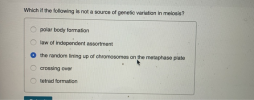 Which if the following is not a source of genetic variation in meiosis? O polar body formation O law of independent assortment o the random lining up of chromosomes on the metaphase plate crossing over O tetrad formation
 Which processes lead to most genetic variation in sexually reproducing organisms? Select all that apply. random fertilization cytokinesis crossing over independent assortment of chromosomes in meiosis
 Processes that determine heredity and contribute to genetic variation Meiosis guarantees that in a sexual life cycle, offspring will inherit one complete set of chromosomes (and their associated genes and traits) from each parent. The transmission of traits from parents to offspring is called heredity. Another important aspect of meiosis and the sexual life cycle is the role these processes play in contributing to genetic variation. Although offspring always resemble their parents, they are genetically different from both of their...
 6. The products of mitosis are mostly genetically identical. The products of meiosis are not a. Explain how meiosis can generate genetic diversity. What specific processes present in meiosis but not mitosis produce cells with different combinations of alleles?
 BI119. Homework - Mitosis/Meiosis Name: Brittany Helman 1. (7pts) Compare and contrast Mitosis -vs- Melosis by filling in the chart. (Don't forget to indicate the correct choice asked in the brackets!) Mitosis Meiosis # Parent cell 1 parent cell 1 parent cell diploid (2n) (haploid(n) or diploid(2n)?] haploid (n) Location of cell division (germ-line cells or somatic cells?] Purpose/Function [repair, growth, gamete production, asexual reproduction, sexual reproduction? Sonratc cells repair germ-line cells gamate produchon sexual reproduction growth a sexual reproducha...
 Which if the following is not a source of genetic variation in meiosis? O polar body formation O law of independent assortment o the random lining up of chromosomes on the metaphase plate crossing over O tetrad formation
Most questions answered within 3 hours.
-
Where is the error in this code sequence?
String s1 = "Hello";
String s2 = "ello";...
asked 10 months ago -
Financial data for Joel de Paris, Inc., for last year
follow:
Joel de Paris, Inc.
Balance...
asked 10 months ago -
Consider this reaction:
Al2(SO4)3 (aq)+ BaCl3
(aq) Al2Cl6 (aq)- +
3BaSO4(s) . What is the...
asked 10 months ago -
Suppose that Savneet is considering increasing her
recent random sample from 20 car rentals to 40...
asked 10 months ago -
Trucks arrive at an unloading terminal at an average rate of 120
per hour.
Trucks arrive...
asked 10 months ago -
Why are methanol and ethanol completely soluble in water while
octanol is not very little soluble....
asked 10 months ago -
A facilities manager at a university reads in a research report
that the mean amount of...
asked 10 months ago -
When the CuSO4 is rehydrated by adding water to the anhydrous
compound, is this an endothermic...
asked 10 months ago -
A ray of sunlight is passing from diamond into crown glass; the
angle of incidence is...
asked 10 months ago -
A block of mass 0.249 kg is placed on top of a light, vertical
spring of...
asked 10 months ago -
how do the kidneys compensate in the presences of acidosis
a) trigger hyperventilate
b) reserve acid...
asked 10 months ago -
Question 501 pts
The rental rate of capital to the firm increases. Which of the
following...
asked 10 months ago