If there are 2.36 g of NO present, how much energy (kJ) will be produced? 2...
If there are 2.36 g of NO present, how much energy (kJ) will be produced?
2 NO (g) → 2 N2 (g) + O2 (g) ΔH = -180.0 kJ
If 3.50 kJ was required for the following reaction, how many grams of KClO3 was produced?
2 KCl (s) + 3 O2 (g) → 2 KClO3 (s) ΔH = 84.9 kJ
If there are 0.709 mol of O2 present, how much energy (kJ) will be consumed when the reaction is reversed?
H2O2 (l) → H2O (l) + O2 (g) ΔH = -196.4 kJ
Homework Answers
2 NO (g)----> 2 N2 (g) + O2 (g) dH = -180.0 kJ
it is given that 2 mole NO to produce product with the
release of 180 KJ energy.negative dH value indicate reaction
is exothermic
So 1 mole NO release 180/2 Kj =90 KJ of energy
2.36 g of NO = 2.36/molar mass of NO moles of energy
= 2.36 g/30.01 g/mol = 0.0786 moles
SO there is 0.0786 moles of NO
0.0786 moles of NO release energy = 90 kj*0.0786
= 7.078 KJ
*******************
2 KCl (s) + 3 O2 (g)----> 2 KClO3 (s) dH = 84.9 kJ
dH is positive means reaction is endothermic ; that means it
absorbs energy
From balanced equation we can make out that 2 moles KClO3 produced
when
84.9 KJ energy is absorbed
1 KJ energy released when 2/84.9 mole KClO3 produced
3.50 KJ is released when [2/84.9]* 3.50 mole KClO3
produced = 0.0824 moles
moles of KClO3 produced = 0.0824 moles
convert this moles to mass using molar mass of KCLO3
mass of KClO3 produced = # moles of KClO3*molar mass
= 0.0824 mole*122.55 g/mol = 10.10 g
******************************
H2O2 (l)----> H2O (l) + O2 (g) dH = -196.4 kJ
the given equation says 1 mole O2 produced
along with the release of 196.4 kJ of heat
So when 0.709 mole O2 produced ;
energy released = 0.709 * 196.4 KJ = 139.2476 KJ
dH = - 139.2476 KJ
This much energy will be released
When this reaction is reverse same amount of heat will be
absorbed.
for reverse reaction keep in mind that ,since it is
endotermic,sign will be positive
SO dH = +139.2476 KJ
*********************
Thank you .hope it is helpful
Add Answer to:
If there are 2.36 g of NO present, how much energy (kJ) will be
produced?
2...
If 3.50 kJ was required for the following reaction, how many grams of KClO3 was produced?...
If 3.50 kJ was required for the following reaction, how many grams of KClO3 was produced? 2 KCl (s) + 3 O2 (g) → 2 KClO3 (s) ΔH = 84.9 kJ If there are 5.96 g of NO present, how much energy (kJ) will be produced? 2 NO (g) → 2 N2 (g) + O2 (g) ΔH = -180.0 kJ
Use the set of three reactions shown below to answer the questions that follow. 2NO(g) + O2(g) → 2NO2(g) ΔH = -116 kJ 2N...
Use the set of three reactions shown below to answer the questions that follow. 2NO(g) + O2(g) → 2NO2(g) ΔH = -116 kJ 2N2(g) + 5O2(g) + 2H2O(l) → 4HNO3(aq) ΔH = -256 kJ N2(g) + O2(g) → 2NO(g) ΔH = +183 kJ a. If 30.2 g of NO g is reacted with excess oxygen, how much heat energy is produced? b. What mass of liquid water will be consumed during the production of 31000 J of energy assuming that...
For the reaction N2(g) + O2(g) → 2 NO(g), AH° = 180.5 kJ. How much energy...
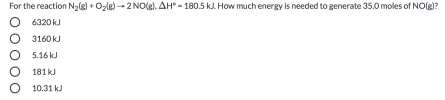 For the reaction N2(g) + O2(g) → 2 NO(g), AH° = 180.5 kJ. How much energy is needed to generate 35.0 moles of NO(g)? 6320 kj 3160 kJ 5.16 kJ 181 kJ 10.31 kJ
Use the set of three reactions shown below to answer the questions that follow. 2NO(g) +...
Use the set of three reactions shown below to answer the questions that follow. 2NO(g) + O2(g) → 2NO2(g) ΔH = -116 kJ 2N2(g) + 5O2(g) + 2H2O(l) → 4HNO3(aq) ΔH = -256 kJ N2(g) + O2(g) → 2NO(g) ΔH = +183 kJ If 27.9 g of NO g is reacted with excess oxygen, how much heat energy is produced? What mass of liquid water will be consumed during the production of 33900 J of energy assuming that there is...
How much heat is produced if 22.2 g of octane (C8H18) is combusted according to the...
How much heat is produced if 22.2 g of octane (C8H18) is combusted according to the following reaction? 2 C8H18 (g) + 25 O2 (g) --> 16 CO2 (g) + 18 H2O (l) ΔH = -5471 kJ/mol
Consider the following data. 2 H2(g) + O2(g) 2 H2O(l) ΔH = -571.7 kJ N2O5(g) +...
Consider the following data. 2 H2(g) + O2(g) 2 H2O(l) ΔH = -571.7 kJ N2O5(g) + H2O(l) 2 HNO3(l) ΔH = -92.0 kJ N2(g) + 3 O2(g) + H2(g) 2 HNO3O(l) ΔH = -348.2 kJ Use Hess's law to calculate ΔH for the reaction below. 2 N2O5(g) 2 N2(g) + 5 O2(g) ΔH = _____kJ
Please help with these two questions :( 1. How much energy (in kJ) is evolved during...
 Please help with these two questions :(
1. How much energy (in kJ) is evolved during the reaction of
76.9 g of Al, according to the reaction below?
Fe2O3(s) + 2 Al(s) →
Al2O3(s) + 2 Fe(s) ΔH°rxn = -852
kJ
Assume that there is excess Fe2O3.
2. A 12.43 g sample of ethanol (C2H5OH) is
burned in a bomb calorimeter with a heat capacity, C = 5.65
kJ/°C.
C2H5OH(l) + 3 O2(g) → 2
CO2(g) + 3 H2O(g) ΔH°rxn...
Please help with these two questions :(
1. How much energy (in kJ) is evolved during the reaction of
76.9 g of Al, according to the reaction below?
Fe2O3(s) + 2 Al(s) →
Al2O3(s) + 2 Fe(s) ΔH°rxn = -852
kJ
Assume that there is excess Fe2O3.
2. A 12.43 g sample of ethanol (C2H5OH) is
burned in a bomb calorimeter with a heat capacity, C = 5.65
kJ/°C.
C2H5OH(l) + 3 O2(g) → 2
CO2(g) + 3 H2O(g) ΔH°rxn...
3. What is the volume of CO2 produced from combusting 5 g of glucose at room...
3. What is the volume of CO2 produced from combusting 5 g of glucose at room temperature and pressure? The balanced reaction is shown below. (use R = 0.0821 L•atm/mol•K) C6H12O6 (s)+ 6 O2 (g) ? 6 CO2 (g) + 6 H2O (g) Part 2 of 3. How many grams of KClO3 are required to produce 1.24 L of O2 at room temperature and pressure? The balanced reaction is shown below. (use R = 0.0821 L•atm/mol•K) 2 KClO3 (s) ? 2...
Given: C(s) + O2(g) ---> CO2(g) ΔH = −393.5 kJ/mol S(s) + O2(g) ---> SO2(g) ΔH...
Given: C(s) + O2(g) ---> CO2(g) ΔH = −393.5 kJ/mol S(s) + O2(g) ---> SO2(g) ΔH = −296.8 kJ/mol C(s) + 2S(s) ---> CS2(ℓ) ΔH = +87.9 kJ/mol A) Calculate the standard enthalpy change for the following reaction CS2(ℓ) + 3O2(g) ---> CO2(g) + 2SO2(g) ΔH° rxn = -1075 kJ/mol B) Using the equation and standard enthalpy change for the reaction (from part A), calculate the amount of heat produced or consumed when 3.2 mol of CS2 reacts with excess...
How much heat in kJ is produced by the oxidation of 18.6 g of Mn? 3...
How much heat in kJ is produced by the oxidation of 18.6 g of Mn? 3 Mn(s) + 2 O2(g) => Mn3O4(s) ΔHo = -1388 kJ
 For the reaction N2(g) + O2(g) → 2 NO(g), AH° = 180.5 kJ. How much energy is needed to generate 35.0 moles of NO(g)? 6320 kj 3160 kJ 5.16 kJ 181 kJ 10.31 kJ
 Please help with these two questions :(
1. How much energy (in kJ) is evolved during the reaction of
76.9 g of Al, according to the reaction below?
Fe2O3(s) + 2 Al(s) →
Al2O3(s) + 2 Fe(s) ΔH°rxn = -852
kJ
Assume that there is excess Fe2O3.
2. A 12.43 g sample of ethanol (C2H5OH) is
burned in a bomb calorimeter with a heat capacity, C = 5.65
kJ/°C.
C2H5OH(l) + 3 O2(g) → 2
CO2(g) + 3 H2O(g) ΔH°rxn...
Please help with these two questions :(
1. How much energy (in kJ) is evolved during the reaction of
76.9 g of Al, according to the reaction below?
Fe2O3(s) + 2 Al(s) →
Al2O3(s) + 2 Fe(s) ΔH°rxn = -852
kJ
Assume that there is excess Fe2O3.
2. A 12.43 g sample of ethanol (C2H5OH) is
burned in a bomb calorimeter with a heat capacity, C = 5.65
kJ/°C.
C2H5OH(l) + 3 O2(g) → 2
CO2(g) + 3 H2O(g) ΔH°rxn...
Most questions answered within 3 hours.
-
Where is the error in this code sequence?
String s1 = "Hello";
String s2 = "ello";...
asked 11 months ago -
Financial data for Joel de Paris, Inc., for last year
follow:
Joel de Paris, Inc.
Balance...
asked 11 months ago -
Consider this reaction:
Al2(SO4)3 (aq)+ BaCl3
(aq) Al2Cl6 (aq)- +
3BaSO4(s) . What is the...
asked 11 months ago -
Suppose that Savneet is considering increasing her
recent random sample from 20 car rentals to 40...
asked 11 months ago -
Trucks arrive at an unloading terminal at an average rate of 120
per hour.
Trucks arrive...
asked 11 months ago -
Why are methanol and ethanol completely soluble in water while
octanol is not very little soluble....
asked 11 months ago -
A facilities manager at a university reads in a research report
that the mean amount of...
asked 11 months ago -
When the CuSO4 is rehydrated by adding water to the anhydrous
compound, is this an endothermic...
asked 11 months ago -
A ray of sunlight is passing from diamond into crown glass; the
angle of incidence is...
asked 11 months ago -
A block of mass 0.249 kg is placed on top of a light, vertical
spring of...
asked 11 months ago -
how do the kidneys compensate in the presences of acidosis
a) trigger hyperventilate
b) reserve acid...
asked 11 months ago -
Question 501 pts
The rental rate of capital to the firm increases. Which of the
following...
asked 11 months ago