Explain with experiment: 1- hydrotropism for root 2- went experiment 3- B.jensen experiments
Explain with experiment:
1- hydrotropism for root
2- went experiment
3- B.jensen experiments
Homework Answers
Hydrotropism is the process of growth or movement of roots towards the source of water. Here is an experiment that is performed to observe the growth of plants when water is present.
Procedure
- Take two beakers 1 and 2.
- In beaker 1 add moist soil and sow the seeds.
- In beaker 2 add dry soil in one part and moist soil in another part and sow the seeds. Also, place a small beaker of water just adjacent to it.
- Keep it for some time so that the plants can grow.
Result
- It was found that in beaker 1 due to the presence of moist soil, plants will grow normally and roots will be straight.
- In beaker 2 it was observed that the presence of water beaker next to its plant grows towards the water as shown in the above figure.
Conclusion
This experiment states that the plants move and grows towards the source of water, hence plants show hydrotropism.

Frits Warmolt Went (May 18, 1903 – May 1, 1990) was a Dutch biologist whose 1928 experiment demonstrated the existence of auxin in plants. ... He then took a position at Caltech in Pasadena, California, first researching plant hormones. His interest gradually shifted to environmental influences on plant growth.

In 1913, Boysen-Jensen modified Fritting's experiment by inserting pieces of mica to block the transport of the signal and showed that transport of auxin toward the base occurs on the dark side of the plant as opposed to the side exposed to the unidirectional light (Boysen-Jensen, 1913).
Add Answer to:
Explain with experiment:
1- hydrotropism for root
2- went experiment
3- B.jensen experiments
Explain the role of auxins in the following: 1- phototropism for both root and stem 2-...
Explain the role of auxins in the following: 1- phototropism for both root and stem 2- hydrotropism for root
5) You perform 4 DNAsel footprinting experiments. All the experiments contain DNA 1. Epxeriments 2, 3,...
 5) You perform 4 DNAsel footprinting experiments. All the
experiments contain DNA 1. Epxeriments 2, 3, and 4 also contain
Protein A which binds DNA 1 in the indicated position. DNA 1 is
labeled by radio lables on the indicated ends. Arrows show
positions that DNAsel can cut. Draw the banding pattern you epect
to see in the 4 different experiments in the box on the right.
5.) DNAsel Footprinting You perform 4 DNAsel footprinting experiments. All the experiments contain...
5) You perform 4 DNAsel footprinting experiments. All the
experiments contain DNA 1. Epxeriments 2, 3, and 4 also contain
Protein A which binds DNA 1 in the indicated position. DNA 1 is
labeled by radio lables on the indicated ends. Arrows show
positions that DNAsel can cut. Draw the banding pattern you epect
to see in the 4 different experiments in the box on the right.
5.) DNAsel Footprinting You perform 4 DNAsel footprinting experiments. All the experiments contain...
1) Distinguish between field experiments and a laboratory experiments outlining the advantages and disadvantages of each...
1) Distinguish between field experiments and a laboratory experiments outlining the advantages and disadvantages of each type of experiment. (8 marks) 2)Explain how interviews are used differently in qualitative and quantitative studies (8 marks) 3) Explain the approach to mixed methods that a researcher might use if they want to design a questionnaire. Outline how the approach will assist in designing a questionnaire. (8 marks) PLEASE DONT COPY OTHERS ANSWER.. AND PLEASE ANSWER ACCORDING TO THE MARKS. THANKS IN ADVANCE
The standard deviations for 4 experiments are listed below. Experiment number Standard deviation 15 Which best...
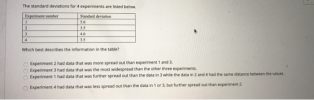 The standard deviations for 4 experiments are listed below. Experiment number Standard deviation 15 Which best describes the information in the table? Experiment 2 had data that was more spread out than experiment 1 and 3. Experiment 3 had data that was the most widespread than the other three experiments Experiment 1 had data that was further spread out than the data in 3 while the data in 2 and 4 had the same distance between the values Experiment 4...
1. In an experiment similar to Part 1, the temperature of 65.0 grams of solution went...
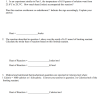 1. In an experiment similar to Part 1, the temperature of 65.0 grams of solution went from 23.8°C to 28.3°C. How much heat (Joules) accompanied this reaction? Was this reaction exothermic or endothermic? Indicate the sign accordingly. Explain your answer. Heat = Joules 2. The reaction described in question 1 above was the result of 6.35 mmol of limiting reactant. Calculate the molar heat of reaction based on this limited reactant. Heat of Reaction = Joules/mol Heat of Reaction =...
3) Look at the image below that represents Asch's conformity experiments 3 Asch's Conformity Experiments il...
 3) Look at the image below that represents Asch's conformity experiments 3 Asch's Conformity Experiments il The operate The confederate The parti Imagine YOU are the experimenter (instead of Asch). You conduct a conformity experiment. When you design your experiment, do NOT use LINES. a) Design YOUR experiment (Write the scenario) b) Write the purpose of YOUR study. c) Clarify the participant in YOUR study d) Clarify the confederates in YOUR study
Explain why it is normally important to randomize the order of conducting a set of experiments....
Explain why it is normally important to randomize the order of conducting a set of experiments. Create an example of such an experiment.
Consider the following experiments: a. Thompson's experiment on the electron charge to mass ration b. Rutherford's...
Consider the following experiments: a. Thompson's experiment on the electron charge to mass ration b. Rutherford's experiment proving the existence of the atomic nucleus c. Stern-Gerlach experiment demonstrating electron spin Draw a schematic diagram of the experiment labeling projectiles or beams, targets and or electromagnetic fields, detectors and other important experiment components. Explain quantitatively what was measured and what was concluded from the measurements.
1) Explain how eukaryotic gene expression is controlled from a distance 2) Describe the experiments that...
1) Explain how eukaryotic gene expression is controlled from a distance 2) Describe the experiments that showed all differentiated cells contain all the genetic instructions to direct the formation of a complete organism. 3) Explain the structure of tryphtophan operon and how this operon is regulated at the low and high concentration of tryphtophan.
Determine whether the series is convergent or divergent. 1 + 1/2 square root 2 + 1/3...
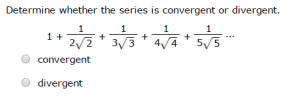 Determine whether the series is convergent or divergent. 1 + 1/2 square root 2 + 1/3 square root 3 + 1/4 square root 4 + 1/5 square root 5 ...
 5) You perform 4 DNAsel footprinting experiments. All the
experiments contain DNA 1. Epxeriments 2, 3, and 4 also contain
Protein A which binds DNA 1 in the indicated position. DNA 1 is
labeled by radio lables on the indicated ends. Arrows show
positions that DNAsel can cut. Draw the banding pattern you epect
to see in the 4 different experiments in the box on the right.
5.) DNAsel Footprinting You perform 4 DNAsel footprinting experiments. All the experiments contain...
5) You perform 4 DNAsel footprinting experiments. All the
experiments contain DNA 1. Epxeriments 2, 3, and 4 also contain
Protein A which binds DNA 1 in the indicated position. DNA 1 is
labeled by radio lables on the indicated ends. Arrows show
positions that DNAsel can cut. Draw the banding pattern you epect
to see in the 4 different experiments in the box on the right.
5.) DNAsel Footprinting You perform 4 DNAsel footprinting experiments. All the experiments contain...
 The standard deviations for 4 experiments are listed below. Experiment number Standard deviation 15 Which best describes the information in the table? Experiment 2 had data that was more spread out than experiment 1 and 3. Experiment 3 had data that was the most widespread than the other three experiments Experiment 1 had data that was further spread out than the data in 3 while the data in 2 and 4 had the same distance between the values Experiment 4...
 1. In an experiment similar to Part 1, the temperature of 65.0 grams of solution went from 23.8°C to 28.3°C. How much heat (Joules) accompanied this reaction? Was this reaction exothermic or endothermic? Indicate the sign accordingly. Explain your answer. Heat = Joules 2. The reaction described in question 1 above was the result of 6.35 mmol of limiting reactant. Calculate the molar heat of reaction based on this limited reactant. Heat of Reaction = Joules/mol Heat of Reaction =...
 3) Look at the image below that represents Asch's conformity experiments 3 Asch's Conformity Experiments il The operate The confederate The parti Imagine YOU are the experimenter (instead of Asch). You conduct a conformity experiment. When you design your experiment, do NOT use LINES. a) Design YOUR experiment (Write the scenario) b) Write the purpose of YOUR study. c) Clarify the participant in YOUR study d) Clarify the confederates in YOUR study
 Determine whether the series is convergent or divergent. 1 + 1/2 square root 2 + 1/3 square root 3 + 1/4 square root 4 + 1/5 square root 5 ...
Most questions answered within 3 hours.
-
Where is the error in this code sequence?
String s1 = "Hello";
String s2 = "ello";...
asked 10 months ago -
Financial data for Joel de Paris, Inc., for last year
follow:
Joel de Paris, Inc.
Balance...
asked 10 months ago -
Consider this reaction:
Al2(SO4)3 (aq)+ BaCl3
(aq) Al2Cl6 (aq)- +
3BaSO4(s) . What is the...
asked 10 months ago -
Suppose that Savneet is considering increasing her
recent random sample from 20 car rentals to 40...
asked 10 months ago -
Trucks arrive at an unloading terminal at an average rate of 120
per hour.
Trucks arrive...
asked 10 months ago -
Why are methanol and ethanol completely soluble in water while
octanol is not very little soluble....
asked 10 months ago -
A facilities manager at a university reads in a research report
that the mean amount of...
asked 10 months ago -
When the CuSO4 is rehydrated by adding water to the anhydrous
compound, is this an endothermic...
asked 10 months ago -
A ray of sunlight is passing from diamond into crown glass; the
angle of incidence is...
asked 10 months ago -
A block of mass 0.249 kg is placed on top of a light, vertical
spring of...
asked 10 months ago -
how do the kidneys compensate in the presences of acidosis
a) trigger hyperventilate
b) reserve acid...
asked 10 months ago -
Question 501 pts
The rental rate of capital to the firm increases. Which of the
following...
asked 10 months ago