The genetically engineered proteins that accumulate in bacterial inclusion bodies form amyloid structures. Such proteins are...
The genetically engineered proteins that accumulate in bacterial inclusion bodies form amyloid structures. Such proteins are often difficult to recover in functional form from the bacteria. Explain.
Homework Answers
The inclusion bodies are tiny particles found freely suspended
and floating within the cytoplasmic matrix.Formation of inclusion
bodies in bacterial hosts poses a major challenge for large scale
recovery of bioactive proteins. The process of obtaining bioactive
protein from inclusion bodies is labor intensive and the yields of
recombinant protein are often low.Formation of inclusion bodies
occurs as a result of intracellular accumulation of partially
folded expressed proteins which aggregate through non-covalent
hydrophobic or ionic interactions or a combination of
both.Aggregates of recombinant proteins occur as small
supramolec-
ular entities in the soluble cell fraction or as larger protein
clusters that precipitate as insoluble materials. Therefore,the
recombinant protein species range along a spectrum of
conformational versions that embrace soluble protein
species,soluble aggregates and insoluble aggregates .Soluble
aggregates or
proto-aggregates have been usually considered as precursors of
large protein deposits. Aggregates tend to eventually accumulate in
recombinant cells
as refractile (under optical microscope visualisation),
electro-dense (under transmission electron microscope
visualisation)submicron particles known as inclusion bodies .
Inclusion bodies are formed during high-level recombinant protein production, and formation of inclusion bodies is a major concern in biotechnology. Despite of the distinctive morphological difference, bacterial inclusion bodies have been found to have some amyloid-like properties, suggesting that they might contain structures similar to amyloid-like fibrils.
Bacterial inclusion bodies are submicron protein clusters usually found in recombinant bacteria that have been traditionally considered as undesirable products from protein production processes. However, being fully biocompatible, they have been recently characterized as nanoparticulate inert materials useful as scaffolds for tissue engineering, with potentially wider applicability in biomedicine and material sciences. Current protocols for inclusion body isolation from Escherichia coli usually offer between 95 to 99% of protein recovery, what in practical terms, might imply extensive bacterial cell contamination, not compatible with the use of inclusion bodies in biological interfaces.
Add Answer to:
The genetically engineered proteins that accumulate in bacterial
inclusion bodies form amyloid structures. Such proteins are...
Choose the true statements about amyloid fibrils. 1. Proteins that form amyloid fibrils are normally soluble....
Choose the true statements about amyloid fibrils. 1. Proteins that form amyloid fibrils are normally soluble. 2. Amyloid fibrils have a high amount of α-helical structure. 3. Because most newly synthesized proteins fold correctly, the accumulation of misfolded proteins (or fragments) tends to occur slowly, thus explaining the slow onset of disease. 4. Some amyloid fibrils are formed from proteolytic fragments that self-assemble into extended β-sheet structures. 5. Proteins that convert to an amyloid structure form soluble fibrils. Can someone...
you have developed a genetically engineered bacterial strain that can make extremely large amounts of human...
you have developed a genetically engineered bacterial strain that can make extremely large amounts of human catalase, but so much so that the catalase becomes an insoluble aggregate and has no enzymatic activity. which of the following procedures would NOT help you obtain soluble, enzymatically active catalase? A. Make the bacteria over produce the chaperone proteins in addition to the catalase. B. Try dissolving the catalase in urea, then slowly remove the urea until enzymatic activity returns. C. Use a...
E. coli makes curli fibers on its cell surface that are bacterial amyloid proteins. These curli...
E. coli makes curli fibers on its cell surface that are bacterial amyloid proteins. These curli are used as models to study eukaryotic amyloid proteins in human disease such as Alzheimer's. In E. coli the protein used to secrete curli fibers is CsgG. Using NCBI, search for this protein - "csgG E. coli. K12 W3110" in the protein database, and select the RefSeq protein entry. From the right-hand side of the protein page, select 'Run BLAST'. Select 'Escherichia coli (taxid:562)'...
This molecule appears in some bacterial proteins, and our bodies raise an immune response to it....
 This molecule appears in some bacterial proteins, and our bodies raise an immune response to it. Answer the three questions following the structure. HO OH NH2 11. Which one of the following structures is present in the molecule? a.) quinone b.) succinyl group c.) glutaryl group d.) catechol 12. Name the functional groups you see in the molecule. 13. The molecule shown above has one chirality center. After each priority listing below, draw the structure (first few atoms) of the...
Porin proteins-which form large, water-filled pores in mitochondrial and bacterial outer membranes-fold into B-barrel structures. The...
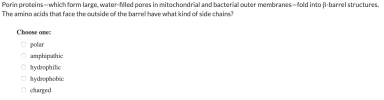 Porin proteins-which form large, water-filled pores in mitochondrial and bacterial outer membranes-fold into B-barrel structures. The amino acids that face the outside of the barrel have what kind of side chains? Choose one: O polar O amphipathic o hydrophilic o hydrophobic O charged
The exogenous DNA used in bacterial transformation can be, RONA mRNA molecule engineered plasmid red fluorescent...
 The exogenous DNA used in bacterial transformation can be, RONA mRNA molecule engineered plasmid red fluorescent protein Incorrect Question 4 0/0.5 pts Bacteria that did not receive a plasmid are put on an LB plate that DOES contain ampicillin. What do you expect to happen? the bacteria will create a lawn the bacteria will not grow a few colonies will be seen http:/misac.instructure.com couro/87588/quizzes/163615 7/29/2020 Review Que: BIOL-8-05-12561.202010 Transformation efficiency. Concentration of plasmid DNA. Question 8 0.5/0.5 pts Super coiled...
please answer all that you can 1. You have genetically engineered green fluorescent protein (GFP) containing...
please answer all that you can 1. You have genetically engineered green fluorescent protein (GFP) containing a KDEL sequence (GFP-KDEL). When GFP-KDEL is expressed in normal human fibroblasts and examined using fluorescence microscopy, the fluorescence appears diffuse across the cytoplasm. How would you explain this observations given that KDEL is supposed to be an ER-specific sorting sequence? A. This engineered GFP would not have a hydrophobic signal sequence to get it into the RER in the first place. B. The...
1. According to the paper, what does lactate dehydrogenase (LDH) do and what does it allow...
 1. According to the paper, what does lactate dehydrogenase
(LDH) do and what does it allow to happen within the myofiber? (5
points)
2. According to the paper, what is the major disadvantage of
relying on glycolysis during high-intensity exercise? (5
points)
3. Using Figure 1 in the paper, briefly describe the different
sources of ATP production at 50% versus 90% AND explain whether you
believe this depiction of ATP production applies to a Type IIX
myofiber in a human....
1. According to the paper, what does lactate dehydrogenase
(LDH) do and what does it allow to happen within the myofiber? (5
points)
2. According to the paper, what is the major disadvantage of
relying on glycolysis during high-intensity exercise? (5
points)
3. Using Figure 1 in the paper, briefly describe the different
sources of ATP production at 50% versus 90% AND explain whether you
believe this depiction of ATP production applies to a Type IIX
myofiber in a human....
 This molecule appears in some bacterial proteins, and our bodies raise an immune response to it. Answer the three questions following the structure. HO OH NH2 11. Which one of the following structures is present in the molecule? a.) quinone b.) succinyl group c.) glutaryl group d.) catechol 12. Name the functional groups you see in the molecule. 13. The molecule shown above has one chirality center. After each priority listing below, draw the structure (first few atoms) of the...
 Porin proteins-which form large, water-filled pores in mitochondrial and bacterial outer membranes-fold into B-barrel structures. The amino acids that face the outside of the barrel have what kind of side chains? Choose one: O polar O amphipathic o hydrophilic o hydrophobic O charged
 The exogenous DNA used in bacterial transformation can be, RONA mRNA molecule engineered plasmid red fluorescent protein Incorrect Question 4 0/0.5 pts Bacteria that did not receive a plasmid are put on an LB plate that DOES contain ampicillin. What do you expect to happen? the bacteria will create a lawn the bacteria will not grow a few colonies will be seen http:/misac.instructure.com couro/87588/quizzes/163615 7/29/2020 Review Que: BIOL-8-05-12561.202010 Transformation efficiency. Concentration of plasmid DNA. Question 8 0.5/0.5 pts Super coiled...
 1. According to the paper, what does lactate dehydrogenase
(LDH) do and what does it allow to happen within the myofiber? (5
points)
2. According to the paper, what is the major disadvantage of
relying on glycolysis during high-intensity exercise? (5
points)
3. Using Figure 1 in the paper, briefly describe the different
sources of ATP production at 50% versus 90% AND explain whether you
believe this depiction of ATP production applies to a Type IIX
myofiber in a human....
1. According to the paper, what does lactate dehydrogenase
(LDH) do and what does it allow to happen within the myofiber? (5
points)
2. According to the paper, what is the major disadvantage of
relying on glycolysis during high-intensity exercise? (5
points)
3. Using Figure 1 in the paper, briefly describe the different
sources of ATP production at 50% versus 90% AND explain whether you
believe this depiction of ATP production applies to a Type IIX
myofiber in a human....
Most questions answered within 3 hours.
-
Where is the error in this code sequence?
String s1 = "Hello";
String s2 = "ello";...
asked 10 months ago -
Financial data for Joel de Paris, Inc., for last year
follow:
Joel de Paris, Inc.
Balance...
asked 10 months ago -
Consider this reaction:
Al2(SO4)3 (aq)+ BaCl3
(aq) Al2Cl6 (aq)- +
3BaSO4(s) . What is the...
asked 10 months ago -
Suppose that Savneet is considering increasing her
recent random sample from 20 car rentals to 40...
asked 10 months ago -
Trucks arrive at an unloading terminal at an average rate of 120
per hour.
Trucks arrive...
asked 10 months ago -
Why are methanol and ethanol completely soluble in water while
octanol is not very little soluble....
asked 10 months ago -
A facilities manager at a university reads in a research report
that the mean amount of...
asked 10 months ago -
When the CuSO4 is rehydrated by adding water to the anhydrous
compound, is this an endothermic...
asked 10 months ago -
A ray of sunlight is passing from diamond into crown glass; the
angle of incidence is...
asked 10 months ago -
A block of mass 0.249 kg is placed on top of a light, vertical
spring of...
asked 10 months ago -
how do the kidneys compensate in the presences of acidosis
a) trigger hyperventilate
b) reserve acid...
asked 10 months ago -
Question 501 pts
The rental rate of capital to the firm increases. Which of the
following...
asked 10 months ago