Design a 4 bit up-down Binary counter counter Based on the value of the direction input...
Design a 4 bit up-down Binary counter counter
Based on the value of the direction input the counter shall
count up from 0000 to 1111 and repeat or it shall count down from
1111 to 0000 and repeat.
At any given time if reset input is asserted (reset = 1) the
counter has to reset to its initial state, 0000. Implement this
counter using JK flip-flops
Homework Answers
The circuit has a up/down input if it is 0 then it is up and if it is 0 it is down.
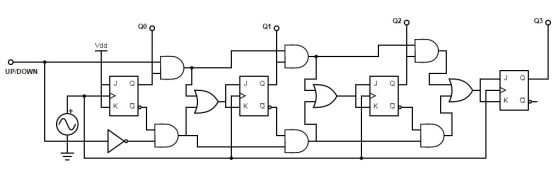
Add Answer to:
Design a 4 bit up-down Binary counter counter
Based on the value of the direction input...
Design a 4-bit binary up counter (like the following state diagram) using JK flip flops.
 Design a 4-bit binary up counter (like the following state diagram) using JK flip flops. State diagram. 0000 0001 11111 (a) Draw the state table with the input values for J K flip flops(b) Simplify the input equations by K map (c) Draw the logic diagram
Design a two-bit up/down binary counter using D flip-flops that can count in binary from 0 to 7.
Design a two-bit up/down binary counter using D flip-flops that can count in binary from 0 to 7. When the control input x is 0, the circuit counts down, and when it is 1, the circuit counts up. (a) Obtain the state table of the two-bit counter. (b) Obtain the state diagram (c) Draw the logic diagram of the circuit.
Up-Down counter with enable using JK flip-flops: Design, construct and test a 2-bit counter that counts up or down.
Up-Down counter with enable using JK flip-flops: Design, construct and test a 2-bit counter that counts up or down. An enable input E determines whether the counter is on or off. If E = 0, the counter is disabled and remains in the present count even though clock pulses are applied to the flip-flops. If E= 1, the counter in enabled and a second input, x, determines the count direction. If x= 1, the circuit counts up with the sequence...
(a) Design an asynchronous Binary Coded Decimal (BCD) count-up counter using JK flip-flops. Draw the counter circuit clearly showing the configuration of the JK flip-flops and the necessary logic gat...
 (a) Design an asynchronous Binary Coded Decimal (BCD) count-up counter using JK flip-flops. Draw the counter circuit clearly showing the configuration of the JK flip-flops and the necessary logic gate(s). Sketch the input and output waveforms of this counter (7 Marks) (b) The binary up/down counter for a cargo lift controller in a 7-storey building has an up-down (UID) control input and a buzzer output (B). The buzzer will sound B 1) when the lift is at level 1 or...
Using Proteus, design Synchronous 4 bit Up binary counter using JK flip flops (Use 74HC76 JK flipflop). The circuit count from 0000 to 1111, etc.
 Q2) 4-bit Synchronous Counter Using Proteus, design Synchronous 4 bit Up binary counter using JK flip flops (Use 74HC76 JK flipflop). The circuit count from 0000 to 1111, etc. Experiment procedure: طريقة اجراء التجربة a) Complete the circuit. You can use external gates based on the following conditions: o Flipflop A switches every clock. o Flipflop B switches when the output of flipflop A=1 o Flipflop C switches when the outputs of A-B=1 o Flipflop D switches when the outputs of A=B=C=1 b) What is the typical feature of...
1) Design a synchronous 3-bit binary UP/DOWN counter uses the following counting pattern 10.2.3.7.6.40.1.3...) the counter...
 1) Design a synchronous 3-bit binary UP/DOWN counter uses the following counting pattern 10.2.3.7.6.40.1.3...) the counter will count in this pattern indefinitely when the input X is equal to 1. When the input the counter will reverse direction and count in the opposite pattern 0. 4 7310) Complete the state diagram, transition table, New state s and solve for the recitation equations for flipflops that will perform this function. (You do not need to draw the flip-flops Use the state...
Please show process and I will rate faster!!! 2. Design a two-bit up/down binary counter using...
 Please show process and I will rate faster!!!
2. Design a two-bit up/down binary counter using T-fip-flops that can count in binary from 0 to 3. When the control input x is 0, the circuit counts up and when it is 1, the circuit counts down. (a) Obtain the state table of the two-bit counter (P. S., Input, N. S., Output). (b) Obtain the state diagram. (c) Draw the logic diagram of the circuit.
Please show process and I will rate faster!!!
2. Design a two-bit up/down binary counter using T-fip-flops that can count in binary from 0 to 3. When the control input x is 0, the circuit counts up and when it is 1, the circuit counts down. (a) Obtain the state table of the two-bit counter (P. S., Input, N. S., Output). (b) Obtain the state diagram. (c) Draw the logic diagram of the circuit.
a. Design a count up/count down counter that counts from 0 up to 4, then 4 down to 0 using D flip flop.
2. Synchronous Counters: a. Design a count up/count down counter that counts from 0 up to 4, then 4 down to 0 using D flip flop. b. Design a count up counter that counts from 0 up to 12 using JK flip flops.
3. Design a counter with the following repeated binary sequence: 0,1,2,4,6. Use D flip-flop.
3. Design a counter with the following repeated binary sequence: 0,1,2,4,6. Use D flip-flop. 4. Design a counter to count with T flip-flops that goes through the following binary repeated sequence: 0,1,3,7,6,4. Find out the counter response towards the unused state. Illustrate the response with a state diagram. 5. Design a mod-7 counter (repeat binary sequence: 0,1,2,3,4,5,6) use JK flip-flop.
Design a 3 bits binary counter that count up from 000 to 111 and recycles according to the following specification: E i...
 Design a 3 bits binary counter that count up from 000 to 111 and recycles according to the following specification: E is the enable input, if E-0 the counter is disabled and remains in its current state even though clock pulses are applied to the flip-flops. And if E-1 the counter is enabled and count upward with the sequence 000,001,010,011,100,101,110, 111 The second input S is the reset if s-1 the counter is reset to the 000 state, is S-o...
 (a) Design an asynchronous Binary Coded Decimal (BCD) count-up counter using JK flip-flops. Draw the counter circuit clearly showing the configuration of the JK flip-flops and the necessary logic gate(s). Sketch the input and output waveforms of this counter (7 Marks) (b) The binary up/down counter for a cargo lift controller in a 7-storey building has an up-down (UID) control input and a buzzer output (B). The buzzer will sound B 1) when the lift is at level 1 or...
 1) Design a synchronous 3-bit binary UP/DOWN counter uses the following counting pattern 10.2.3.7.6.40.1.3...) the counter will count in this pattern indefinitely when the input X is equal to 1. When the input the counter will reverse direction and count in the opposite pattern 0. 4 7310) Complete the state diagram, transition table, New state s and solve for the recitation equations for flipflops that will perform this function. (You do not need to draw the flip-flops Use the state...
 Please show process and I will rate faster!!!
2. Design a two-bit up/down binary counter using T-fip-flops that can count in binary from 0 to 3. When the control input x is 0, the circuit counts up and when it is 1, the circuit counts down. (a) Obtain the state table of the two-bit counter (P. S., Input, N. S., Output). (b) Obtain the state diagram. (c) Draw the logic diagram of the circuit.
Please show process and I will rate faster!!!
2. Design a two-bit up/down binary counter using T-fip-flops that can count in binary from 0 to 3. When the control input x is 0, the circuit counts up and when it is 1, the circuit counts down. (a) Obtain the state table of the two-bit counter (P. S., Input, N. S., Output). (b) Obtain the state diagram. (c) Draw the logic diagram of the circuit.
 Design a 3 bits binary counter that count up from 000 to 111 and recycles according to the following specification: E is the enable input, if E-0 the counter is disabled and remains in its current state even though clock pulses are applied to the flip-flops. And if E-1 the counter is enabled and count upward with the sequence 000,001,010,011,100,101,110, 111 The second input S is the reset if s-1 the counter is reset to the 000 state, is S-o...
Most questions answered within 3 hours.
-
Where is the error in this code sequence?
String s1 = "Hello";
String s2 = "ello";...
asked 11 months ago -
Financial data for Joel de Paris, Inc., for last year
follow:
Joel de Paris, Inc.
Balance...
asked 11 months ago -
Consider this reaction:
Al2(SO4)3 (aq)+ BaCl3
(aq) Al2Cl6 (aq)- +
3BaSO4(s) . What is the...
asked 11 months ago -
Suppose that Savneet is considering increasing her
recent random sample from 20 car rentals to 40...
asked 11 months ago -
Trucks arrive at an unloading terminal at an average rate of 120
per hour.
Trucks arrive...
asked 11 months ago -
Why are methanol and ethanol completely soluble in water while
octanol is not very little soluble....
asked 11 months ago -
A facilities manager at a university reads in a research report
that the mean amount of...
asked 11 months ago -
When the CuSO4 is rehydrated by adding water to the anhydrous
compound, is this an endothermic...
asked 11 months ago -
A ray of sunlight is passing from diamond into crown glass; the
angle of incidence is...
asked 11 months ago -
A block of mass 0.249 kg is placed on top of a light, vertical
spring of...
asked 11 months ago -
how do the kidneys compensate in the presences of acidosis
a) trigger hyperventilate
b) reserve acid...
asked 11 months ago -
Question 501 pts
The rental rate of capital to the firm increases. Which of the
following...
asked 11 months ago