![7. Bonus [3+3+4pts] Before answering this question, read the Google page rank article on Pi- azza in the General Resources](http://img.homeworklib.com/images/ded8aa2f-4c5b-4133-b808-35f9b879a920.png?x-oss-process=image/resize,w_560)
Can you help me with this question please? For the code, please do it on MATLAB. Thanks
Homework Answers
clc
clear
close all
n = 100; % any integer >=100
I = eye(n);
A = 0.5*I(randperm(n),:)+(max(2,randn(n,n))-2);
A = A - diag(diag(A));
L = A*diag(1./(max(1e-10,sum(A,1))));
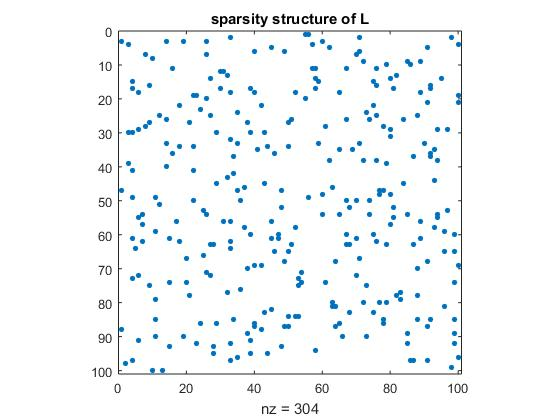
spy(L)
title('sparsity structure of L')
% computing eigen values of L
eigValuesOfL = eig(L)
realPartEigValuesOfL = real(eigValuesOfL);
imagPartEigValuesOfL = imag(eigValuesOfL);
%plotting imag vs real
figure
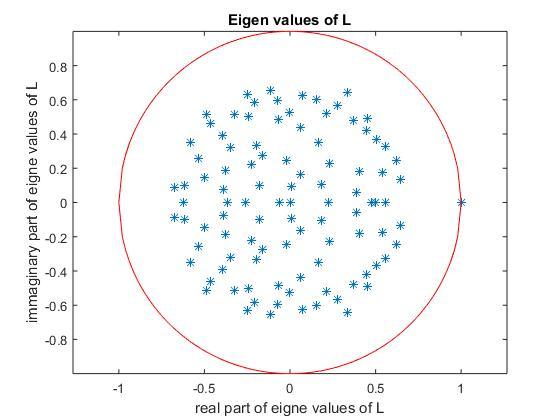
plot(realPartEigValuesOfL,imagPartEigValuesOfL,'*')
%computing and plotting the unit circle centered at (0,0)
x = linspace(-1,1,100);
yUpper = sqrt(1-x.^2); % x^2+y^2=1
yLower = -yUpper;
hold on
plot(x,yUpper,'-r')
hold on
plot(x,yLower,'-r')
axis equal
xlabel('real part of eigne values of L')
ylabel('immaginary part of eigne values of L')
title('Eigen values of L')
% matrix E of all values = 1/n
E = ones(n,n).*1/n;
% let k start at 0.1 increase by 0.1 upto 3
K = 0.1:0.1:3;
for i=1:numel(K)
k = K(i);
S = k*L + (1-k)*E;
eigValuesOfS = eig(S);
% we can determine the rate of convergence by comparing the
ratio of the
% first to second largest eigen value for each value k
% for purposes of computing the cpnvergence rate
sizeOfEachEignValue = abs(eigValuesOfS);
sortedEig = sort(sizeOfEachEignValue);
% ratio of largest to second largest eignen value
ratio(i) = sortedEig(end)/sortedEig(end-1);
end
figure
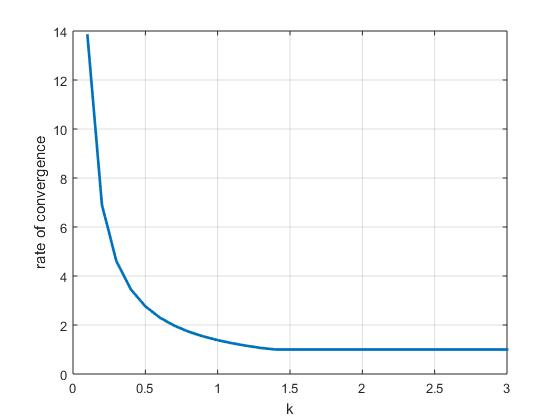
plot(K,ratio,'linewidth',2)
xlabel('k')
ylabel('rate of convergence')
grid on
% the rate of convergence is seen to exponentially decrease as k
tends to 1
% and remains almost constant and low after k=1 so values of k<1
will increase the
% speed of convergence of the power method
COMMENT DOWN FOR ANY QUERY RELATED TO THIS ANSWER,
IF YOU'RE SATISFIED, GIVE A THUMBS UP
Add Answer to:
Can you help me with this question please? For the code, please do it on MATLAB. Thanks
Can you please help me with this question. Much appreciated. So I have a sample code,...
 Can you please help me with this question. Much appreciated. So
I have a sample code, but we need to change the code in a way that
fits the problem.
A planar slab of material is initially at a temperature of 300 K. At the time t=0, microwave radiation is directed at the material, leading to internal heat generation that is uniform within the material. The sides of the slab experience negligible heat losses and a water bath maintains the...
Can you please help me with this question. Much appreciated. So
I have a sample code, but we need to change the code in a way that
fits the problem.
A planar slab of material is initially at a temperature of 300 K. At the time t=0, microwave radiation is directed at the material, leading to internal heat generation that is uniform within the material. The sides of the slab experience negligible heat losses and a water bath maintains the...
on matlab (1) Matrices are entered row-wise. Row commas. Enter 1 2 3 (2) Element A,...
 on matlab
(1) Matrices are entered row-wise. Row commas. Enter 1 2 3 (2) Element A, of matrix A is accesser (3) Correcting an entry is easy to (4) Any submatrix of Ais obtained by d row wise. Rows are separated by semicolons and columns are separated by spaces ner A l 23:45 6. B and hit the return/enter kry matrix A is accessed as A Enter and hit the returnerter key an entry is easy through indesine Enter 19...
on matlab
(1) Matrices are entered row-wise. Row commas. Enter 1 2 3 (2) Element A, of matrix A is accesser (3) Correcting an entry is easy to (4) Any submatrix of Ais obtained by d row wise. Rows are separated by semicolons and columns are separated by spaces ner A l 23:45 6. B and hit the return/enter kry matrix A is accessed as A Enter and hit the returnerter key an entry is easy through indesine Enter 19...
In this exercise, you will work with a QR factorization of an mxn matrix. We will proceed in the ...
 In this exercise, you will work with a QR factorization of an mxn matrix. We will proceed in the way that is chosen by MATLAB, which is different from the textbook presentation. An mxn matrix A can be presented as a product of a unitary (or orthogonal) mxm matrix Q and an upper-triangular m × n matrix R, that is, A = Q * R . Theory: a square mxm matrix Q is called unitary (or orthogona) if -,or equivalently,...
Can somebody help me with my matlab code? I am plotting the POWER SPECTRAL DENSITY OF...
Can somebody help me with my matlab code? I am plotting the POWER SPECTRAL DENSITY OF Manchester, Polar, UNIPOLAR, and BIPOLAR. It wont run. The error I am getting is "incorrect dimensions for matrix multiplication. Check that the number of columns in the first matrix matches the number of rows in the second matrix. To perform element wise multiplication, use '.*'. " clc; clear all; %Declaration of variables bandwidth = 1; total_bandwidth = 1/bandwidth; f = 0:.05*bandwidth:2*total_bandwidth; x=f*total_bandwidth; %Manchester Power...
PLEASE USE MATLAB. The code is basically given to you with the algorithm above. Write a...
 PLEASE USE MATLAB. The code is basically given to you with the
algorithm above.
Write a program for solving the system Ar-b by using Gauss-Seidel iterative method discussed in class that uses a computer memory for one iterate only. This could be summarized as follows: Input n -- the size of the system, matrix A-(a(i,j), the vectoir b (b (1), . . . , b(n)), the intitial guess x (x(1), ..., x(n)) (you can use x=b) maximum number of iterations...
PLEASE USE MATLAB. The code is basically given to you with the
algorithm above.
Write a program for solving the system Ar-b by using Gauss-Seidel iterative method discussed in class that uses a computer memory for one iterate only. This could be summarized as follows: Input n -- the size of the system, matrix A-(a(i,j), the vectoir b (b (1), . . . , b(n)), the intitial guess x (x(1), ..., x(n)) (you can use x=b) maximum number of iterations...
For MATLAB users. Can you please type the answers for the MATLAB sections. Consider the RLC circuit where R - 5, C- 1, L- 4 and Vs - 8 1. Use circuit analysis laws to show that the resistor's vol...
 For MATLAB users. Can you please type the answers for the MATLAB
sections.
Consider the RLC circuit where R - 5, C- 1, L- 4 and Vs - 8 1. Use circuit analysis laws to show that the resistor's voltage and induc- tor's voltage can be modelled as the system of ODEs Vi VL RC 2. Solve the eigenvalues and eigenvectors of the coefficient matrix in the system of ODEs. 3. Verify your answer for question (2) by using the...
For MATLAB users. Can you please type the answers for the MATLAB
sections.
Consider the RLC circuit where R - 5, C- 1, L- 4 and Vs - 8 1. Use circuit analysis laws to show that the resistor's voltage and induc- tor's voltage can be modelled as the system of ODEs Vi VL RC 2. Solve the eigenvalues and eigenvectors of the coefficient matrix in the system of ODEs. 3. Verify your answer for question (2) by using the...
Please help to solve that question very appreciate if you can help me to solve all the part...
 please help to solve that question
very appreciate if you can help me to solve all the part as my due
date coming soon but got stuck in this question.
Consider two separate linear regression models and For concreteness, assume that the vector yi contains observations on the wealth ofn randomly selected individuals in Australia and y2 contains observations on the wealth of n randomly selected individuals in New Zealand. The matrix Xi contains n observations on ki explanatory variables...
please help to solve that question
very appreciate if you can help me to solve all the part as my due
date coming soon but got stuck in this question.
Consider two separate linear regression models and For concreteness, assume that the vector yi contains observations on the wealth ofn randomly selected individuals in Australia and y2 contains observations on the wealth of n randomly selected individuals in New Zealand. The matrix Xi contains n observations on ki explanatory variables...
the last pic is number 14 please answer it as a,b,c,d as well. thanks 1. If...
 the last pic is number 14 please answer it as a,b,c,d as
well.
thanks
1. If A is diagonalizable then A is diagonalizable. a) True b) The statement is incomplete c) False d) None of the above 2. In every vector space the vector (-1)u is equal to? a) -U b) All of the above c) None of the above d) u 3. The set of vectors {} is linearly dependent for a) k = 3 b) k = 1...
the last pic is number 14 please answer it as a,b,c,d as
well.
thanks
1. If A is diagonalizable then A is diagonalizable. a) True b) The statement is incomplete c) False d) None of the above 2. In every vector space the vector (-1)u is equal to? a) -U b) All of the above c) None of the above d) u 3. The set of vectors {} is linearly dependent for a) k = 3 b) k = 1...
Can someone please help me with this, I'm really stuck. here a sample code provide for the matlab...
 can someone please help me with this, I'm really stuck.
here a sample code provide for the matlab:
clear all; close all;
% ---------- (a) ----------
a = 0.7; % attenuation coef.
D = 5; % digital time delay
UnitImpulse = [1 zeros(1,???)]; % creat unit impulse, starting from
n=0;
x = UnitImpulse;
y = filter(1, [1 zeros(1, D-1) -a], x); % help filter, do you know
the usage of filter() now?
n = 0:(length(y)-1); % check length of y[n]...
can someone please help me with this, I'm really stuck.
here a sample code provide for the matlab:
clear all; close all;
% ---------- (a) ----------
a = 0.7; % attenuation coef.
D = 5; % digital time delay
UnitImpulse = [1 zeros(1,???)]; % creat unit impulse, starting from
n=0;
x = UnitImpulse;
y = filter(1, [1 zeros(1, D-1) -a], x); % help filter, do you know
the usage of filter() now?
n = 0:(length(y)-1); % check length of y[n]...
I have all of the answers to this can someone just actually explain this matlab code and the results to me so i can get a better understanding? b) (c) and (d) %% Matlab code %% clc; close all; clear...
 I have all of the answers to this can someone just actually
explain this matlab code and the results to me so i can get a
better understanding?
b)
(c) and (d)
%% Matlab code %%
clc;
close all;
clear all;
format long;
f=@(t,y)y*(1-y);
y(1)=0.01;
%%%% Exact solution
[t1 y1]=ode45(f,[0 9],y(1));
figure;
plot(t1,y1,'*');
hold on
% Eular therom
M=[32 64 128];
T=9;
fprintf(' M Max error \n' );
for n=1:length(M)
k=T/M(n);
t=0:k:T;
for h=1:length(t)-1
y(h+1)=y(h)+k*f(t(h),y(h));
end
plot(t,y);
hold on
%%%...
I have all of the answers to this can someone just actually
explain this matlab code and the results to me so i can get a
better understanding?
b)
(c) and (d)
%% Matlab code %%
clc;
close all;
clear all;
format long;
f=@(t,y)y*(1-y);
y(1)=0.01;
%%%% Exact solution
[t1 y1]=ode45(f,[0 9],y(1));
figure;
plot(t1,y1,'*');
hold on
% Eular therom
M=[32 64 128];
T=9;
fprintf(' M Max error \n' );
for n=1:length(M)
k=T/M(n);
t=0:k:T;
for h=1:length(t)-1
y(h+1)=y(h)+k*f(t(h),y(h));
end
plot(t,y);
hold on
%%%...
 Can you please help me with this question. Much appreciated. So
I have a sample code, but we need to change the code in a way that
fits the problem.
A planar slab of material is initially at a temperature of 300 K. At the time t=0, microwave radiation is directed at the material, leading to internal heat generation that is uniform within the material. The sides of the slab experience negligible heat losses and a water bath maintains the...
Can you please help me with this question. Much appreciated. So
I have a sample code, but we need to change the code in a way that
fits the problem.
A planar slab of material is initially at a temperature of 300 K. At the time t=0, microwave radiation is directed at the material, leading to internal heat generation that is uniform within the material. The sides of the slab experience negligible heat losses and a water bath maintains the...
 on matlab
(1) Matrices are entered row-wise. Row commas. Enter 1 2 3 (2) Element A, of matrix A is accesser (3) Correcting an entry is easy to (4) Any submatrix of Ais obtained by d row wise. Rows are separated by semicolons and columns are separated by spaces ner A l 23:45 6. B and hit the return/enter kry matrix A is accessed as A Enter and hit the returnerter key an entry is easy through indesine Enter 19...
on matlab
(1) Matrices are entered row-wise. Row commas. Enter 1 2 3 (2) Element A, of matrix A is accesser (3) Correcting an entry is easy to (4) Any submatrix of Ais obtained by d row wise. Rows are separated by semicolons and columns are separated by spaces ner A l 23:45 6. B and hit the return/enter kry matrix A is accessed as A Enter and hit the returnerter key an entry is easy through indesine Enter 19...
 In this exercise, you will work with a QR factorization of an mxn matrix. We will proceed in the way that is chosen by MATLAB, which is different from the textbook presentation. An mxn matrix A can be presented as a product of a unitary (or orthogonal) mxm matrix Q and an upper-triangular m × n matrix R, that is, A = Q * R . Theory: a square mxm matrix Q is called unitary (or orthogona) if -,or equivalently,...
 PLEASE USE MATLAB. The code is basically given to you with the
algorithm above.
Write a program for solving the system Ar-b by using Gauss-Seidel iterative method discussed in class that uses a computer memory for one iterate only. This could be summarized as follows: Input n -- the size of the system, matrix A-(a(i,j), the vectoir b (b (1), . . . , b(n)), the intitial guess x (x(1), ..., x(n)) (you can use x=b) maximum number of iterations...
PLEASE USE MATLAB. The code is basically given to you with the
algorithm above.
Write a program for solving the system Ar-b by using Gauss-Seidel iterative method discussed in class that uses a computer memory for one iterate only. This could be summarized as follows: Input n -- the size of the system, matrix A-(a(i,j), the vectoir b (b (1), . . . , b(n)), the intitial guess x (x(1), ..., x(n)) (you can use x=b) maximum number of iterations...
 For MATLAB users. Can you please type the answers for the MATLAB
sections.
Consider the RLC circuit where R - 5, C- 1, L- 4 and Vs - 8 1. Use circuit analysis laws to show that the resistor's voltage and induc- tor's voltage can be modelled as the system of ODEs Vi VL RC 2. Solve the eigenvalues and eigenvectors of the coefficient matrix in the system of ODEs. 3. Verify your answer for question (2) by using the...
For MATLAB users. Can you please type the answers for the MATLAB
sections.
Consider the RLC circuit where R - 5, C- 1, L- 4 and Vs - 8 1. Use circuit analysis laws to show that the resistor's voltage and induc- tor's voltage can be modelled as the system of ODEs Vi VL RC 2. Solve the eigenvalues and eigenvectors of the coefficient matrix in the system of ODEs. 3. Verify your answer for question (2) by using the...
 please help to solve that question
very appreciate if you can help me to solve all the part as my due
date coming soon but got stuck in this question.
Consider two separate linear regression models and For concreteness, assume that the vector yi contains observations on the wealth ofn randomly selected individuals in Australia and y2 contains observations on the wealth of n randomly selected individuals in New Zealand. The matrix Xi contains n observations on ki explanatory variables...
please help to solve that question
very appreciate if you can help me to solve all the part as my due
date coming soon but got stuck in this question.
Consider two separate linear regression models and For concreteness, assume that the vector yi contains observations on the wealth ofn randomly selected individuals in Australia and y2 contains observations on the wealth of n randomly selected individuals in New Zealand. The matrix Xi contains n observations on ki explanatory variables...
 the last pic is number 14 please answer it as a,b,c,d as
well.
thanks
1. If A is diagonalizable then A is diagonalizable. a) True b) The statement is incomplete c) False d) None of the above 2. In every vector space the vector (-1)u is equal to? a) -U b) All of the above c) None of the above d) u 3. The set of vectors {} is linearly dependent for a) k = 3 b) k = 1...
the last pic is number 14 please answer it as a,b,c,d as
well.
thanks
1. If A is diagonalizable then A is diagonalizable. a) True b) The statement is incomplete c) False d) None of the above 2. In every vector space the vector (-1)u is equal to? a) -U b) All of the above c) None of the above d) u 3. The set of vectors {} is linearly dependent for a) k = 3 b) k = 1...
 can someone please help me with this, I'm really stuck.
here a sample code provide for the matlab:
clear all; close all;
% ---------- (a) ----------
a = 0.7; % attenuation coef.
D = 5; % digital time delay
UnitImpulse = [1 zeros(1,???)]; % creat unit impulse, starting from
n=0;
x = UnitImpulse;
y = filter(1, [1 zeros(1, D-1) -a], x); % help filter, do you know
the usage of filter() now?
n = 0:(length(y)-1); % check length of y[n]...
can someone please help me with this, I'm really stuck.
here a sample code provide for the matlab:
clear all; close all;
% ---------- (a) ----------
a = 0.7; % attenuation coef.
D = 5; % digital time delay
UnitImpulse = [1 zeros(1,???)]; % creat unit impulse, starting from
n=0;
x = UnitImpulse;
y = filter(1, [1 zeros(1, D-1) -a], x); % help filter, do you know
the usage of filter() now?
n = 0:(length(y)-1); % check length of y[n]...
 I have all of the answers to this can someone just actually
explain this matlab code and the results to me so i can get a
better understanding?
b)
(c) and (d)
%% Matlab code %%
clc;
close all;
clear all;
format long;
f=@(t,y)y*(1-y);
y(1)=0.01;
%%%% Exact solution
[t1 y1]=ode45(f,[0 9],y(1));
figure;
plot(t1,y1,'*');
hold on
% Eular therom
M=[32 64 128];
T=9;
fprintf(' M Max error \n' );
for n=1:length(M)
k=T/M(n);
t=0:k:T;
for h=1:length(t)-1
y(h+1)=y(h)+k*f(t(h),y(h));
end
plot(t,y);
hold on
%%%...
I have all of the answers to this can someone just actually
explain this matlab code and the results to me so i can get a
better understanding?
b)
(c) and (d)
%% Matlab code %%
clc;
close all;
clear all;
format long;
f=@(t,y)y*(1-y);
y(1)=0.01;
%%%% Exact solution
[t1 y1]=ode45(f,[0 9],y(1));
figure;
plot(t1,y1,'*');
hold on
% Eular therom
M=[32 64 128];
T=9;
fprintf(' M Max error \n' );
for n=1:length(M)
k=T/M(n);
t=0:k:T;
for h=1:length(t)-1
y(h+1)=y(h)+k*f(t(h),y(h));
end
plot(t,y);
hold on
%%%...
Most questions answered within 3 hours.
-
Where is the error in this code sequence?
String s1 = "Hello";
String s2 = "ello";...
asked 10 months ago -
Financial data for Joel de Paris, Inc., for last year
follow:
Joel de Paris, Inc.
Balance...
asked 10 months ago -
Consider this reaction:
Al2(SO4)3 (aq)+ BaCl3
(aq) Al2Cl6 (aq)- +
3BaSO4(s) . What is the...
asked 10 months ago -
Suppose that Savneet is considering increasing her
recent random sample from 20 car rentals to 40...
asked 10 months ago -
Trucks arrive at an unloading terminal at an average rate of 120
per hour.
Trucks arrive...
asked 10 months ago -
Why are methanol and ethanol completely soluble in water while
octanol is not very little soluble....
asked 10 months ago -
A facilities manager at a university reads in a research report
that the mean amount of...
asked 10 months ago -
When the CuSO4 is rehydrated by adding water to the anhydrous
compound, is this an endothermic...
asked 10 months ago -
A ray of sunlight is passing from diamond into crown glass; the
angle of incidence is...
asked 10 months ago -
A block of mass 0.249 kg is placed on top of a light, vertical
spring of...
asked 10 months ago -
how do the kidneys compensate in the presences of acidosis
a) trigger hyperventilate
b) reserve acid...
asked 10 months ago -
Question 501 pts
The rental rate of capital to the firm increases. Which of the
following...
asked 10 months ago