

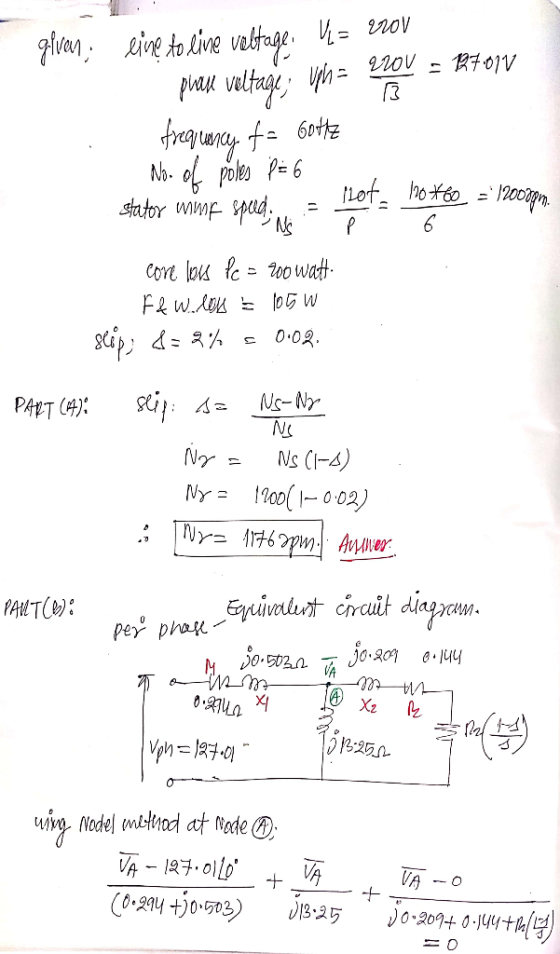
(40 points) Induction Motor Equivalent Circuit Analysis. A three-phase, 220V AC (line to line), 60 Hertz, six pole induction motor has the following line-to-neutral equivalent circuit. 1. 1 2 0.294 Ohms 0.50 Ohms- 0.209 Ohms 0.144 Ohms VAG V 1 R2 (1-s)/s j 13.25 Ohms All circuit elements are given in Ohms. Core losses are 200 Watts. Friction and windage losses are 105 Watts. The motor operates at a slip of 2%. (15 points) Find the rotor speed. a. b. (25 points) Find the motor's output torque. Include the effect of core losses and friction and windage losses in decreasing the output torque.
Homework Answers

Add Answer to:
I want to solve this problem step by step. Thanks (35 points) Induction Generator Real Power Generation. A three phase, 220V line to line, six pole, 60Hz, wye connected induction machine op...
A 3 phase, 460V, 60Hz, 6-pole induction motor has the following equivalent circuit parameters per phase:...
A 3 phase, 460V, 60Hz, 6-pole induction motor has the following equivalent circuit parameters per phase: R1 = 0.2 ohms R2 = 0.28 ohms X1 = X2 = 1.055 ohms Xm = 33.9 ohms The no load losses, comprising friction, windage, and iron losses equal 26W. The motor is coupled to a load and connected to a 460V supply, and the rotor speed is found to be 1156 RPM. For this motor connected to a 460V supply calculate the following:...
Problem Solving: 1. A 220V, 4-pole, 60Hz, 1-phase induction motor has an effective rotor resistance and...
 Problem Solving: 1. A 220V, 4-pole, 60Hz, 1-phase induction motor has an effective rotor resistance and leakage reactance of 0.5 Ohms and 5 ohms respectively. It is running at a speed of 1,800 rpm. Determine: a. Frequencies of forward and backward rotor current components b. Relative magnitudes of forward and backward fluxes. Neglect magnetizing current and stator impedance. A 220-W, 2-pole, 115-V, 60-Hz single-phase induction motor delivers rated output at a slip 10%. The total copper loss at full load...
Problem # 3: Induction Motor Analysis [30 points] The parameters of the per phase equivalent circuit...
 Problem # 3: Induction Motor Analysis [30 points] The parameters of the per phase equivalent circuit of a three phase wye-connected, 220 V (line- line, rms) 10 hp, 60 Hz, six-pole induction motor are given as: Ri = 0.3 Ohm, R2-0.15 Ohm, Xi-0.5 Ohms, X2= 0.2 Ohm, Xm-15.0 The total friction, windage and core losses add up to be a constant of 400 W. For a slip of 0.025 with motor operating at rated frequency and stator voltage, calculate the...
The input power to a 480V, 3 phase, 6 pole, 50 Hz induction motor is 75kW...
The input power to a 480V, 3 phase, 6 pole, 50 Hz induction motor is 75kW with a line current of 75A and runs at a slip of 2.5%. If the stator core loss is 2 kW, windage and friction loss is 1.2 kW, and the stator resistance per phase is 0.16 ohm. Calculate: a. Power supplied to the rotor (Air gap power) b. Rotor copper loss c. Shaft power d. Efficiency of the motor e. Shaft torque f What...
4. A certain four-pole 240-V-rms 50-Hz delta-connected three-phase induction motor operates at slip 5% at full...
4. A certain four-pole 240-V-rms 50-Hz delta-connected three-phase induction motor operates at slip 5% at full load and has rotational losses (windage + friction) of 100 W. The stator resistance per phase is 0.2 Ohm. The results of no-load and locked-rotor tests on this motor are as follows: No-load test Locked-rotor test Line-to-line input voltage: 240 V 45 V Input active power: 1100 W 1300 W Input line current: 10 A 30 A Using the tests data, determine parameters of...
6.12 A three-phase, Y-connected, 460-V (line-line), 37-kW, 60-Hz, four-pole induction motor has the following equivalent-circuit parameters...
 6.12 A three-phase, Y-connected, 460-V (line-line), 37-kW, 60-Hz, four-pole induction motor has the following equivalent-circuit parameters in ohms-per-phase referred to the statr: R10.070 R2 0.152 X 0.743 X2 0.764 Xm 40.1 The total friction and windage losses may be assumed constant at 390 W, and the core loss may be assumed to be equal to 325 W. With the motor connected directly to a 460-V source, compute the speed, output shaft torque and power, input power, and power factor and...
A 460-V, three-phase, 4-pole induction motor is known to have the following single-phase equivalent-circuit parameters in ohms-per-phase Y R 19.7 x 10⁻³ Xi=0.129 X2 0.187 Xm 13.9 The motor is observe...
 A 460-V, three-phase, 4-pole induction motor is known to have the following single-phase equivalent-circuit parameters in ohms-per-phase Y R 19.7 x 10⁻³ Xi=0.129 X2 0.187 Xm 13.9 The motor is observed to be operating at a terminal voltage of 450 V, line-line with an output power of 95 kW at a speed of 1780.7 r/min. Calculate the single-phase equivalent-circuit rotor resistance R2 assuming that the motor core loss is 1200 W and the friction and windage loss is 700 W....
Problem # 2: Induction Motor Analysis Using The Thevenin Theorem [37 points] A three-phase, two p...
 Problem # 2: Induction Motor Analysis Using The Thevenin Theorem [37 points] A three-phase, two pole, 25hp, 460V (line-line), 60Hz, wye-connected, squirrel-cage induction motor has the following per-phase parameters: Ri 0.53 Ohm X2 0.80 Ohm Xi 1.80 Ohms R2 0.30 Ohm Re- 400 Ohms Xm 25.0 Ohms You cannot use any approximate circ uit or any approximation in the calculations. (1) Determine the parameters of the Thevenin equivalent circuit. Draw the equivalent circuit with the appropriate parameter values indicated on...
Problem 2 (10 points): A 3-phase, 208-V (H), six-pole Y-connected, 25-hp, design class B (X,-15%)...
 Problem 2 (10 points): A 3-phase, 208-V (H), six-pole Y-connected, 25-hp, design class B (X,-15%) induction motor is tested in the laboratory, with the following results: DC test: 13.5 V, 64 A No load: 208 V, 24.0 A, 1400 W, 60 Hz Locked rotor: 24.6 V, 64.5 A, 2200 W, 15 Hz Neglecting the core losses (a) Find the equivalent circuit parameters of this motor and show them on the equivalent circuit. (b) What is the rotational losses of this...
Two tests were performed on a 230-V, 60-Hz, 4-pole, Y-connected, three-phase induction motor and the obtained...
 Two tests were performed on a 230-V, 60-Hz, 4-pole, Y-connected, three-phase induction motor and the obtained data are given in the table below. The friction and windage loss is 15 W, and the stator winding resistance between any two lines is 3.96ohm Determine: 1) The equivalent circuit parameters of the motor 3) The motor efficiency at a slip of 8%. No-load test 137 0.43 230 Blocked-rotor test 70 1.18 47 3-phase power input, W Line-line voltage, V
 Problem Solving: 1. A 220V, 4-pole, 60Hz, 1-phase induction motor has an effective rotor resistance and leakage reactance of 0.5 Ohms and 5 ohms respectively. It is running at a speed of 1,800 rpm. Determine: a. Frequencies of forward and backward rotor current components b. Relative magnitudes of forward and backward fluxes. Neglect magnetizing current and stator impedance. A 220-W, 2-pole, 115-V, 60-Hz single-phase induction motor delivers rated output at a slip 10%. The total copper loss at full load...
 Problem # 3: Induction Motor Analysis [30 points] The parameters of the per phase equivalent circuit of a three phase wye-connected, 220 V (line- line, rms) 10 hp, 60 Hz, six-pole induction motor are given as: Ri = 0.3 Ohm, R2-0.15 Ohm, Xi-0.5 Ohms, X2= 0.2 Ohm, Xm-15.0 The total friction, windage and core losses add up to be a constant of 400 W. For a slip of 0.025 with motor operating at rated frequency and stator voltage, calculate the...
 6.12 A three-phase, Y-connected, 460-V (line-line), 37-kW, 60-Hz, four-pole induction motor has the following equivalent-circuit parameters in ohms-per-phase referred to the statr: R10.070 R2 0.152 X 0.743 X2 0.764 Xm 40.1 The total friction and windage losses may be assumed constant at 390 W, and the core loss may be assumed to be equal to 325 W. With the motor connected directly to a 460-V source, compute the speed, output shaft torque and power, input power, and power factor and...
 A 460-V, three-phase, 4-pole induction motor is known to have the following single-phase equivalent-circuit parameters in ohms-per-phase Y R 19.7 x 10⁻³ Xi=0.129 X2 0.187 Xm 13.9 The motor is observed to be operating at a terminal voltage of 450 V, line-line with an output power of 95 kW at a speed of 1780.7 r/min. Calculate the single-phase equivalent-circuit rotor resistance R2 assuming that the motor core loss is 1200 W and the friction and windage loss is 700 W....
 Problem # 2: Induction Motor Analysis Using The Thevenin Theorem [37 points] A three-phase, two pole, 25hp, 460V (line-line), 60Hz, wye-connected, squirrel-cage induction motor has the following per-phase parameters: Ri 0.53 Ohm X2 0.80 Ohm Xi 1.80 Ohms R2 0.30 Ohm Re- 400 Ohms Xm 25.0 Ohms You cannot use any approximate circ uit or any approximation in the calculations. (1) Determine the parameters of the Thevenin equivalent circuit. Draw the equivalent circuit with the appropriate parameter values indicated on...
 Problem 2 (10 points): A 3-phase, 208-V (H), six-pole Y-connected, 25-hp, design class B (X,-15%) induction motor is tested in the laboratory, with the following results: DC test: 13.5 V, 64 A No load: 208 V, 24.0 A, 1400 W, 60 Hz Locked rotor: 24.6 V, 64.5 A, 2200 W, 15 Hz Neglecting the core losses (a) Find the equivalent circuit parameters of this motor and show them on the equivalent circuit. (b) What is the rotational losses of this...
 Two tests were performed on a 230-V, 60-Hz, 4-pole, Y-connected, three-phase induction motor and the obtained data are given in the table below. The friction and windage loss is 15 W, and the stator winding resistance between any two lines is 3.96ohm Determine: 1) The equivalent circuit parameters of the motor 3) The motor efficiency at a slip of 8%. No-load test 137 0.43 230 Blocked-rotor test 70 1.18 47 3-phase power input, W Line-line voltage, V
Most questions answered within 3 hours.
-
Where is the error in this code sequence?
String s1 = "Hello";
String s2 = "ello";...
asked 11 months ago -
Financial data for Joel de Paris, Inc., for last year
follow:
Joel de Paris, Inc.
Balance...
asked 11 months ago -
Consider this reaction:
Al2(SO4)3 (aq)+ BaCl3
(aq) Al2Cl6 (aq)- +
3BaSO4(s) . What is the...
asked 11 months ago -
Suppose that Savneet is considering increasing her
recent random sample from 20 car rentals to 40...
asked 11 months ago -
Trucks arrive at an unloading terminal at an average rate of 120
per hour.
Trucks arrive...
asked 11 months ago -
Why are methanol and ethanol completely soluble in water while
octanol is not very little soluble....
asked 11 months ago -
A facilities manager at a university reads in a research report
that the mean amount of...
asked 11 months ago -
When the CuSO4 is rehydrated by adding water to the anhydrous
compound, is this an endothermic...
asked 11 months ago -
A ray of sunlight is passing from diamond into crown glass; the
angle of incidence is...
asked 11 months ago -
A block of mass 0.249 kg is placed on top of a light, vertical
spring of...
asked 11 months ago -
how do the kidneys compensate in the presences of acidosis
a) trigger hyperventilate
b) reserve acid...
asked 11 months ago -
Question 501 pts
The rental rate of capital to the firm increases. Which of the
following...
asked 11 months ago