
Homework Answers
Add Answer to:
12. A metal complex is Cr(H2O)2Br4. a) Name the complex. (25 pt) Give formulas of ligands. b) What is charge of Cr?...
12. A metal complex is Cr(H2O)2 Bra. (25 pt) a) Name the complex. b) Give formulas...
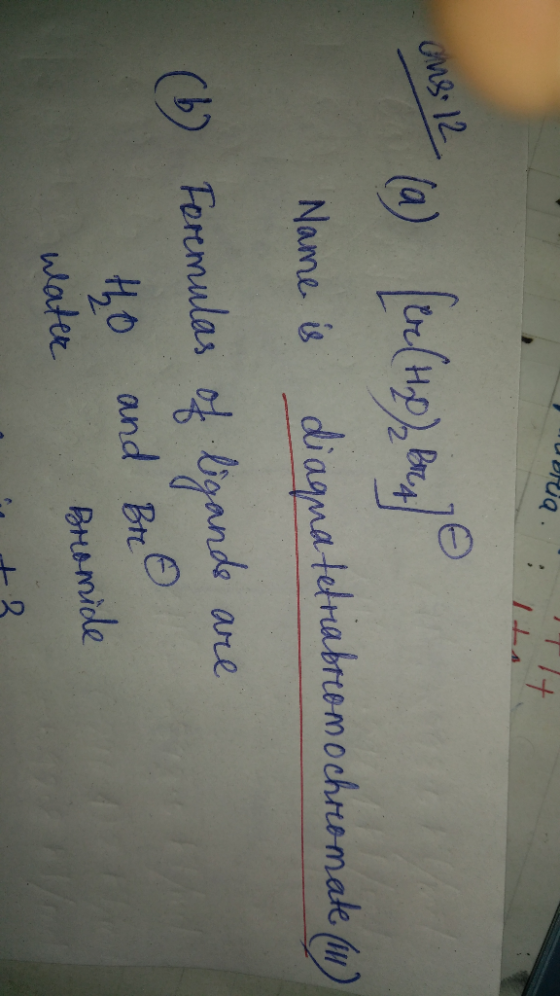
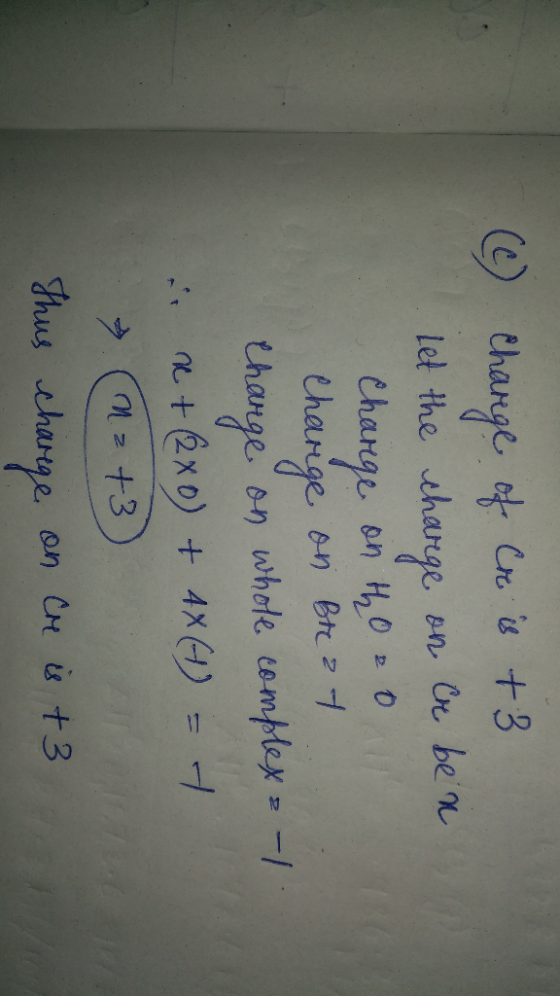
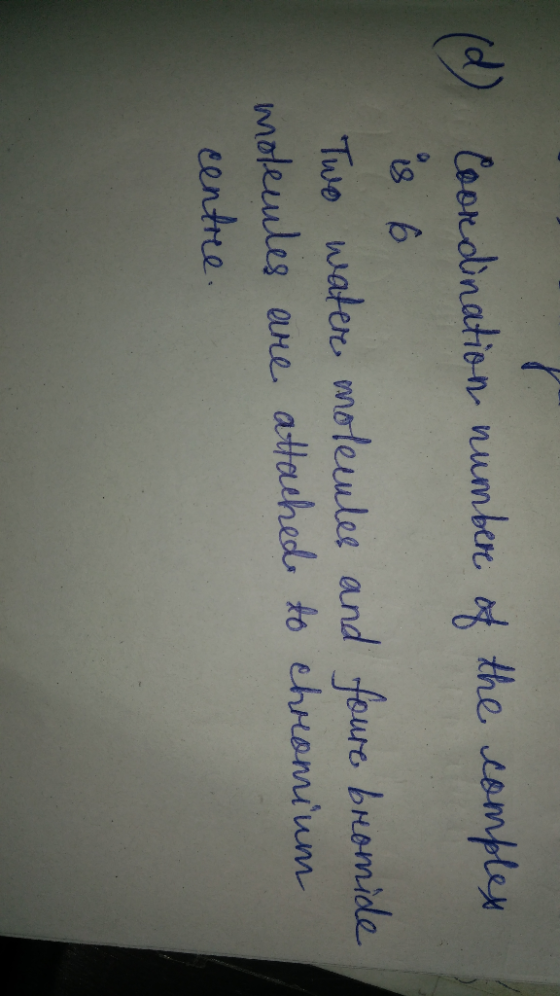
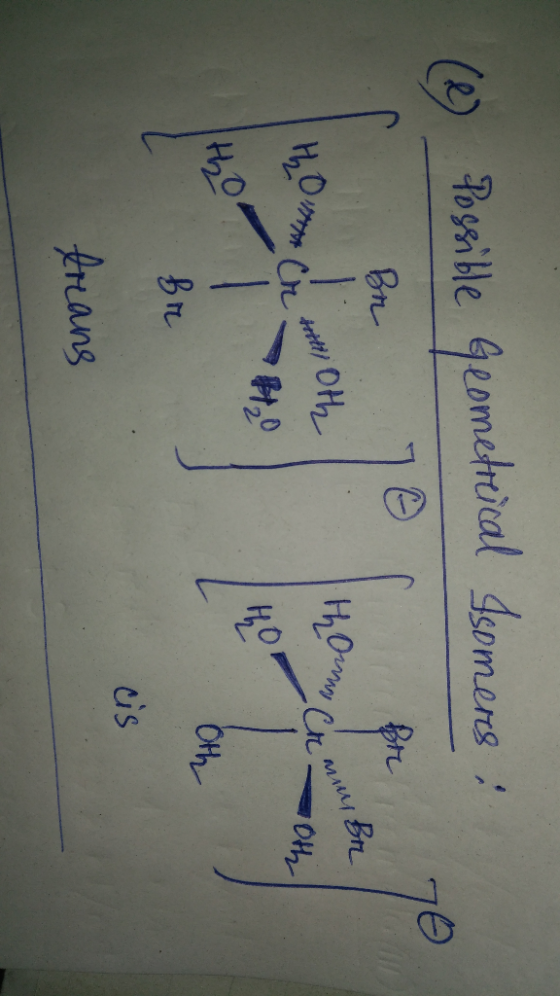
 12. A metal complex is Cr(H2O)2 Bra. (25 pt) a) Name the complex. b) Give formulas of ligands. c) What is charge of Cr? Find the coordination number of the complex. d) Sketch all possible geometric isomers, labeling cis/trans. e)
12. A metal complex is Cr(H20) Bra a) Name the complex. (25 pt) b) Give formulas...
 12. A metal complex is Cr(H20) Bra a) Name the complex. (25 pt) b) Give formulas of ligands. c) What is charge of Cr? d) Find the coordination number of the complex e) Sketch all possible geometric isomers, labeling cis/trans.
12. A metal complex is Cr(H20) Bra a) Name the complex. (25 pt) b) Give formulas...
 12. A metal complex is Cr(H20) Bra a) Name the complex. (25 pt) b) Give formulas of ligands. c) What is charge of Cr? d) Find the coordination number of the complex. e) Sketch all possible geometric isomers, labeling cis/trans.
anawer all 2 questions pleaseeeee 11. Indicate each of the following aqueous solutions is acidic, basic,...
 anawer all 2 questions pleaseeeee
11. Indicate each of the following aqueous solutions is acidic, basic, or neutral: KF KI HI КОН 12. A metal complex is Cr(H2O)2Bra a) Name the complex (25 pt) Give formulas of ligands. b) What is charge of Cr? c) Find the coordination number of the complex. d) e) Sketch all possible geometric isomers, labeling cis/trans.
anawer all 2 questions pleaseeeee
11. Indicate each of the following aqueous solutions is acidic, basic, or neutral: KF KI HI КОН 12. A metal complex is Cr(H2O)2Bra a) Name the complex (25 pt) Give formulas of ligands. b) What is charge of Cr? c) Find the coordination number of the complex. d) e) Sketch all possible geometric isomers, labeling cis/trans.
10. Calculate the pH of a solution made by mixing 10,0 mL of 0.100 HCI and 150 ml of 0.100 M NOH. 11. Indicate...
 10. Calculate the pH of a solution made by mixing 10,0 mL of 0.100 HCI and 150 ml of 0.100 M NOH. 11. Indicate each of the following aqueous solutions is acidic, basic, or neutral: KOH 12. A metal complex is Cr(HO) Bra a) Name the complex (25 pt) b) Give formulas of ligands. c) What is charge of Cr? d) Find the coordination number of the complex e) Sketch all possible geometric isomers, labeling cis/trans.
10. Calculate pH of a solution formed by 20.0 mL of 0.10 M HNO, after 19.9...
 10. Calculate pH of a solution formed by 20.0 mL of 0.10 M HNO, after 19.9 mL of 0.10 M KOH are added. 11. Which salt in water is acidic, basic, or neutral? AICI, NaBr, K,SOa, NH4I 12. The formula of a coordination compound is Li[Co(NHs)2(H2O)Clh . [26 pt) a) Name the coordination compound. b) Point out formulas of ligands. c) What is charge of Co? What is coordination number of the complex? d) Sketch all possible geometric isomers, labeling...
Circle the pairs of compounds that are isomers of each other: (a) [Co(en)_3]Cl_3 and [Co(en)_3]Br_3 (b)...
 Circle the pairs of compounds that are isomers of each other: (a) [Co(en)_3]Cl_3 and [Co(en)_3]Br_3 (b) [Co(H_2O)_4 Br_2]Cl and [Co(H_2O)_4BrCl]Br (c) [Cr(H_2O)_2(CO_3)_2]^2+ and [Cr(H_2O)_2(CO)_2(O_2)_2]^2+ (d) trans-[Pt(NH_3)_2Cl_2] and [Pt(NH_3)_3Cl]Cl Circle the appropriate description of the distinction between "geometric isomers" and "optical isomers": (a) Geometric isomers have a different set of bonds. optical isomers have the same set of bonds. (b) Geometric isomers differ in the spatial arrangement of bonds. In optical isomers the arrangement of bonds is the same. (c) Geometric...
What is the charge on the anion in the coordination compound K2[Pt(NO2)2Cl2]? The pair of brackets...
What is the charge on the anion in the coordination compound K2[Pt(NO2)2Cl2]? The pair of brackets “[‘” and “]” indicate the presence of a metal complex, and this collection of atoms/ions can be thought of as one molecular species (in this case an anion). Platinum is at the center of the complex with NO2− (through the N) and Cl− forming coordinate bonds with the Pt. Draw the Lewis structures of NO2− (nitro) and Cl−. Circle the electron pair in each...
1. Name the following transition metal complexes AND give the coordination number for each metal in the complex ion...
 1. Name the following transition metal complexes AND give the coordination number for each metal in the complex ion: Name Coordination # (a) K[Fe(CN).] (b)Ks[Fe(ox).] (c) Cr(en).]C13 (d) (Cr(NH3):(HO)](NO3) (e)ky [Cr(NH3),Cla]
Write the chemical names for the following compounds (if the metal is in a complex ion,...
Write the chemical names for the following compounds (if the metal is in a complex ion, be sure to include its oxidation number!) a. Rb[AgF4] b. fac-[Re(bpy)(CO)3Cl] c. [Co(NH3)5(H2O)]SO4 d. [Ag(NH3)2][PF6] e. mer-[Fe(H2O)3I3] f. trans-[CoCl2(en)2]Cl g. [Ni(bpy)3](NO3)2 h. Mo(CO)6 2. Sketch all optical and/or geometric isomers of the following: a. [Pt(NH3)3Cl3] + b. [PtCl2(en)2] 2+ c. Pt(NH3)2Cl2
 12. A metal complex is Cr(H2O)2 Bra. (25 pt) a) Name the complex. b) Give formulas of ligands. c) What is charge of Cr? Find the coordination number of the complex. d) Sketch all possible geometric isomers, labeling cis/trans. e)
 12. A metal complex is Cr(H20) Bra a) Name the complex. (25 pt) b) Give formulas of ligands. c) What is charge of Cr? d) Find the coordination number of the complex e) Sketch all possible geometric isomers, labeling cis/trans.
 12. A metal complex is Cr(H20) Bra a) Name the complex. (25 pt) b) Give formulas of ligands. c) What is charge of Cr? d) Find the coordination number of the complex. e) Sketch all possible geometric isomers, labeling cis/trans.
 anawer all 2 questions pleaseeeee
11. Indicate each of the following aqueous solutions is acidic, basic, or neutral: KF KI HI КОН 12. A metal complex is Cr(H2O)2Bra a) Name the complex (25 pt) Give formulas of ligands. b) What is charge of Cr? c) Find the coordination number of the complex. d) e) Sketch all possible geometric isomers, labeling cis/trans.
anawer all 2 questions pleaseeeee
11. Indicate each of the following aqueous solutions is acidic, basic, or neutral: KF KI HI КОН 12. A metal complex is Cr(H2O)2Bra a) Name the complex (25 pt) Give formulas of ligands. b) What is charge of Cr? c) Find the coordination number of the complex. d) e) Sketch all possible geometric isomers, labeling cis/trans.
 10. Calculate the pH of a solution made by mixing 10,0 mL of 0.100 HCI and 150 ml of 0.100 M NOH. 11. Indicate each of the following aqueous solutions is acidic, basic, or neutral: KOH 12. A metal complex is Cr(HO) Bra a) Name the complex (25 pt) b) Give formulas of ligands. c) What is charge of Cr? d) Find the coordination number of the complex e) Sketch all possible geometric isomers, labeling cis/trans.
 10. Calculate pH of a solution formed by 20.0 mL of 0.10 M HNO, after 19.9 mL of 0.10 M KOH are added. 11. Which salt in water is acidic, basic, or neutral? AICI, NaBr, K,SOa, NH4I 12. The formula of a coordination compound is Li[Co(NHs)2(H2O)Clh . [26 pt) a) Name the coordination compound. b) Point out formulas of ligands. c) What is charge of Co? What is coordination number of the complex? d) Sketch all possible geometric isomers, labeling...
 Circle the pairs of compounds that are isomers of each other: (a) [Co(en)_3]Cl_3 and [Co(en)_3]Br_3 (b) [Co(H_2O)_4 Br_2]Cl and [Co(H_2O)_4BrCl]Br (c) [Cr(H_2O)_2(CO_3)_2]^2+ and [Cr(H_2O)_2(CO)_2(O_2)_2]^2+ (d) trans-[Pt(NH_3)_2Cl_2] and [Pt(NH_3)_3Cl]Cl Circle the appropriate description of the distinction between "geometric isomers" and "optical isomers": (a) Geometric isomers have a different set of bonds. optical isomers have the same set of bonds. (b) Geometric isomers differ in the spatial arrangement of bonds. In optical isomers the arrangement of bonds is the same. (c) Geometric...
 1. Name the following transition metal complexes AND give the coordination number for each metal in the complex ion: Name Coordination # (a) K[Fe(CN).] (b)Ks[Fe(ox).] (c) Cr(en).]C13 (d) (Cr(NH3):(HO)](NO3) (e)ky [Cr(NH3),Cla]
Most questions answered within 3 hours.
-
Where is the error in this code sequence?
String s1 = "Hello";
String s2 = "ello";...
asked 10 months ago -
Financial data for Joel de Paris, Inc., for last year
follow:
Joel de Paris, Inc.
Balance...
asked 10 months ago -
Consider this reaction:
Al2(SO4)3 (aq)+ BaCl3
(aq) Al2Cl6 (aq)- +
3BaSO4(s) . What is the...
asked 10 months ago -
Suppose that Savneet is considering increasing her
recent random sample from 20 car rentals to 40...
asked 10 months ago -
Trucks arrive at an unloading terminal at an average rate of 120
per hour.
Trucks arrive...
asked 10 months ago -
Why are methanol and ethanol completely soluble in water while
octanol is not very little soluble....
asked 10 months ago -
A facilities manager at a university reads in a research report
that the mean amount of...
asked 10 months ago -
When the CuSO4 is rehydrated by adding water to the anhydrous
compound, is this an endothermic...
asked 10 months ago -
A ray of sunlight is passing from diamond into crown glass; the
angle of incidence is...
asked 10 months ago -
A block of mass 0.249 kg is placed on top of a light, vertical
spring of...
asked 10 months ago -
how do the kidneys compensate in the presences of acidosis
a) trigger hyperventilate
b) reserve acid...
asked 10 months ago -
Question 501 pts
The rental rate of capital to the firm increases. Which of the
following...
asked 10 months ago