
Homework Answers
Here is the solution of your question. If you have any doubt or need any clarification please comment in comment box and will definitely resolve your query. If you find useful please upvote it. Thanks in advance.
Add Answer to:
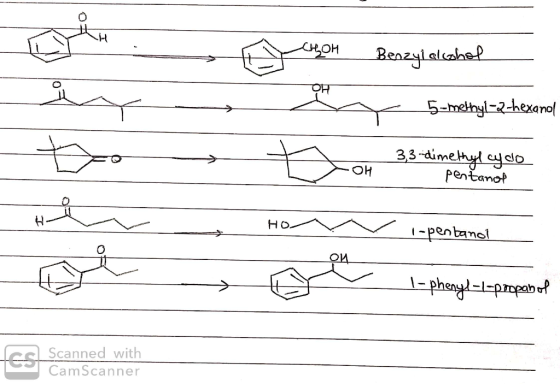
3. Draw the organic product of the reduction of each of these carbonyl compounds using NaBH4 in ethanol.
3. Draw the organic product of the reduction of each of these carbonyl compounds using NaBH, in ethanol. 4. The...
 3. Draw the organic product of the reduction of each of these carbonyl compounds using NaBH, in ethanol. 4. The reduction of this ketone with NaBHin ethanol give two organic products. Explain why there are two products and draw both of them in a way that clearly shows the difference.
1) Draw the acetal produced when ethanol adds to ethanal. 2) Draw the major organic product formed when...
1) Draw the acetal produced when ethanol adds to ethanal. 2) Draw the major organic product formed when 2-butanone undergoes a reaction with NaBH4. 3) Predict the organic product formed when heptan-3-one undergoes reaction with LiAlH4. 4) Reduction of 1-phenylpropan-1-one using NH2NH2 and HO-, heat: Draw the structure of the product formed when 1-phenylpropan-1-one is heated with NH2NH2 under basic conditions.
draw the ACETAL produced when ETHANOL adds to ETHANAL
1) Draw the acetal produced when ethanol adds to ethanal. 2) Draw the major organic product formed when 2-butanone undergoes a reaction with NaBH4. 3) Predict the organic product formed when heptan-3-one undergoes reaction with LiAlH4. 4) Reduction of 1-phenylpropan-1-one using NH2NH2 and HO-, heat: Draw the structure of the product formed when 1-phenylpropan-1-one is heated with NH2NH2 under basic conditions.
Give the plausible mechanism of reduction of 3-nitroacetophenone by NaBH4. (Ethanol was used in the experiment....
Give the plausible mechanism of reduction of 3-nitroacetophenone by NaBH4. (Ethanol was used in the experiment. 3-Nitrophenylethanol was created)
3.) For each of the following compounds, draw the major organic product of reaction with HCl...
 3.) For each of the following compounds, draw the major organic product of reaction with HCl or NaOH and circle whether the starting materials and products will be more soluble in organic solvent or water Benzoic Acid + HCl: Benzoic Acid + NaOH: OH Benzoic Acid Water/Organic Water Organic Fluorenone HС: Fluorenone + NaOH: Fluorenone Water/Organic Water/Organic Веnzocaine + HCi: Benzocaine + N»OH: H2N Benzocaine Water/Organic Water Organic O=
3.) For each of the following compounds, draw the major organic...
3.) For each of the following compounds, draw the major organic product of reaction with HCl or NaOH and circle whether the starting materials and products will be more soluble in organic solvent or water Benzoic Acid + HCl: Benzoic Acid + NaOH: OH Benzoic Acid Water/Organic Water Organic Fluorenone HС: Fluorenone + NaOH: Fluorenone Water/Organic Water/Organic Веnzocaine + HCi: Benzocaine + N»OH: H2N Benzocaine Water/Organic Water Organic O=
3.) For each of the following compounds, draw the major organic...
Organolithium compounds react with carbonyl compounds in a way that is similar to that of Grignard...
 Organolithium compounds react with carbonyl compounds in a way
that is similar to that of Grignard reactions.
Draw the structure of the expected product when the compound
below reacts with methyllithium followed by aqueous acid
workup.
organolithium compounds react with carbonyl compounds in a way that is similar to that of Grignard reactions Draw the structure of the expected product when the compound below reacts with methyllithium followed by aqueous acid workup. You do not have to consider stereochemistry. You...
Organolithium compounds react with carbonyl compounds in a way
that is similar to that of Grignard reactions.
Draw the structure of the expected product when the compound
below reacts with methyllithium followed by aqueous acid
workup.
organolithium compounds react with carbonyl compounds in a way that is similar to that of Grignard reactions Draw the structure of the expected product when the compound below reacts with methyllithium followed by aqueous acid workup. You do not have to consider stereochemistry. You...
18 Question (1 point) Draw the product that results from the following reaction. NaBH4 ethanol C)
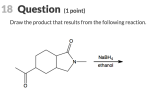 18 Question (1 point) Draw the product that results from the following reaction. NaBH4 ethanol C)
in the lab we are doing the chemoselective reduction of 3-nitroacetophenone using sodium borohydride , a...
in the lab we are doing the chemoselective reduction of 3-nitroacetophenone using sodium borohydride , a question our lab demonstrator asked us to do for the lab report was to draw the mechanism of reduction with NaBH4 but show all steps. i.e 1 x NaBH4 reduces 4 x carbonyls and not to stop when one mole of carbonyl is reduced and to also show alkoxide salts formed at each step...
Draw the major organic product (other than ethanol) formed in the following reaction Draw the major...
 Draw the major organic product (other than ethanol) formed in
the following reaction
Draw the major organic product (other than ethanol) formed in the following reaction
Draw the major organic product (other than ethanol) formed in
the following reaction
Draw the major organic product (other than ethanol) formed in the following reaction
For the reduction of benzophenone to benzohydrol by NaBH4 1) Draw the reaction, showing the reactants...
For the reduction of benzophenone to benzohydrol by NaBH4 1) Draw the reaction, showing the reactants and products. • What apparatus and conditions (solvent, temp., reaction time, etc) will be used for the reaction? (we are using ethanol and Buchner funnel filtration) • How will the benzhydrol product be isolated from the reaction mixture and how will it then be further purified? How will the product be characterized? • Identify which is the reducing agent and which is the oxidizing...
 3. Draw the organic product of the reduction of each of these carbonyl compounds using NaBH, in ethanol. 4. The reduction of this ketone with NaBHin ethanol give two organic products. Explain why there are two products and draw both of them in a way that clearly shows the difference.
 3.) For each of the following compounds, draw the major organic product of reaction with HCl or NaOH and circle whether the starting materials and products will be more soluble in organic solvent or water Benzoic Acid + HCl: Benzoic Acid + NaOH: OH Benzoic Acid Water/Organic Water Organic Fluorenone HС: Fluorenone + NaOH: Fluorenone Water/Organic Water/Organic Веnzocaine + HCi: Benzocaine + N»OH: H2N Benzocaine Water/Organic Water Organic O=
3.) For each of the following compounds, draw the major organic...
3.) For each of the following compounds, draw the major organic product of reaction with HCl or NaOH and circle whether the starting materials and products will be more soluble in organic solvent or water Benzoic Acid + HCl: Benzoic Acid + NaOH: OH Benzoic Acid Water/Organic Water Organic Fluorenone HС: Fluorenone + NaOH: Fluorenone Water/Organic Water/Organic Веnzocaine + HCi: Benzocaine + N»OH: H2N Benzocaine Water/Organic Water Organic O=
3.) For each of the following compounds, draw the major organic...
 Organolithium compounds react with carbonyl compounds in a way
that is similar to that of Grignard reactions.
Draw the structure of the expected product when the compound
below reacts with methyllithium followed by aqueous acid
workup.
organolithium compounds react with carbonyl compounds in a way that is similar to that of Grignard reactions Draw the structure of the expected product when the compound below reacts with methyllithium followed by aqueous acid workup. You do not have to consider stereochemistry. You...
Organolithium compounds react with carbonyl compounds in a way
that is similar to that of Grignard reactions.
Draw the structure of the expected product when the compound
below reacts with methyllithium followed by aqueous acid
workup.
organolithium compounds react with carbonyl compounds in a way that is similar to that of Grignard reactions Draw the structure of the expected product when the compound below reacts with methyllithium followed by aqueous acid workup. You do not have to consider stereochemistry. You...
 18 Question (1 point) Draw the product that results from the following reaction. NaBH4 ethanol C)
 Draw the major organic product (other than ethanol) formed in
the following reaction
Draw the major organic product (other than ethanol) formed in the following reaction
Draw the major organic product (other than ethanol) formed in
the following reaction
Draw the major organic product (other than ethanol) formed in the following reaction
Most questions answered within 3 hours.
-
Where is the error in this code sequence?
String s1 = "Hello";
String s2 = "ello";...
asked 11 months ago -
Financial data for Joel de Paris, Inc., for last year
follow:
Joel de Paris, Inc.
Balance...
asked 11 months ago -
Consider this reaction:
Al2(SO4)3 (aq)+ BaCl3
(aq) Al2Cl6 (aq)- +
3BaSO4(s) . What is the...
asked 11 months ago -
Suppose that Savneet is considering increasing her
recent random sample from 20 car rentals to 40...
asked 11 months ago -
Trucks arrive at an unloading terminal at an average rate of 120
per hour.
Trucks arrive...
asked 11 months ago -
Why are methanol and ethanol completely soluble in water while
octanol is not very little soluble....
asked 11 months ago -
A facilities manager at a university reads in a research report
that the mean amount of...
asked 11 months ago -
When the CuSO4 is rehydrated by adding water to the anhydrous
compound, is this an endothermic...
asked 11 months ago -
A ray of sunlight is passing from diamond into crown glass; the
angle of incidence is...
asked 11 months ago -
A block of mass 0.249 kg is placed on top of a light, vertical
spring of...
asked 11 months ago -
how do the kidneys compensate in the presences of acidosis
a) trigger hyperventilate
b) reserve acid...
asked 11 months ago -
Question 501 pts
The rental rate of capital to the firm increases. Which of the
following...
asked 11 months ago