
Homework Answers
Add Answer to:
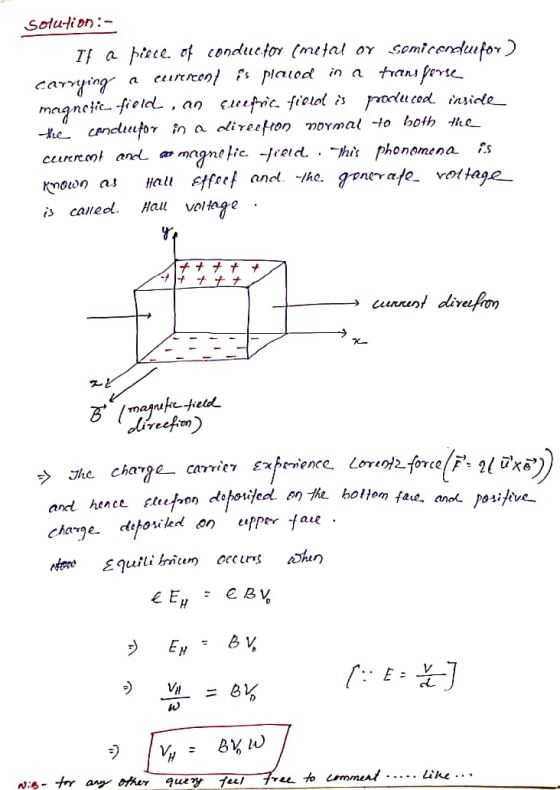
Hall effect: Describe the Hall effect with the aid of a neat, labelled diagram. What is...
In a Hall-effect experiment, a current of 2.2 A sent lengthwise through a conductor 1.1 cm...
In a Hall-effect experiment, a current of 2.2 A sent lengthwise through a conductor 1.1 cm wide, 4.4cm long, and 8μm thick produces a transverse (across the width) Hall voltage of 9.4 μV when a magnetic field of 1.7 T is passed perpendicularly through the thickness of the conductor. From these data, find the drift velocity of the charge carriers. Tries 0/20 Find the number density of charge carriers. ( m-3) Tries 0/20
(8c28p70) In a Hall-effect experiment, a current of 3.1 A sent lengthwise through a conductor 1.1...
(8c28p70) In a Hall-effect experiment, a current of 3.1 A sent lengthwise through a conductor 1.1 cm wide, 3.6 cm long, and 12μm thick produces a transverse (across the width) Hall voltage of 8.2 μV when a magnetic field of 1.5 T is passed perpendicularly through the thickness of the conductor. From these data, find the drift velocity of the charge carriers. 4.97×10⁻⁴ m/s You are correct. Your receipt no. is 158-6556 Help: Receipt Previous Tries Find the number density...
A thin metal film of length 2.20 cm, width of 0.550 cm, and thickness of 34.0...
A thin metal film of length 2.20 cm, width of 0.550 cm, and thickness of 34.0 micrometers is used to measure the Hall effect. A current of 1.80 A is maintained along the length of the sample. The Hall voltage of 17.0 microVolts is detected across its width, when a magnetic field of 1.50 Tesla is applied normal to the film. 1. Calculate the drift velocity of the charge carriers. 2. Assuming the charge carriers are electrons, calculate their density....
A metal strip 2.50 cm wide and 1.80 cm thick carries a current of 25.9 A...
A metal strip 2.50 cm wide and 1.80 cm thick carries a current of 25.9 A in a region containing a perpendicular uniform magnetic field of strength 1.65 T. The Hall voltage across the 2.50 cm width of the strip is measured to be 4.36 μV. Calculate the drift speed of the electrons in the strip. Find the number density of the charge carriers in the strip (in m-3).
30. The Hall-effect generator is constructed of a. N material 31. What three factors determine voltage...
 30. The Hall-effect generator is constructed of a. N material 31. What three factors determine voltage amplitude produced by a Hall generator? a. Size of Hall generator b. Polarity of voltage applied c. Magnetic field strength b. P material (select all) d. Magnitude of current applied by source e. Temperature of Hall generator 32. What are two methods used to increase output signal from a Hall generator? use a diode across device b. use of concentrators (tuning) a. c. increase...
A Hall sample is made of p-type silicon doped with 1019 borons/cm². Its resistivity is 0.009...
 A Hall sample is made of p-type silicon doped with 1019 borons/cm². Its resistivity is 0.009 ohm-cm. The sample has a cross section of 0.2mmx2mm and a length of 50mm. A voltage of 10V is applied in the longitudinal (length) direction. The effective mass of holes is 2 of electron rest mass. Temperature is 300K. Calculate: a. The Hall coefficient, b. Hole mobility, c. Longitudinal electrical field, d. Drift velocity, e. Mean free time, f. The Hall voltage across 2mm...
A Hall-effect probe operates with a 120-mA current. When the probe is placed in a uniform...
 A Hall-effect probe operates with a 120-mA current. When the probe is placed in a uniform magnetic field of magnitude 0.0820 T, it produces a Hall voltage of 0.720 V. (a) When it is used to measure an unknown magnetic field, the Hall voltage is 0.320 WV. What is the magnitude of the unknown field? x Your response differs from the correct answer by more than 10%. Double check your calculations. mt (b) The thickness of the probe in the...
I tried to solve this exercise: Which says to think about the Hall effect, but usually...
 I
tried to solve this exercise:
Which says to think about the Hall effect, but usually there’s
an external current flow when considering this effect, so I tried
to solve the exercise in another way. My questions are:
1) did I solve it right (see below)?
2) how can I solve the exercise considering the Hall effect
(and Lorentz force) ?
A cubic metal volume of side d =1.5? and density of charge carriers n is moving along y-axis with...
I
tried to solve this exercise:
Which says to think about the Hall effect, but usually there’s
an external current flow when considering this effect, so I tried
to solve the exercise in another way. My questions are:
1) did I solve it right (see below)?
2) how can I solve the exercise considering the Hall effect
(and Lorentz force) ?
A cubic metal volume of side d =1.5? and density of charge carriers n is moving along y-axis with...
please answer d & e with full explanations, thanks! 1. This problem investigates the use of...
 please answer d & e with full explanations, thanks!
1. This problem investigates the use of the Hall effect to study blood flow. When a current / travels along a conducting plate of width w, which lies perpendicular to a magnetic field B, a potential difference V develops across the plate as shown in the figure below. + + + + + + a. Show the direction of the electric field on the diagram. (Either copy the diagram from this...
please answer d & e with full explanations, thanks!
1. This problem investigates the use of the Hall effect to study blood flow. When a current / travels along a conducting plate of width w, which lies perpendicular to a magnetic field B, a potential difference V develops across the plate as shown in the figure below. + + + + + + a. Show the direction of the electric field on the diagram. (Either copy the diagram from this...
Taking pure silicon (Si) as an example, explain what is meant by the terms electron-hole generation...
 Taking pure silicon (Si) as an example, explain what is meant by the terms electron-hole generation and recombination, how they affect the electrical conductivity, and define what is meant by the "intrinsic carrier density", n. [5 marks] Q3. a) b) With the aid of both lattice and energy band diagrams, explain how n-type doping of Si is achieved and state two types of suitable dopant atoms. [7 marks] c) An n-type region on a Si wafer has a donor concentration...
 30. The Hall-effect generator is constructed of a. N material 31. What three factors determine voltage amplitude produced by a Hall generator? a. Size of Hall generator b. Polarity of voltage applied c. Magnetic field strength b. P material (select all) d. Magnitude of current applied by source e. Temperature of Hall generator 32. What are two methods used to increase output signal from a Hall generator? use a diode across device b. use of concentrators (tuning) a. c. increase...
 A Hall sample is made of p-type silicon doped with 1019 borons/cm². Its resistivity is 0.009 ohm-cm. The sample has a cross section of 0.2mmx2mm and a length of 50mm. A voltage of 10V is applied in the longitudinal (length) direction. The effective mass of holes is 2 of electron rest mass. Temperature is 300K. Calculate: a. The Hall coefficient, b. Hole mobility, c. Longitudinal electrical field, d. Drift velocity, e. Mean free time, f. The Hall voltage across 2mm...
 A Hall-effect probe operates with a 120-mA current. When the probe is placed in a uniform magnetic field of magnitude 0.0820 T, it produces a Hall voltage of 0.720 V. (a) When it is used to measure an unknown magnetic field, the Hall voltage is 0.320 WV. What is the magnitude of the unknown field? x Your response differs from the correct answer by more than 10%. Double check your calculations. mt (b) The thickness of the probe in the...
 I
tried to solve this exercise:
Which says to think about the Hall effect, but usually there’s
an external current flow when considering this effect, so I tried
to solve the exercise in another way. My questions are:
1) did I solve it right (see below)?
2) how can I solve the exercise considering the Hall effect
(and Lorentz force) ?
A cubic metal volume of side d =1.5? and density of charge carriers n is moving along y-axis with...
I
tried to solve this exercise:
Which says to think about the Hall effect, but usually there’s
an external current flow when considering this effect, so I tried
to solve the exercise in another way. My questions are:
1) did I solve it right (see below)?
2) how can I solve the exercise considering the Hall effect
(and Lorentz force) ?
A cubic metal volume of side d =1.5? and density of charge carriers n is moving along y-axis with...
 please answer d & e with full explanations, thanks!
1. This problem investigates the use of the Hall effect to study blood flow. When a current / travels along a conducting plate of width w, which lies perpendicular to a magnetic field B, a potential difference V develops across the plate as shown in the figure below. + + + + + + a. Show the direction of the electric field on the diagram. (Either copy the diagram from this...
please answer d & e with full explanations, thanks!
1. This problem investigates the use of the Hall effect to study blood flow. When a current / travels along a conducting plate of width w, which lies perpendicular to a magnetic field B, a potential difference V develops across the plate as shown in the figure below. + + + + + + a. Show the direction of the electric field on the diagram. (Either copy the diagram from this...
 Taking pure silicon (Si) as an example, explain what is meant by the terms electron-hole generation and recombination, how they affect the electrical conductivity, and define what is meant by the "intrinsic carrier density", n. [5 marks] Q3. a) b) With the aid of both lattice and energy band diagrams, explain how n-type doping of Si is achieved and state two types of suitable dopant atoms. [7 marks] c) An n-type region on a Si wafer has a donor concentration...
Most questions answered within 3 hours.
-
Where is the error in this code sequence?
String s1 = "Hello";
String s2 = "ello";...
asked 10 months ago -
Financial data for Joel de Paris, Inc., for last year
follow:
Joel de Paris, Inc.
Balance...
asked 10 months ago -
Consider this reaction:
Al2(SO4)3 (aq)+ BaCl3
(aq) Al2Cl6 (aq)- +
3BaSO4(s) . What is the...
asked 10 months ago -
Suppose that Savneet is considering increasing her
recent random sample from 20 car rentals to 40...
asked 10 months ago -
Trucks arrive at an unloading terminal at an average rate of 120
per hour.
Trucks arrive...
asked 10 months ago -
Why are methanol and ethanol completely soluble in water while
octanol is not very little soluble....
asked 10 months ago -
A facilities manager at a university reads in a research report
that the mean amount of...
asked 10 months ago -
When the CuSO4 is rehydrated by adding water to the anhydrous
compound, is this an endothermic...
asked 10 months ago -
A ray of sunlight is passing from diamond into crown glass; the
angle of incidence is...
asked 10 months ago -
A block of mass 0.249 kg is placed on top of a light, vertical
spring of...
asked 10 months ago -
how do the kidneys compensate in the presences of acidosis
a) trigger hyperventilate
b) reserve acid...
asked 10 months ago -
Question 501 pts
The rental rate of capital to the firm increases. Which of the
following...
asked 10 months ago