If a dense 20.0-kg object is falling in air at half its terminal velocity (drag force...
If a dense 20.0-kg object is falling in air at half its terminal velocity (drag force is proportional to the square of the object’s speed), what is the drag force on the object at this moment?
a. 25 N
b. 50 N
c. 75 N
d. 100 N
e. 150 N
Homework Answers

Add Answer to:
If a dense 20.0-kg object is falling in air at half its terminal
velocity (drag force...
An object falling through air experiences a drag force that is proportional to the square of...
An object falling through air experiences a drag force that is proportional to the square of its speed. If its cross-sectional area is defined as A, its terminal speed is proportional to: A. A-1 B. A1/2 C. A2 D. A-1/2
Calculate the terminal velocity for a pollen grain falling through the air using the drag force...
Calculate the terminal velocity for a pollen grain falling through the air using the drag force equation. Assume the pollen grain has a diameter of 7 µm and a density of 0.3 g/cm3. If this grain is released from the top of a tree (height 11 m), estimate the time it will take to fall to the ground. Hint: The pollen grain will reach its terminal velocity very quickly and will have this velocity for essentially the entire motion. Your...
When an object is falling in air at terminal velocity, (choose all correct answers) Group of...
When an object is falling in air at terminal velocity, (choose all correct answers) Group of answer choices the net force on the object is down. the net force on the object is zero. the net force on the object is up. there is no gravitational force on the object. there is a gravitational force on the object up. there is a gravitational force on the object down. the velocity is decreasing. the velocity is increasing. the velocity is constant.
5. A baseball thrown vertically up in the air experiences a drag force proportional to the...
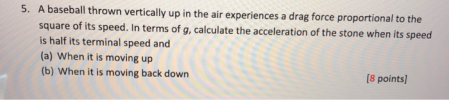 5. A baseball thrown vertically up in the air experiences a drag force proportional to the square of its speed. In terms of g, calculate the acceleration of the stone when its speed is half its terminal speed and (a) When it is moving up [8 points] (b) When it is moving back down
The drag force on falling box is described by FD=(1/2)ρACDv2, where ρ is the density of...
The drag force on falling box is described by FD=(1/2)ρACDv2, where ρ is the density of air, 1.2 kg/m3. The mass of the box is 12.0 g, and the effective area of the bottom of the box is 109 cm2. Assume a drag coefficient of 1.10 a) Determine the drag force on the box when it is falling at a speed of 1.21 m/s. b) The box will reach terminal speed when the drag force on it is equal to...
n Chapter 5 we look at drag due to air resistance for falling objects. Using the...
 n Chapter 5 we look at drag due to air resistance for falling objects. Using the Dv form of dr discussed in class, write a program (or solve analytically) to determine how long (sec.) and how far m) a 150 gram ball whose radius is 3.5cm would fall before it reached 75% of its terminal velocity. Assume ball falls in air whose density is 1.21 kg/m3, has a drag coefficient C .3, cross-sectional area s just the disk a sphere...
The drag force Fp on a smooth sphere falling in water depends on the sphere speed...
 The drag force Fp on a smooth sphere falling in water depends on
the sphere speed V, the sphere density P. the density p and dynamic
viscosity of water, the sphere diameter Dand the gravitational
acceleration g. Using dimensional analysis with p. V and D as
repeating variables, determine suitable dimensionless groups to
obtain a reneral relationship between the drag force and the other
variables. If the same sphere were to fall through air, determine
the ratio of the drag...
The drag force Fp on a smooth sphere falling in water depends on
the sphere speed V, the sphere density P. the density p and dynamic
viscosity of water, the sphere diameter Dand the gravitational
acceleration g. Using dimensional analysis with p. V and D as
repeating variables, determine suitable dimensionless groups to
obtain a reneral relationship between the drag force and the other
variables. If the same sphere were to fall through air, determine
the ratio of the drag...
1. A. An oil drop has a mass m. The drop is falling at a terminal...
1. A. An oil drop has a mass m. The drop is falling at a terminal speed vfall. Draw a free body diagram for the drop. Write the Newton’s Second law equation for the drop. Find the expression for the value of k in terms of the mass of the drop (m), the terminal speed (vfall), and g. B. The oil drop from C has a charge +q. It is now in a uniform electric field that points upward with...
1.There is a falling object, whose mass is A [kg] and experiences a force (its own weight) equal ...
1.There is a falling object, whose mass is A [kg] and experiences a force (its own weight) equal numerically to A times 9.81. The object starts from rest and the air causes a retarding force numerically equal to B times its velocity. a)Find general expression for velocity as a function of time, and draw its graph. b)Evaluate velocity for t = C (s) Depending on your value of R choose R A B C 0 6 0.180 4 1 7 ...
The mass density of air on Mars is ρ=0.016 kg/m3. The gravity on Mars is gMars=...
The mass density of air on Mars is ρ=0.016 kg/m3. The gravity on Mars is gMars= 3.7 m/s2. The mass density of air on earth under standard pressure and temperature conditions is ρ=1.225 kg/m3. A NASA mars probe weighs 1000 N on Earth. At terminal velocity, the weight of a falling object is equal to the drag force. Assume that the drag coefficient of the parachute used is constant, and has the same value on both Earth or Mars, and...
 5. A baseball thrown vertically up in the air experiences a drag force proportional to the square of its speed. In terms of g, calculate the acceleration of the stone when its speed is half its terminal speed and (a) When it is moving up [8 points] (b) When it is moving back down
 n Chapter 5 we look at drag due to air resistance for falling objects. Using the Dv form of dr discussed in class, write a program (or solve analytically) to determine how long (sec.) and how far m) a 150 gram ball whose radius is 3.5cm would fall before it reached 75% of its terminal velocity. Assume ball falls in air whose density is 1.21 kg/m3, has a drag coefficient C .3, cross-sectional area s just the disk a sphere...
 The drag force Fp on a smooth sphere falling in water depends on
the sphere speed V, the sphere density P. the density p and dynamic
viscosity of water, the sphere diameter Dand the gravitational
acceleration g. Using dimensional analysis with p. V and D as
repeating variables, determine suitable dimensionless groups to
obtain a reneral relationship between the drag force and the other
variables. If the same sphere were to fall through air, determine
the ratio of the drag...
The drag force Fp on a smooth sphere falling in water depends on
the sphere speed V, the sphere density P. the density p and dynamic
viscosity of water, the sphere diameter Dand the gravitational
acceleration g. Using dimensional analysis with p. V and D as
repeating variables, determine suitable dimensionless groups to
obtain a reneral relationship between the drag force and the other
variables. If the same sphere were to fall through air, determine
the ratio of the drag...
Most questions answered within 3 hours.
-
Where is the error in this code sequence?
String s1 = "Hello";
String s2 = "ello";...
asked 10 months ago -
Financial data for Joel de Paris, Inc., for last year
follow:
Joel de Paris, Inc.
Balance...
asked 10 months ago -
Consider this reaction:
Al2(SO4)3 (aq)+ BaCl3
(aq) Al2Cl6 (aq)- +
3BaSO4(s) . What is the...
asked 10 months ago -
Suppose that Savneet is considering increasing her
recent random sample from 20 car rentals to 40...
asked 10 months ago -
Trucks arrive at an unloading terminal at an average rate of 120
per hour.
Trucks arrive...
asked 10 months ago -
Why are methanol and ethanol completely soluble in water while
octanol is not very little soluble....
asked 10 months ago -
A facilities manager at a university reads in a research report
that the mean amount of...
asked 10 months ago -
When the CuSO4 is rehydrated by adding water to the anhydrous
compound, is this an endothermic...
asked 10 months ago -
A ray of sunlight is passing from diamond into crown glass; the
angle of incidence is...
asked 10 months ago -
A block of mass 0.249 kg is placed on top of a light, vertical
spring of...
asked 10 months ago -
how do the kidneys compensate in the presences of acidosis
a) trigger hyperventilate
b) reserve acid...
asked 10 months ago -
Question 501 pts
The rental rate of capital to the firm increases. Which of the
following...
asked 10 months ago