
Homework Answers
Add Answer to:
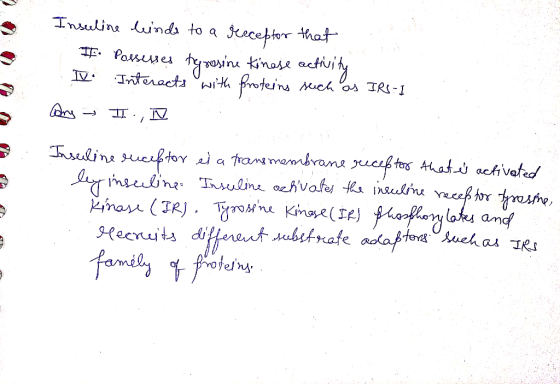
Insulin binds to a receptor that_ I. is coupled to a G protein II. possesses tyrosine...
Which of the following statements concerning signal transduction by the insulin receptor is NOT correct? A....
Which of the following statements concerning signal transduction by the insulin receptor is NOT correct? A. The insulin receptor substrate protein IRS-1 in its phosphorylated form activates other proteins. B. The pathway for insulin-stimulated transcription of specific genes involves the protein Ras. C. The insulin receptor phosphorylates itself in the activation process. D. Insulin stimulation of the insulin receptor initiates a cascade of events causing activation of glycogen synthase. E. The receptor protein kinase activity is specific for serine residues...
Place each of the following events into the correct stage of cell signaling -A G protein...
Place each of the following events into the correct stage of cell signaling -A G protein catalyzes the hydrolysis of GTP to GDP and Pi -Receptor kinase dimerizes after binding insulin -Inactivation of a receptor kinase by a protein phosphatase -Changes in gene expression -Adrenaline binds the extracellular domain of a G protein-coupled receptor -Activation of protein kinase A (PKA)
In order to impact cell differentiation and proliferation, the insulin receptor substrate 1 must be phosphorylated...
In order to impact cell differentiation and proliferation, the insulin receptor substrate 1 must be phosphorylated on a _________ residue and directly bind to __________. serine; growth factor receptor-bound protein 2 tyrosine; growth factor receptor-bound protein 10 serine; growth factor receptor-bound protein 10 tyrosine; growth factor receptor-bound protein 2 What is the name of the enzyme cascade that leads to cell proliferation and differentiation? Phosphatidylinositol pathway Mitogen pathway MAPK pathway Insulin mitogen pathway A comparison of the insulin signaling pathway...
Signaling of GPCRs (G-protein coupled receptors) is terminated by which mechanism? Phosphorylation of receptors by cAMP...
Signaling of GPCRs (G-protein coupled receptors) is terminated by which mechanism? Phosphorylation of receptors by cAMP (cyclic adenosine monophosphate) activated PKA (protein kinase A), which blocks the interaction with G-protein Cleavage of the GPCRs by receptor-specific serine or threonine proteases Hydrolysis of GTP (guanosine triphosphate) to GDP (guonosine diphosphate) by G-protein α. None of the above All of the above
Total question is worth 10 marks A1. Answer ALL parts: In insulin-responsive cells the insulin receptor...
 Total question is worth 10 marks A1. Answer ALL parts: In insulin-responsive cells the insulin receptor substrate 1 (IRS-1) protein is believed to be a major component of signal transduction. Several experiments were performed to investigate the relationship between IRS-1 and three adaptor proteins (Grb2, Shc, and p85) with respect to their role in insulin signaling. The descriptions of experiments are provided in the legends to the figures. Use Figures 1, 2 and 3 to provide the most appropriate answer....
G-protein coupled receptors can exhibit which of the following actions? Select one: a. Dimerization b. Tyrosine...
G-protein coupled receptors can exhibit which of the following actions? Select one: a. Dimerization b. Tyrosine kinase activity c. Nuclear Localization d. Activation of Adenylate Cyclase e. ATPase activity
1. What is the difference between: a. A G Protein and G Protein-Coupled Receptor b. Trimeric...
1. What is the difference between: a. A G Protein and G Protein-Coupled Receptor b. Trimeric and Monomeric G proteins
Select one compound (drug or toxicant) that targets one of the three receptor types(G-protein coupled receptor pathway, A receptor tyrosine kinase pathway, An ion channel pathway ) and discuss the fol...
Select one compound (drug or toxicant) that targets one of the three receptor types(G-protein coupled receptor pathway, A receptor tyrosine kinase pathway, An ion channel pathway ) and discuss the following for the selected compound: The name of the receptor involved The type of ligand that the drug or toxicant presents: Agonist, antagonist Are there natural ligands that interact with the receptor? If so explain the interaction. Provide a brief explanation of the mechanism of the cellular response upon ligand...
The small monomeric G protein Ras is an important component of most receptor tyrosine kinase signaling...
 The small monomeric G protein Ras is an important component of most receptor tyrosine kinase signaling pathways. It can regulate a number of downstream signaling components, perhaps most famously the MAPK cascade. Unlike other monomeric G proteins that we have discussed previously in class, Ras is anchored at the plasma membrane by a covalently bound lipid anchor. If Ras was specifically mutated so that it did not get this lipid modification (but was otherwise completely unchanged), what do you hypothesize...
Question 6 You and your G-protein coupled receptors o You have encountered G-protein coupled receptors in...
 Question 6 You and your G-protein coupled receptors o You have encountered G-protein coupled receptors in Intro Bio I lecture (or soon will), and will encounter them briefly again in Intro Bio II. You will spend 2 or 3 lectures on them in Cell Bio. They are integral (transmembrane) proteins embedded in the plasma membrane of every eukaryotic cell in your body. We will treat them as being 50 Angstroms in diameter. Considering the plasma membrane scaled up to the...
 Total question is worth 10 marks A1. Answer ALL parts: In insulin-responsive cells the insulin receptor substrate 1 (IRS-1) protein is believed to be a major component of signal transduction. Several experiments were performed to investigate the relationship between IRS-1 and three adaptor proteins (Grb2, Shc, and p85) with respect to their role in insulin signaling. The descriptions of experiments are provided in the legends to the figures. Use Figures 1, 2 and 3 to provide the most appropriate answer....
 The small monomeric G protein Ras is an important component of most receptor tyrosine kinase signaling pathways. It can regulate a number of downstream signaling components, perhaps most famously the MAPK cascade. Unlike other monomeric G proteins that we have discussed previously in class, Ras is anchored at the plasma membrane by a covalently bound lipid anchor. If Ras was specifically mutated so that it did not get this lipid modification (but was otherwise completely unchanged), what do you hypothesize...
 Question 6 You and your G-protein coupled receptors o You have encountered G-protein coupled receptors in Intro Bio I lecture (or soon will), and will encounter them briefly again in Intro Bio II. You will spend 2 or 3 lectures on them in Cell Bio. They are integral (transmembrane) proteins embedded in the plasma membrane of every eukaryotic cell in your body. We will treat them as being 50 Angstroms in diameter. Considering the plasma membrane scaled up to the...
Most questions answered within 3 hours.
-
Where is the error in this code sequence?
String s1 = "Hello";
String s2 = "ello";...
asked 10 months ago -
Financial data for Joel de Paris, Inc., for last year
follow:
Joel de Paris, Inc.
Balance...
asked 10 months ago -
Consider this reaction:
Al2(SO4)3 (aq)+ BaCl3
(aq) Al2Cl6 (aq)- +
3BaSO4(s) . What is the...
asked 10 months ago -
Suppose that Savneet is considering increasing her
recent random sample from 20 car rentals to 40...
asked 10 months ago -
Trucks arrive at an unloading terminal at an average rate of 120
per hour.
Trucks arrive...
asked 10 months ago -
Why are methanol and ethanol completely soluble in water while
octanol is not very little soluble....
asked 10 months ago -
A facilities manager at a university reads in a research report
that the mean amount of...
asked 10 months ago -
When the CuSO4 is rehydrated by adding water to the anhydrous
compound, is this an endothermic...
asked 10 months ago -
A ray of sunlight is passing from diamond into crown glass; the
angle of incidence is...
asked 10 months ago -
A block of mass 0.249 kg is placed on top of a light, vertical
spring of...
asked 10 months ago -
how do the kidneys compensate in the presences of acidosis
a) trigger hyperventilate
b) reserve acid...
asked 10 months ago -
Question 501 pts
The rental rate of capital to the firm increases. Which of the
following...
asked 10 months ago