In Organic Chemistry II for the 'Preparation and Properties of Soap' lab, please help answer the...
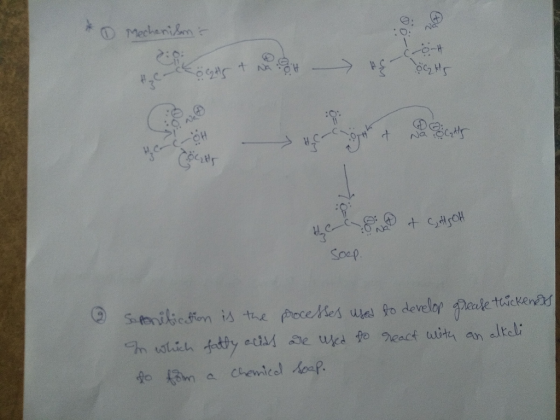
In Organic Chemistry II for the 'Preparation and Properties of Soap' lab, please help answer the following questions;
1. Write out a step-by-step mechanism for saponification. You may begin with a simple ester such as ethyl acetate.
2. The experimental procedure directs you to generously lubricate (grease) the ground glass connection between the 10 ml r.b flask in which saponification is being carried out and the reflux condenser. Why is this generous lubrication needed?
Homework Answers
Add Answer to:
In Organic Chemistry II for the 'Preparation and Properties of Soap' lab, please help answer the...
In Organic Chemistry for the Preparation and Properties of Polymers Lab (using toluene, styrene, benzoyl peroxide,...
In Organic Chemistry for the Preparation and Properties of Polymers Lab (using toluene, styrene, benzoyl peroxide, methanol, adipoyl chloride, cyclohexane, hexanediamine, sodium hydroxide, phthalic anhydride, sodium acetate, and ethylene glycol), please help answer the following question; 1. The observation between the two heated polyesters were different. What structural features account for the differences observed? (test tube 1 contained phthalic anhydride, sodium acetate and ethylene glycol and the second test tube contained phthalic anhydride, sodium acetate and glycerol.)
Hi! Can you please answer questions a and b for my organic lab report :) The...
 Hi! Can you please answer questions a and b for my organic lab
report :) The pictures below the questions is my lab procedure.
Thank you
6. Analysis Questions: a) This lab utilized a new technique called reflux, and the use of a condenser tube while heating the reaction. What is the purpose of the condenser? Why not just heat the reaction in a closed vessel instead? b) A student misread the instructions and first refluxed the sodium methoxide in...
Hi! Can you please answer questions a and b for my organic lab
report :) The pictures below the questions is my lab procedure.
Thank you
6. Analysis Questions: a) This lab utilized a new technique called reflux, and the use of a condenser tube while heating the reaction. What is the purpose of the condenser? Why not just heat the reaction in a closed vessel instead? b) A student misread the instructions and first refluxed the sodium methoxide in...
Organic Chemistry Addition of Bromine to an Alkene-HELP ASAP PLEASE table of reagents and properties Reagent &n
Organic Chemistry Addition of Bromine to an Alkene-HELP ASAP PLEASE table of reagents and properties Reagent MW (g/mol) mp(Celsius) d( g/ml) trans-cinamic acid 148.2 132-135 acetic acid 60 1.05 pyridinium tribromide 319.8 - 2,3-dibromo-3-phenylpropanoic acid 308.0 Pair A: 93-95, Pair B: 202-204 Organic Chemistry- addition of bromine to an Alkene For a lab the preparation of 2,3-dibromo-3 phenylpropanoic acid was done. 1.2 g of trans-cinnamic acid was dissolved in 4 ml of glacial acetic acid. 2.5 g of pyrimide tribromide...
Please can someone help me to interpret this. This was from Orgo II Williamson ether Lab. These a...
 Please can someone help me to interpret this. This was
from Orgo II Williamson ether Lab. These are the results and I need
help interpreting what this is showing. More especially for the
discussion and conclusion section. Thank You!
(if needed here are the procedures)
Add a magnetic stir bar to a 25ml round or pear-shaped
flask.
Add guaiacol (0.55ml,5mmoles) to the flask along with 3ml of
95% ethanol. Make sure the guaiacol dissolves in the ethanol before
proceeding.
Add...
Please can someone help me to interpret this. This was
from Orgo II Williamson ether Lab. These are the results and I need
help interpreting what this is showing. More especially for the
discussion and conclusion section. Thank You!
(if needed here are the procedures)
Add a magnetic stir bar to a 25ml round or pear-shaped
flask.
Add guaiacol (0.55ml,5mmoles) to the flask along with 3ml of
95% ethanol. Make sure the guaiacol dissolves in the ethanol before
proceeding.
Add...
The following questions are from an experiment titled Friedel-Crafts Alkylation for Organic Chemistry II Lab. There...
 The following questions are from an experiment titled
Friedel-Crafts Alkylation for Organic Chemistry II Lab. There are
pictures attached of the lab manual.
2) Is this method a good route for the preparation of
p-sec-butyltoulene? Give reasons for your answer.
3) Why do you use a large excess of toulene. What are its
functions?
4) What is the purpose for adding the hydrochloric acid to the
water in the separatory funnel in step 5? Hint: If no acid is
added,...
The following questions are from an experiment titled
Friedel-Crafts Alkylation for Organic Chemistry II Lab. There are
pictures attached of the lab manual.
2) Is this method a good route for the preparation of
p-sec-butyltoulene? Give reasons for your answer.
3) Why do you use a large excess of toulene. What are its
functions?
4) What is the purpose for adding the hydrochloric acid to the
water in the separatory funnel in step 5? Hint: If no acid is
added,...
Please help answer P1-P4 for this Perkin Reaction Lab Perkin Reaction Organic REActivity PERKIN REACTION (ALDOL...
 Please help answer P1-P4 for this Perkin Reaction Lab
Perkin Reaction Organic REActivity PERKIN REACTION (ALDOL CONDENSATION) The Reaction Scheme: Formation of trans-cinnamic acid The following reaction is named the Perkin Reaction. It is a very specific type of Aldol condensation that forms a variety of cinnamic acid derivatives. In this lab, you will perform a Perkin reaction using benzaldehyde and potassium carbonate in acetic anhydride to form trans- cinnamic acid (1). Trans-cinnamic acid is a natural compound found in...
Please help answer P1-P4 for this Perkin Reaction Lab
Perkin Reaction Organic REActivity PERKIN REACTION (ALDOL CONDENSATION) The Reaction Scheme: Formation of trans-cinnamic acid The following reaction is named the Perkin Reaction. It is a very specific type of Aldol condensation that forms a variety of cinnamic acid derivatives. In this lab, you will perform a Perkin reaction using benzaldehyde and potassium carbonate in acetic anhydride to form trans- cinnamic acid (1). Trans-cinnamic acid is a natural compound found in...
Please help with calculating the yield on this first page...the other two are data for your...
 Please help with calculating the yield on this first page...the
other two are data for your calculations. I believe the limiting
agent is 2-methoxyphenol, but I don't know how to calculate the
percent yield, or how to set that up...thank you
We were unable to transcribe this imageCHEM 246 Fundamentals of Organic Chemistry Laboratory Experimental Procedure Day 1 1. Bring a 50 mL round bottom flask, a yellow cap, and a cork ring to the reagent hood, measure 1 mL...
Please help with calculating the yield on this first page...the
other two are data for your calculations. I believe the limiting
agent is 2-methoxyphenol, but I don't know how to calculate the
percent yield, or how to set that up...thank you
We were unable to transcribe this imageCHEM 246 Fundamentals of Organic Chemistry Laboratory Experimental Procedure Day 1 1. Bring a 50 mL round bottom flask, a yellow cap, and a cork ring to the reagent hood, measure 1 mL...
Give a detailed mechanism for this reaction and give a separation scheme NUCLEOPHILIC ACYL SUBSTITUTION: Synthesis...
 Give a detailed mechanism for this reaction and give a separation
scheme
NUCLEOPHILIC ACYL SUBSTITUTION: Synthesis of an Ester Isoamyl acetate (Banana Oil) Purpose This experiment demonstrat and alcohol. The technique of refluxing the reaction mixture is introduced. es the procedure for the synthesis of an ester from a carboxylic acid Esters are an important functional group in organic chemistry, and esters are found widely distributed in nature. Many lower molecular weight esters are associated with natural fuit flavors and...
Give a detailed mechanism for this reaction and give a separation
scheme
NUCLEOPHILIC ACYL SUBSTITUTION: Synthesis of an Ester Isoamyl acetate (Banana Oil) Purpose This experiment demonstrat and alcohol. The technique of refluxing the reaction mixture is introduced. es the procedure for the synthesis of an ester from a carboxylic acid Esters are an important functional group in organic chemistry, and esters are found widely distributed in nature. Many lower molecular weight esters are associated with natural fuit flavors and...
Organic chemistry post-lab question: "Why is important to add the alkyl halide dropwise in your reaction?...
 Organic chemistry post-lab question: "Why is important
to add the alkyl halide dropwise in your reaction? (Hint: your
reaction is not heated, but you still need a water-cooled
condenser!)" Please answer in detail!
Here is a copy of the experiment, thank you!
The Grignard reaction is an important synthetic process by which a carbon-carbon bond is formed. Magnesium metal is first reacted with an organic halide. The resultant organo-magnesium halide (Grignard reagent) is then combined with a carbonyl compound, ultimately...
Organic chemistry post-lab question: "Why is important
to add the alkyl halide dropwise in your reaction? (Hint: your
reaction is not heated, but you still need a water-cooled
condenser!)" Please answer in detail!
Here is a copy of the experiment, thank you!
The Grignard reaction is an important synthetic process by which a carbon-carbon bond is formed. Magnesium metal is first reacted with an organic halide. The resultant organo-magnesium halide (Grignard reagent) is then combined with a carbonyl compound, ultimately...
cant figure out number FOUR please thanks for your help Experiment 5 Preparation of Synthetic Banana...
 cant figure out number FOUR please thanks for your help
Experiment 5 Preparation of Synthetic Banana Oil Compare the sum of these estimated losses with your actual product loss and try to account for any significant differences. 2/ What gas escaped during the sodium bicarbonate washing? Write bal- anced equations for two reactions that took place during this operation. 3. (a) Calculate the atom economy and reaction efficiency of your synthe- sis of isopentyl acetate. (b) Tell how the procedure...
cant figure out number FOUR please thanks for your help
Experiment 5 Preparation of Synthetic Banana Oil Compare the sum of these estimated losses with your actual product loss and try to account for any significant differences. 2/ What gas escaped during the sodium bicarbonate washing? Write bal- anced equations for two reactions that took place during this operation. 3. (a) Calculate the atom economy and reaction efficiency of your synthe- sis of isopentyl acetate. (b) Tell how the procedure...
 Hi! Can you please answer questions a and b for my organic lab
report :) The pictures below the questions is my lab procedure.
Thank you
6. Analysis Questions: a) This lab utilized a new technique called reflux, and the use of a condenser tube while heating the reaction. What is the purpose of the condenser? Why not just heat the reaction in a closed vessel instead? b) A student misread the instructions and first refluxed the sodium methoxide in...
Hi! Can you please answer questions a and b for my organic lab
report :) The pictures below the questions is my lab procedure.
Thank you
6. Analysis Questions: a) This lab utilized a new technique called reflux, and the use of a condenser tube while heating the reaction. What is the purpose of the condenser? Why not just heat the reaction in a closed vessel instead? b) A student misread the instructions and first refluxed the sodium methoxide in...
 Please can someone help me to interpret this. This was
from Orgo II Williamson ether Lab. These are the results and I need
help interpreting what this is showing. More especially for the
discussion and conclusion section. Thank You!
(if needed here are the procedures)
Add a magnetic stir bar to a 25ml round or pear-shaped
flask.
Add guaiacol (0.55ml,5mmoles) to the flask along with 3ml of
95% ethanol. Make sure the guaiacol dissolves in the ethanol before
proceeding.
Add...
Please can someone help me to interpret this. This was
from Orgo II Williamson ether Lab. These are the results and I need
help interpreting what this is showing. More especially for the
discussion and conclusion section. Thank You!
(if needed here are the procedures)
Add a magnetic stir bar to a 25ml round or pear-shaped
flask.
Add guaiacol (0.55ml,5mmoles) to the flask along with 3ml of
95% ethanol. Make sure the guaiacol dissolves in the ethanol before
proceeding.
Add...
 The following questions are from an experiment titled
Friedel-Crafts Alkylation for Organic Chemistry II Lab. There are
pictures attached of the lab manual.
2) Is this method a good route for the preparation of
p-sec-butyltoulene? Give reasons for your answer.
3) Why do you use a large excess of toulene. What are its
functions?
4) What is the purpose for adding the hydrochloric acid to the
water in the separatory funnel in step 5? Hint: If no acid is
added,...
The following questions are from an experiment titled
Friedel-Crafts Alkylation for Organic Chemistry II Lab. There are
pictures attached of the lab manual.
2) Is this method a good route for the preparation of
p-sec-butyltoulene? Give reasons for your answer.
3) Why do you use a large excess of toulene. What are its
functions?
4) What is the purpose for adding the hydrochloric acid to the
water in the separatory funnel in step 5? Hint: If no acid is
added,...
 Please help answer P1-P4 for this Perkin Reaction Lab
Perkin Reaction Organic REActivity PERKIN REACTION (ALDOL CONDENSATION) The Reaction Scheme: Formation of trans-cinnamic acid The following reaction is named the Perkin Reaction. It is a very specific type of Aldol condensation that forms a variety of cinnamic acid derivatives. In this lab, you will perform a Perkin reaction using benzaldehyde and potassium carbonate in acetic anhydride to form trans- cinnamic acid (1). Trans-cinnamic acid is a natural compound found in...
Please help answer P1-P4 for this Perkin Reaction Lab
Perkin Reaction Organic REActivity PERKIN REACTION (ALDOL CONDENSATION) The Reaction Scheme: Formation of trans-cinnamic acid The following reaction is named the Perkin Reaction. It is a very specific type of Aldol condensation that forms a variety of cinnamic acid derivatives. In this lab, you will perform a Perkin reaction using benzaldehyde and potassium carbonate in acetic anhydride to form trans- cinnamic acid (1). Trans-cinnamic acid is a natural compound found in...
 Please help with calculating the yield on this first page...the
other two are data for your calculations. I believe the limiting
agent is 2-methoxyphenol, but I don't know how to calculate the
percent yield, or how to set that up...thank you
We were unable to transcribe this imageCHEM 246 Fundamentals of Organic Chemistry Laboratory Experimental Procedure Day 1 1. Bring a 50 mL round bottom flask, a yellow cap, and a cork ring to the reagent hood, measure 1 mL...
Please help with calculating the yield on this first page...the
other two are data for your calculations. I believe the limiting
agent is 2-methoxyphenol, but I don't know how to calculate the
percent yield, or how to set that up...thank you
We were unable to transcribe this imageCHEM 246 Fundamentals of Organic Chemistry Laboratory Experimental Procedure Day 1 1. Bring a 50 mL round bottom flask, a yellow cap, and a cork ring to the reagent hood, measure 1 mL...
 Give a detailed mechanism for this reaction and give a separation
scheme
NUCLEOPHILIC ACYL SUBSTITUTION: Synthesis of an Ester Isoamyl acetate (Banana Oil) Purpose This experiment demonstrat and alcohol. The technique of refluxing the reaction mixture is introduced. es the procedure for the synthesis of an ester from a carboxylic acid Esters are an important functional group in organic chemistry, and esters are found widely distributed in nature. Many lower molecular weight esters are associated with natural fuit flavors and...
Give a detailed mechanism for this reaction and give a separation
scheme
NUCLEOPHILIC ACYL SUBSTITUTION: Synthesis of an Ester Isoamyl acetate (Banana Oil) Purpose This experiment demonstrat and alcohol. The technique of refluxing the reaction mixture is introduced. es the procedure for the synthesis of an ester from a carboxylic acid Esters are an important functional group in organic chemistry, and esters are found widely distributed in nature. Many lower molecular weight esters are associated with natural fuit flavors and...
 Organic chemistry post-lab question: "Why is important
to add the alkyl halide dropwise in your reaction? (Hint: your
reaction is not heated, but you still need a water-cooled
condenser!)" Please answer in detail!
Here is a copy of the experiment, thank you!
The Grignard reaction is an important synthetic process by which a carbon-carbon bond is formed. Magnesium metal is first reacted with an organic halide. The resultant organo-magnesium halide (Grignard reagent) is then combined with a carbonyl compound, ultimately...
Organic chemistry post-lab question: "Why is important
to add the alkyl halide dropwise in your reaction? (Hint: your
reaction is not heated, but you still need a water-cooled
condenser!)" Please answer in detail!
Here is a copy of the experiment, thank you!
The Grignard reaction is an important synthetic process by which a carbon-carbon bond is formed. Magnesium metal is first reacted with an organic halide. The resultant organo-magnesium halide (Grignard reagent) is then combined with a carbonyl compound, ultimately...
 cant figure out number FOUR please thanks for your help
Experiment 5 Preparation of Synthetic Banana Oil Compare the sum of these estimated losses with your actual product loss and try to account for any significant differences. 2/ What gas escaped during the sodium bicarbonate washing? Write bal- anced equations for two reactions that took place during this operation. 3. (a) Calculate the atom economy and reaction efficiency of your synthe- sis of isopentyl acetate. (b) Tell how the procedure...
cant figure out number FOUR please thanks for your help
Experiment 5 Preparation of Synthetic Banana Oil Compare the sum of these estimated losses with your actual product loss and try to account for any significant differences. 2/ What gas escaped during the sodium bicarbonate washing? Write bal- anced equations for two reactions that took place during this operation. 3. (a) Calculate the atom economy and reaction efficiency of your synthe- sis of isopentyl acetate. (b) Tell how the procedure...
Most questions answered within 3 hours.
-
Where is the error in this code sequence?
String s1 = "Hello";
String s2 = "ello";...
asked 11 months ago -
Financial data for Joel de Paris, Inc., for last year
follow:
Joel de Paris, Inc.
Balance...
asked 11 months ago -
Consider this reaction:
Al2(SO4)3 (aq)+ BaCl3
(aq) Al2Cl6 (aq)- +
3BaSO4(s) . What is the...
asked 11 months ago -
Suppose that Savneet is considering increasing her
recent random sample from 20 car rentals to 40...
asked 11 months ago -
Trucks arrive at an unloading terminal at an average rate of 120
per hour.
Trucks arrive...
asked 11 months ago -
Why are methanol and ethanol completely soluble in water while
octanol is not very little soluble....
asked 11 months ago -
A facilities manager at a university reads in a research report
that the mean amount of...
asked 11 months ago -
When the CuSO4 is rehydrated by adding water to the anhydrous
compound, is this an endothermic...
asked 11 months ago -
A ray of sunlight is passing from diamond into crown glass; the
angle of incidence is...
asked 11 months ago -
A block of mass 0.249 kg is placed on top of a light, vertical
spring of...
asked 11 months ago -
how do the kidneys compensate in the presences of acidosis
a) trigger hyperventilate
b) reserve acid...
asked 11 months ago -
Question 501 pts
The rental rate of capital to the firm increases. Which of the
following...
asked 11 months ago