
Homework Answers
(A)
So it remains invariant.
(B)
(C)
Since the kinetic energy is not, generally, invariant under a Galilean transformation so the total energy is not, generally, invariant under a Galilean transformation.
Add Answer to:
Problem 7. A) Show that the potential energy of two particles is invariant under a Galilean...
Assuming that the potential V() is invariant under rotation, let im be a solution of the...
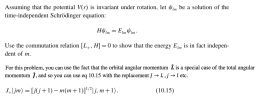 Assuming that the potential V() is invariant under rotation, let im be a solution of the time-independent Schrödinger equation: Use the commutation relation [L dent of m H 0 to show that the energy Elm is in fact indepen For this problem, you can use the fact that the orbital angular momentum L is a special case of the total angular momentum 1, and so you can use eq 10.15 with the replacementJ-L.j - letc. (10.15)
3. Potential energy of rings. You know that the gravitational potential energy of two interacting spherical...
 3. Potential energy of rings. You know that the gravitational potential energy of two interacting spherical masses (e g. Earth and Sun) s u--GMm, where r distance between their centers. If the masses are not spherical, this expression is not valid. However, we can still find the total potential energy by dividing the non-spherical mass into bits, treating each tiny bit as a point mass (which gravitates like a sphere), and adding their effects. That is, U-J -GMdm. This integral...
A system consists of two particles of mass mi and m2 interacting with an interaction potential...
 A system consists of two particles of mass mi and m2 interacting with an interaction potential V(r) that depends only on the relative distancer- Iri-r2l between the particles, where r- (ri,/i,21) and r2 22,ひ2,22 are the coordinates of the two particles in three dimensions (3D) (a) /3 pointsl Show that for such an interaction potential, the Hamiltonian of the system H- am▽ri _ 2m2 ▽22 + V(r) can be, put in the form 2M where ▽ and ▽ are the...
11.9. As shown in the figure, an object of charge Q, and mass m moves near a stationary object wi...
 11.9. As shown in the figure, an object of charge Q, and mass m moves near a stationary object with charge Q2. Assume the mass and the charges are constants, and assume the objects are surrounded by free space. The kinetic energy of the moving object is converted to or from energy stored in the electric field between the objects. The kinetic energy of the moving object is given by m). The energy of the electric field is given by...
Chapter 13, Problem 032 (a) What is the gravitational potential energy of a two-particle system with...
 Chapter 13, Problem 032 (a) What is the gravitational potential energy of a two-particle system with masses 7.0 kg and 2.1 kg, if they are separated by 2.9 m? If you triple the separation between the particles, how much work is done (b) by the gravitational force between the particles and (c) by you? (a) Number (b) Number (c) Number Units Units Units SHOW HINT LINK TO TEXT LINK TO SAMPLE PROBLEM LINK TO SAMPLE PROBLEM MATH HELP Question Attempts:...
11. For the following be aware that work has the same units as energy (In fact...
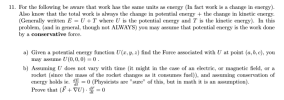 11. For the following be aware that work has the same units as energy (In fact work is a change in energy). Also know that the total work is always the change in potential energy + the change in kinetic energy. (Generally written E = U+T where U is the potential energy and T is the kinetic energy). In this problem, (and in general, though not ALWAYS) you may assume that potential energy is the work done by a conservative...
Problem 2. Recall that any undamped spring-mass system is described by an initial value problem of...
 Problem 2. Recall that any undamped spring-mass system is described by an initial value problem of the form m" + ky= 0, (0) = 0, v(0) = to, where m is the mass and k is the spring constant. Since there is no damping, we would expect that no energy is lost as the mass moves. That is, the total energy (potential plus kinetic) in the system at any time I should equal the initial amount of energy in the...
please solve B? and C) The total energy for the vibrating string problem can be written...
 please
solve B? and C)
The total energy for the vibrating string problem can be written as E = Kinetic Energy + Potential Energy = dx. Consider the case where u(r, t) satisfies the wave equation with the boundary con ditions ux(0,t) 4(L, t)-0. (a) Show that E is constant in time (b) Calculate the energy in 1 mode. (c) Show that the total energy is the sum of the energies contained in each mode
please
solve B? and C)
The total energy for the vibrating string problem can be written as E = Kinetic Energy + Potential Energy = dx. Consider the case where u(r, t) satisfies the wave equation with the boundary con ditions ux(0,t) 4(L, t)-0. (a) Show that E is constant in time (b) Calculate the energy in 1 mode. (c) Show that the total energy is the sum of the energies contained in each mode
A particle of mass m is bound by the spherically-symmetric three-dimensional harmonic- oscillator potential energy ,...
 A particle of mass m is bound by the spherically-symmetric three-dimensional harmonic- oscillator potential energy , and ф are the usual spherical coordinates. (a) In the form given above, why is it clear that the potential energy function V) is (b) For this problem, it will be more convenient to express this spherically-symmetric where r , spherically symmetric? A brief answer is sufficient. potential energy in Cartesian coordinates x, y, and z as physically the same potential energy as the...
1.4 The potential ergy of an object in simple harmonic about an equilibrium at x =...
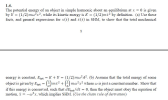 1.4 The potential ergy of an object in simple harmonic about an equilibrium at x = 0 is given by U (1/2)mo2x2, while its kinetic energy is K (1/2)mi2 by definition. (a) Use these facts. aid general expressions for x(t) and X(t) in SHM. to show that the total mechanical energy is constant. Etot-K + U = (1/2) mao2A2. (b) Assume that the total energy of some object is given by Etot-(-) mx2 + (-) mu'x2 where a) 1s just...
 Assuming that the potential V() is invariant under rotation, let im be a solution of the time-independent Schrödinger equation: Use the commutation relation [L dent of m H 0 to show that the energy Elm is in fact indepen For this problem, you can use the fact that the orbital angular momentum L is a special case of the total angular momentum 1, and so you can use eq 10.15 with the replacementJ-L.j - letc. (10.15)
 3. Potential energy of rings. You know that the gravitational potential energy of two interacting spherical masses (e g. Earth and Sun) s u--GMm, where r distance between their centers. If the masses are not spherical, this expression is not valid. However, we can still find the total potential energy by dividing the non-spherical mass into bits, treating each tiny bit as a point mass (which gravitates like a sphere), and adding their effects. That is, U-J -GMdm. This integral...
 A system consists of two particles of mass mi and m2 interacting with an interaction potential V(r) that depends only on the relative distancer- Iri-r2l between the particles, where r- (ri,/i,21) and r2 22,ひ2,22 are the coordinates of the two particles in three dimensions (3D) (a) /3 pointsl Show that for such an interaction potential, the Hamiltonian of the system H- am▽ri _ 2m2 ▽22 + V(r) can be, put in the form 2M where ▽ and ▽ are the...
 11.9. As shown in the figure, an object of charge Q, and mass m moves near a stationary object with charge Q2. Assume the mass and the charges are constants, and assume the objects are surrounded by free space. The kinetic energy of the moving object is converted to or from energy stored in the electric field between the objects. The kinetic energy of the moving object is given by m). The energy of the electric field is given by...
 Chapter 13, Problem 032 (a) What is the gravitational potential energy of a two-particle system with masses 7.0 kg and 2.1 kg, if they are separated by 2.9 m? If you triple the separation between the particles, how much work is done (b) by the gravitational force between the particles and (c) by you? (a) Number (b) Number (c) Number Units Units Units SHOW HINT LINK TO TEXT LINK TO SAMPLE PROBLEM LINK TO SAMPLE PROBLEM MATH HELP Question Attempts:...
 11. For the following be aware that work has the same units as energy (In fact work is a change in energy). Also know that the total work is always the change in potential energy + the change in kinetic energy. (Generally written E = U+T where U is the potential energy and T is the kinetic energy). In this problem, (and in general, though not ALWAYS) you may assume that potential energy is the work done by a conservative...
 Problem 2. Recall that any undamped spring-mass system is described by an initial value problem of the form m" + ky= 0, (0) = 0, v(0) = to, where m is the mass and k is the spring constant. Since there is no damping, we would expect that no energy is lost as the mass moves. That is, the total energy (potential plus kinetic) in the system at any time I should equal the initial amount of energy in the...
 please
solve B? and C)
The total energy for the vibrating string problem can be written as E = Kinetic Energy + Potential Energy = dx. Consider the case where u(r, t) satisfies the wave equation with the boundary con ditions ux(0,t) 4(L, t)-0. (a) Show that E is constant in time (b) Calculate the energy in 1 mode. (c) Show that the total energy is the sum of the energies contained in each mode
please
solve B? and C)
The total energy for the vibrating string problem can be written as E = Kinetic Energy + Potential Energy = dx. Consider the case where u(r, t) satisfies the wave equation with the boundary con ditions ux(0,t) 4(L, t)-0. (a) Show that E is constant in time (b) Calculate the energy in 1 mode. (c) Show that the total energy is the sum of the energies contained in each mode
 A particle of mass m is bound by the spherically-symmetric three-dimensional harmonic- oscillator potential energy , and ф are the usual spherical coordinates. (a) In the form given above, why is it clear that the potential energy function V) is (b) For this problem, it will be more convenient to express this spherically-symmetric where r , spherically symmetric? A brief answer is sufficient. potential energy in Cartesian coordinates x, y, and z as physically the same potential energy as the...
 1.4 The potential ergy of an object in simple harmonic about an equilibrium at x = 0 is given by U (1/2)mo2x2, while its kinetic energy is K (1/2)mi2 by definition. (a) Use these facts. aid general expressions for x(t) and X(t) in SHM. to show that the total mechanical energy is constant. Etot-K + U = (1/2) mao2A2. (b) Assume that the total energy of some object is given by Etot-(-) mx2 + (-) mu'x2 where a) 1s just...
Most questions answered within 3 hours.
-
Where is the error in this code sequence?
String s1 = "Hello";
String s2 = "ello";...
asked 10 months ago -
Financial data for Joel de Paris, Inc., for last year
follow:
Joel de Paris, Inc.
Balance...
asked 10 months ago -
Consider this reaction:
Al2(SO4)3 (aq)+ BaCl3
(aq) Al2Cl6 (aq)- +
3BaSO4(s) . What is the...
asked 10 months ago -
Suppose that Savneet is considering increasing her
recent random sample from 20 car rentals to 40...
asked 10 months ago -
Trucks arrive at an unloading terminal at an average rate of 120
per hour.
Trucks arrive...
asked 10 months ago -
Why are methanol and ethanol completely soluble in water while
octanol is not very little soluble....
asked 10 months ago -
A facilities manager at a university reads in a research report
that the mean amount of...
asked 10 months ago -
When the CuSO4 is rehydrated by adding water to the anhydrous
compound, is this an endothermic...
asked 10 months ago -
A ray of sunlight is passing from diamond into crown glass; the
angle of incidence is...
asked 10 months ago -
A block of mass 0.249 kg is placed on top of a light, vertical
spring of...
asked 10 months ago -
how do the kidneys compensate in the presences of acidosis
a) trigger hyperventilate
b) reserve acid...
asked 10 months ago -
Question 501 pts
The rental rate of capital to the firm increases. Which of the
following...
asked 10 months ago