

Homework Answers
(a)
Following is the sample space when 4 sided dice twice rolled and also shows the sum of outcome:
Let X shows the sum of two fair die. So X can take values 2, 3, 4,...8. Following table shows the probability distribution of X:
| X | P(X=x) |
| 2 | 1/16 |
| 3 | 2/16 |
| 4 | 3/16 |
| 5 | 4/16 |
| 6 | 3/16 |
| 7 | 2/16 |
| 8 | 1/16 |
Following table shows the calculations for mean and variance of X:
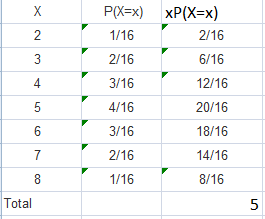
The expected value of X is

(b)
Let Y shows the amount you win. So you have
Y = 5X - A
The expected value of Y is
E(Y) = E(5X-A) = 5E(X) - A =5*5 - A = 25 - A
For break even expected value of Y must be equal to 0 so
E(Y) = 0
25 -A =0
A = 25
Answer: A = $25
(C)
Following table shows the calculations:
| X | P(X=x) | P(X=x) | X^2 | P(X^2=x^2) | X^2*P(X^2=x^2) |
| 2 | 1/16 | 0.0625 | 4 | 0.0625 | 0.25 |
| 3 | 2/16 | 0.125 | 9 | 0.125 | 1.125 |
| 4 | 3/16 | 0.1875 | 16 | 0.1875 | 3 |
| 5 | 4/16 | 0.25 | 25 | 0.25 | 6.25 |
| 6 | 3/16 | 0.1875 | 36 | 0.1875 | 6.75 |
| 7 | 2/16 | 0.125 | 49 | 0.125 | 6.125 |
| 8 | 1/16 | 0.0625 | 64 | 0.0625 | 4 |
| Total | 1 | 27.5 |
The expected value of X^2 is

Let Y shows the amount you win. So you have

The expected value of Y is

For break even expected value of Y must be equal to 0 so
E(Y) = 0
137.5-A =0
A = 137.5
Answer: A = $137.5
Add Answer to:
Problem 4. Two four-sided dice are rolled simultaneously. (a) Let X be the sum of the...
Two identical fair 6-sided dice are rolled simultaneously. Each die that shows a number less than...
Two identical fair 6-sided dice are rolled simultaneously. Each die that shows a number less than or equal to 4 is rolled once again. Let X be the number of dice that show a number less than or equal to 4 on the first roll, and let Y be the total number of dice that show a number greater than 4 at the end. (a) Find the joint PMF of X and Y . (Show your final answer in a...
Three six-sided dice are rolled. Let X be the sum of the dice. Determine the range...
Three six-sided dice are rolled. Let X be the sum of the dice. Determine the range of X and compute P(X = 18) and P(X ≤ 4).
Two dice are rolled repeatedly until the sum of the two numbers rolled is 10 or...
Two dice are rolled repeatedly until the sum of the two numbers rolled is 10 or more. a) What is the probability that exactly 5 rolls are needed? (Count each time you roll the dice as one roll). b) What is the probability that more than 5 rolls are needed? c) Find the expected number of rolls.
You roll two six-sided fair dice. a. Let A be the event that either a 4...
You roll two six-sided fair dice. a. Let A be the event that either a 4 or 5 is rolled first followed by an even number. P(A) = Round your answer to four decimal places. b. Let B be the event that the sum of the two dice is at most 5. P(B) = Round your answer to four decimal places. c. Are A and B mutually exclusive events? d. Are A and B independent events?
Answer it as soon as possible please. Two fair six-sided dice are rolled. Let X be...
 Answer it as soon as possible please.
Two fair six-sided dice are rolled. Let X be the maximum of the two tosses (for example, if you roll a 2 and a 5, X = 5). Construct a pdf for X, and use it to calculate the following probabilities: p(z) F(x) 1, P(X=3) 3. Construct a cdf for X and use it to calculate P(X s 4).
Answer it as soon as possible please.
Two fair six-sided dice are rolled. Let X be the maximum of the two tosses (for example, if you roll a 2 and a 5, X = 5). Construct a pdf for X, and use it to calculate the following probabilities: p(z) F(x) 1, P(X=3) 3. Construct a cdf for X and use it to calculate P(X s 4).
Roll two fair four-sided dice. Let X and Y be the die scores from the 1st...
Roll two fair four-sided dice. Let X and Y be the die scores from the 1st die and the 2nd die, respectively, and define a random variable Z = X − Y (a) Find the pmf of Z. (b) Draw the histogram of the pmf of Z. (c) Find P{Z < 0}. (d) Are the events {Z < 0} and {Z is odd} independent? Why?
A) Suppose I roll two fair six-sided dice. What is the probability that I rolled a...
A) Suppose I roll two fair six-sided dice. What is the probability that I rolled a total of 5? B) Suppose I roll two fair six-sided die and I announce that the sum of the two die is 6 or less. What is the probability that I rolled a total of 5?
Problem 1 (10 points). If two fair dice are rolled 10 times, what is the probability...
 Problem 1 (10 points). If two fair dice are rolled 10 times, what is the probability of at least one 6 (on either die) in exactly five of these 10 rolls? (Hint: For each roll, two dice are rolled at the same time. It is considered as the success if at least one of two dice is 6 and as the failure if neither of dice is 6.]
Suppose you roll two 4 sided dice. Let the probabilities of the first die be represented...
Suppose you roll two 4 sided dice. Let the probabilities of the first die be represented by random variable X and those of the second die be represented by random variable Y. Let random variable Z be |X-Y|. The range of Z will be from 0 to 3. 1. Find E(Z). 2. Find P(Z = 1|Z <3). 3. What is the probability that you have to play the game 4 times before you roll Z=3? 4. What is the probability...
1. Suppose 7 dice are rolled. The dice are 6-sided and fair. a). Find the probability...
1. Suppose 7 dice are rolled. The dice are 6-sided and fair. a). Find the probability that more than 5 dice show 2 or less (you may leave your answer in unsimplified form). I found this answer to be 5/729= 0.006859 b). Suppose we roll 7 dice and count the number showing 2 or less. We repeat this experiment over and over, each time counting the number showing 2 or less. What should we expect to compute as an average...
 Answer it as soon as possible please.
Two fair six-sided dice are rolled. Let X be the maximum of the two tosses (for example, if you roll a 2 and a 5, X = 5). Construct a pdf for X, and use it to calculate the following probabilities: p(z) F(x) 1, P(X=3) 3. Construct a cdf for X and use it to calculate P(X s 4).
Answer it as soon as possible please.
Two fair six-sided dice are rolled. Let X be the maximum of the two tosses (for example, if you roll a 2 and a 5, X = 5). Construct a pdf for X, and use it to calculate the following probabilities: p(z) F(x) 1, P(X=3) 3. Construct a cdf for X and use it to calculate P(X s 4).
 Problem 1 (10 points). If two fair dice are rolled 10 times, what is the probability of at least one 6 (on either die) in exactly five of these 10 rolls? (Hint: For each roll, two dice are rolled at the same time. It is considered as the success if at least one of two dice is 6 and as the failure if neither of dice is 6.]
Most questions answered within 3 hours.
-
Where is the error in this code sequence?
String s1 = "Hello";
String s2 = "ello";...
asked 10 months ago -
Financial data for Joel de Paris, Inc., for last year
follow:
Joel de Paris, Inc.
Balance...
asked 10 months ago -
Consider this reaction:
Al2(SO4)3 (aq)+ BaCl3
(aq) Al2Cl6 (aq)- +
3BaSO4(s) . What is the...
asked 10 months ago -
Suppose that Savneet is considering increasing her
recent random sample from 20 car rentals to 40...
asked 10 months ago -
Trucks arrive at an unloading terminal at an average rate of 120
per hour.
Trucks arrive...
asked 10 months ago -
Why are methanol and ethanol completely soluble in water while
octanol is not very little soluble....
asked 10 months ago -
A facilities manager at a university reads in a research report
that the mean amount of...
asked 10 months ago -
When the CuSO4 is rehydrated by adding water to the anhydrous
compound, is this an endothermic...
asked 10 months ago -
A ray of sunlight is passing from diamond into crown glass; the
angle of incidence is...
asked 10 months ago -
A block of mass 0.249 kg is placed on top of a light, vertical
spring of...
asked 10 months ago -
how do the kidneys compensate in the presences of acidosis
a) trigger hyperventilate
b) reserve acid...
asked 10 months ago -
Question 501 pts
The rental rate of capital to the firm increases. Which of the
following...
asked 10 months ago