The development of antibiotic resistance by pathogenic bacteria represents a major health...
The development of antibiotic resistance by pathogenic bacteria represents a major health concern. One potential new antibiotic is evernimicin, which was isolated from Micromonospora carbonacea? Evernimicin is an oligosaccharide with antibiotic activity against a broad range of gram-positive pathogenic bacteria. To determine the mode of action of this drug, researchers have analyzed 23S ribosomal DNA mutants that showed reduced sensitivity to evernimicin (e.g., Adrian et al., 2000. Antimicrob. Ag. and Chemo. 44: 3101–3106). They discovered two classes of mutants that conferred resistance: In one class, the mutation occurs in 23S rRNA nucleotides 2475–2483; in the other class, it occurs in ribosomal protein L16. This suggests that these two ribosomal components are structurally and functionally linked. It turns out that the tRNA anticodon stem-loop appears to bind to the A site of the ribosome at rRNA bases 2465–2485. This finding conforms to the proposed function of L16, which appears to be involved in attracting the aminoacyl stem of the tRNA to the ribosome at its A site. Using your sketch of the translation machinery from Problem 35 along with this information, designate where the proposed antibacterial action of evernimicin is likely to occur.
The emergence of antibiotic-resistant strains of Enterococci and transfer of resistant genes to other bacterial pathogens have highlighted the need for new generations of antibiotics to combat serious infections. To grasp the range of potential sites for the action of existing antibiotics, sketch the components of the translation machinery (e.g., see Step 3 of Figure), and using a series of numbered pointers, indicate the specific location for the action of the antibiotics shown in the following table.
Antibiotic | Action |
1. Streptomycin | Binds to 30S ribosomal subunit |
2. Chloramphenicol | Inhibits peptidyl transferase of 70S ribosome |
3. Tetracycline | Inhibits binding of charged tRNA to ribosome |
4. Erythromycin | Binds to free 50S particle and prevents formation of 70S ribosome |
5. Kasugamycin | Inhibits binding of tRNAfmet |
6. Thiostrepton | Prevents translocation by inhibiting EF-G |
Figure
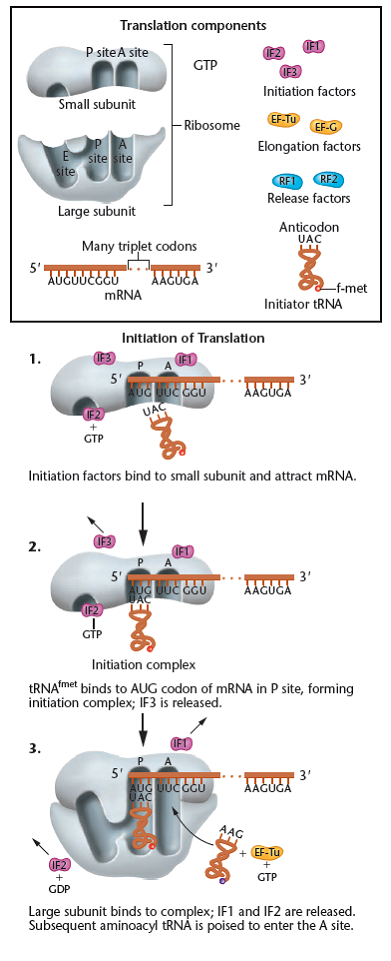
Initiation of translation. The separate components are depicted at the left of the figure.
Step-by-Step Solution
Request Solution!
We need at least 10 more requests to produce the solution.
0 / 10 have requested this problem solution
The more requests, the faster the answer.
Most questions answered within 3 hours.
-
Calculating the space time for parallel reactions. m-Xylene is reacted over a ZSM-5 zeolit...
-
Determine Vo and ID for the networks of Fig. 2.160.FIG. 2.160
-
The truck travels along a circular road that has a radius of 50 m at a speed of 4 m/s. F...
-
A state legislature enacted a statute that required any motorcycle operator or passenger...
-
A 1024 × 1024 8-bit image with 5.3 bits/pixel entropy [computed from its histogram using E...
-
In Problem 3.3, we estimated the equationwhere we now report standard errors along with th...
-
In each of the following cases, deduce the nature of the light that is consistent with the...
-
Solve Example 20.5 such that the x, y, z axes move with curvilinear translation, Ω = 0 in...
-
In Fig. 6.43, if i = cos 4t and v = sin 4t, the element is:(a)a resistor(b) a capacitor(c)...
-
Sketch vo for each network of Fig. 2.181 for the input shown.FIG. 2.181
-
(Supplement B) Computing and Reporting Cash Flow Effectsof Sale of Plant and EquipmentDuri...
-
A 350-mL spherical flask contains 0.075 mol of an ideal gas at a temperature of 293 K. Wha...