You react acetic acid with an unknown alcohol, and obtain the
following NMR of the product. What is the unknown alcohol?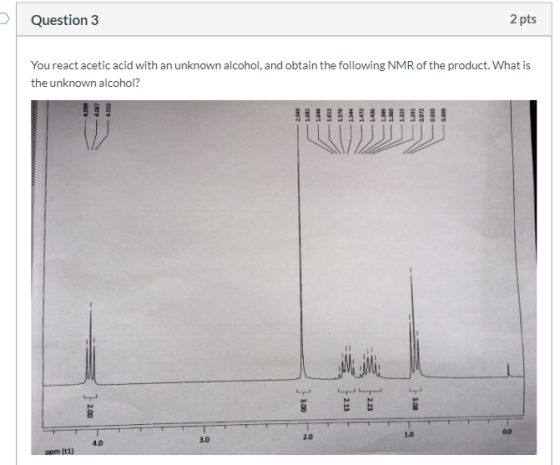
![3 ] 2.00 1- 3.00 0.0 4.0 ppm (11) 2-propanol (CH3)2CHOH) 1-propanol (CH3CH2CH2OH) 2-methyl-1-propanol (CH3)2CHCH2OH) 1-butano](http://img.homeworklib.com/questions/601b10e0-7066-11ea-ad45-e95b0503137f.png?x-oss-process=image/resize,w_560)
Homework Answers
ANSWER:-
ANSWER SHOULD BE 1-BUTANOL
BECAUSE REACTION OF 1-BUTANOL WITH ACETIC ACID GIVES product CH3CH2CH2CH2COOCH3 in which all 12 hydrogen atoms which is matching with NMR SPECTRA and also multiplicity and signals and chemical shifts are also matching with this spectra. total 5 signal observed in this spectrum.
due to CH3 near to COO group a singlet is observed chemical shift of 2.049 ppm
due to CH3 left of the structure a triplet observed due to adjacent 2 protons
due to CH2 near to COO group a triplet observed at 4.09
due to middle two CH2 groups a multiplet observed due to two adjacent groups.
Add Answer to:
You react acetic acid with an unknown alcohol, and obtain the
following NMR of the product....
You react acetic acid with an unknown alcohol, and obtain the following NMR of the product....
 You react acetic acid with an unknown alcohol, and obtain the following NMR of the product. What is the unknown alcohol? 2.049 1.682 1.648 1.613 1.325 1.291 0.972 0.935 6680 - 2.00 4.0 ppm (t1) 2-methyl-1-propanol (CH3)2CHCH2OH) 1-butanol (CH3CH2CH2CH2OH) 2-propanol (CH3)2CHOH) 1-propanol (CH3CH2CH2OH) 2-butanol (CH3CHOHCH2OHCH3)
You react acetic acid with an unknown alcohol, and obtain the following NMR of the product...
 You react acetic acid with an unknown alcohol, and obtain the following NMR of the product What is the unknown alcohol? 1-butanol (CH3CH2CH2CH2OH) 2-propanol (CH3)2CHOH) 2-methyl-1-propanol ((CH3)2CHCH2OH) 1-propanol (CH3CH2CH2OH) 2-butanol (CH3CHOHCH2OHCH2)
You add 0.58 mL of n-propanol (0.803 g/mL, 60.1 g/mol) to an excess of acetic acid...
 You add 0.58 mL of n-propanol (0.803 g/mL, 60.1 g/mol) to an excess of acetic acid to create the pear ester propyl acetate (102.1 g/mol). If you obtain 0.53 grams of the product, what was your percent yield? You react acetic acid with an unknown alcohol, and obtain the following NMR of the product. What is the unknown alcohol? LLLLLLLL LES LL 20 1-butanol (CH3CH2CH2CH2OH) 2-propanol (CH3)2CHOH) 1-propanol (CH3CH2CH20H) 2-methyl-1-propanol (CH3)2CHCH2OH) 2 butanol (CH3CHOHCH2OHCH) 3 Mi Consider the below general...
1) 2) 3) question 3 answer choices. You add 0.58 mL of n-propanol (0.803 g/mL, 60.1...
 1)
2)
3)
question
3 answer choices.
You add 0.58 mL of n-propanol (0.803 g/mL, 60.1 g/mol) to an excess of acetic acid to create the pear ester propyl acetate (102.1 g/mol). If you obtain 0.53 grams of the product, what was your percent yield? You react acetic acid with an unknown alcohol, and obtain the following NMR of the product. What is the unknown alcohol? 1.0 20 3.0 4.0 ppm (t1) 1-butanol (CH3CH2CH2CH2OH) O 2-propanol ((CH3)2CHOH) O 1-propanol (CH3CH2CH2OH)...
1)
2)
3)
question
3 answer choices.
You add 0.58 mL of n-propanol (0.803 g/mL, 60.1 g/mol) to an excess of acetic acid to create the pear ester propyl acetate (102.1 g/mol). If you obtain 0.53 grams of the product, what was your percent yield? You react acetic acid with an unknown alcohol, and obtain the following NMR of the product. What is the unknown alcohol? 1.0 20 3.0 4.0 ppm (t1) 1-butanol (CH3CH2CH2CH2OH) O 2-propanol ((CH3)2CHOH) O 1-propanol (CH3CH2CH2OH)...
What alcohol IR spectrum is that when reacted with acetic acid UNKNOWN D PPM 112 1-butanol...
 What alcohol IR spectrum is that when reacted with acetic
acid
UNKNOWN D PPM 112 1-butanol (n-butyl alcohol) 2-butanol (sec-butyl alcohol) 2-methyl-1-propanol (isobutyl alcohol) 3-methyl-1-butanol (isopentyl alcohol) 1-pentanol (n-pentyl alcohol) 2-pentanol 3-pentanol cyclopentanol
What alcohol IR spectrum is that when reacted with acetic
acid
UNKNOWN D PPM 112 1-butanol (n-butyl alcohol) 2-butanol (sec-butyl alcohol) 2-methyl-1-propanol (isobutyl alcohol) 3-methyl-1-butanol (isopentyl alcohol) 1-pentanol (n-pentyl alcohol) 2-pentanol 3-pentanol cyclopentanol
Which mechanism gives you this NMR spectrum and what is the name of it? Acetic acid...
 Which mechanism gives you this NMR spectrum and what is the name
of it?
Acetic acid + 1-pentanol
Acetic acid + 2-pentanol
Acetic acid + isopentyl alcohol
Acetic acid + hexyl alcohol
Acetic acid + 4-methyl-2-pentanol
Also, please label the structure's Hydrogens as (Ha,Hb,Hc,Hd
etc)
Thanks!
20 40 3.0 2.0 1.0 0 (ppm)
Which mechanism gives you this NMR spectrum and what is the name
of it?
Acetic acid + 1-pentanol
Acetic acid + 2-pentanol
Acetic acid + isopentyl alcohol
Acetic acid + hexyl alcohol
Acetic acid + 4-methyl-2-pentanol
Also, please label the structure's Hydrogens as (Ha,Hb,Hc,Hd
etc)
Thanks!
20 40 3.0 2.0 1.0 0 (ppm)
using the IR, the 13C, and DEPT NMR spectra of your product determine the identity of...
 using the IR, the 13C, and DEPT NMR spectra of your product
determine the identity of your unknown ester from a C-4 or C-5
alcohol. the identity of the C-4 or C-5 alcohol also needs to be
determined.
The following C-4 or C-5 alcohols will be used in this
experiment:
1-butanol (n-butyl alcohol)
2-butanol (sec-butyl alcohol)
2-methyl-1-propanol (isobutyl alcohol)
3-methyl-1-butanol (isopentyl alcohol)
1-pentanol (n-pentyl alcohol)
2-pentanol
3-pentanol
cyclopentanol
Questions:
1. Why is the mixture extracted with aqueous sodium
bicarbonate solution?...
using the IR, the 13C, and DEPT NMR spectra of your product
determine the identity of your unknown ester from a C-4 or C-5
alcohol. the identity of the C-4 or C-5 alcohol also needs to be
determined.
The following C-4 or C-5 alcohols will be used in this
experiment:
1-butanol (n-butyl alcohol)
2-butanol (sec-butyl alcohol)
2-methyl-1-propanol (isobutyl alcohol)
3-methyl-1-butanol (isopentyl alcohol)
1-pentanol (n-pentyl alcohol)
2-pentanol
3-pentanol
cyclopentanol
Questions:
1. Why is the mixture extracted with aqueous sodium
bicarbonate solution?...
In today’s experiment, we will react isopentyl alcohol with acetic acid to produce isopentyl acetate. Isopentyl...
In today’s experiment, we will react isopentyl alcohol with acetic acid to produce isopentyl acetate. Isopentyl acetate smells like bananas: CH3 O CH3 O + H3COH H3C -H2O H3C O CH3 Isopentyl Acetate However, instead of using conventional heating, we will use microwave energy to promote the reaction and we will use an acidic resin, Dowex-50, in place of the mineral acid to catalyze the process. Questions 1. The three standards have different retention times on the Mini-GC. What physical...
I need help determining the product using this NMR and IR spectras. The reaction is happening...
 I need help determining the product using this NMR and IR
spectras. The reaction is happening with glacial acetic acid and an
unknown alcohol.
ppm (t1) 007 - 4.0 - 4.09 4.06 4.03= 3.0 - 00e { 2.049 1.682 1.648 - 1,613 1.576 ετζ لالا مه 15 - είί 1.0 1.473 1.436 1.399 1360 1.325 1.291 0.972 - 0.935 0.899 0.0 TRANSHETTANCE D + 4000 2000 2000 1500 1000 500 HAVENUHBERI-
I need help determining the product using this NMR and IR
spectras. The reaction is happening with glacial acetic acid and an
unknown alcohol.
ppm (t1) 007 - 4.0 - 4.09 4.06 4.03= 3.0 - 00e { 2.049 1.682 1.648 - 1,613 1.576 ετζ لالا مه 15 - είί 1.0 1.473 1.436 1.399 1360 1.325 1.291 0.972 - 0.935 0.899 0.0 TRANSHETTANCE D + 4000 2000 2000 1500 1000 500 HAVENUHBERI-
Finding the structure of the ester from the following ir peaks. This experiment was performed by...
 Finding the structure of the ester from the following
ir peaks.
This experiment was performed by taking an unknown
alcohol;
1-butanol
2-butanol
3-methyl-1-propanol
cyclopentanol
1-pentanol
2-pentanol
3-pentanol
3-methyl-1-butanol
and acetic acid. to prepare the ester.
Finding the structure of the ester from the following
ir peaks.
This experiment was performed by taking an unknown
alcohol;
1-butanol
2-butanol
3-methyl-1-propanol
cyclopentanol
1-pentanol
2-pentanol
3-pentanol
3-methyl-1-butanol
and acetic acid. to prepare the ester.
 You react acetic acid with an unknown alcohol, and obtain the following NMR of the product. What is the unknown alcohol? 2.049 1.682 1.648 1.613 1.325 1.291 0.972 0.935 6680 - 2.00 4.0 ppm (t1) 2-methyl-1-propanol (CH3)2CHCH2OH) 1-butanol (CH3CH2CH2CH2OH) 2-propanol (CH3)2CHOH) 1-propanol (CH3CH2CH2OH) 2-butanol (CH3CHOHCH2OHCH3)
 You react acetic acid with an unknown alcohol, and obtain the following NMR of the product What is the unknown alcohol? 1-butanol (CH3CH2CH2CH2OH) 2-propanol (CH3)2CHOH) 2-methyl-1-propanol ((CH3)2CHCH2OH) 1-propanol (CH3CH2CH2OH) 2-butanol (CH3CHOHCH2OHCH2)
 You add 0.58 mL of n-propanol (0.803 g/mL, 60.1 g/mol) to an excess of acetic acid to create the pear ester propyl acetate (102.1 g/mol). If you obtain 0.53 grams of the product, what was your percent yield? You react acetic acid with an unknown alcohol, and obtain the following NMR of the product. What is the unknown alcohol? LLLLLLLL LES LL 20 1-butanol (CH3CH2CH2CH2OH) 2-propanol (CH3)2CHOH) 1-propanol (CH3CH2CH20H) 2-methyl-1-propanol (CH3)2CHCH2OH) 2 butanol (CH3CHOHCH2OHCH) 3 Mi Consider the below general...
 1)
2)
3)
question
3 answer choices.
You add 0.58 mL of n-propanol (0.803 g/mL, 60.1 g/mol) to an excess of acetic acid to create the pear ester propyl acetate (102.1 g/mol). If you obtain 0.53 grams of the product, what was your percent yield? You react acetic acid with an unknown alcohol, and obtain the following NMR of the product. What is the unknown alcohol? 1.0 20 3.0 4.0 ppm (t1) 1-butanol (CH3CH2CH2CH2OH) O 2-propanol ((CH3)2CHOH) O 1-propanol (CH3CH2CH2OH)...
1)
2)
3)
question
3 answer choices.
You add 0.58 mL of n-propanol (0.803 g/mL, 60.1 g/mol) to an excess of acetic acid to create the pear ester propyl acetate (102.1 g/mol). If you obtain 0.53 grams of the product, what was your percent yield? You react acetic acid with an unknown alcohol, and obtain the following NMR of the product. What is the unknown alcohol? 1.0 20 3.0 4.0 ppm (t1) 1-butanol (CH3CH2CH2CH2OH) O 2-propanol ((CH3)2CHOH) O 1-propanol (CH3CH2CH2OH)...
 What alcohol IR spectrum is that when reacted with acetic
acid
UNKNOWN D PPM 112 1-butanol (n-butyl alcohol) 2-butanol (sec-butyl alcohol) 2-methyl-1-propanol (isobutyl alcohol) 3-methyl-1-butanol (isopentyl alcohol) 1-pentanol (n-pentyl alcohol) 2-pentanol 3-pentanol cyclopentanol
What alcohol IR spectrum is that when reacted with acetic
acid
UNKNOWN D PPM 112 1-butanol (n-butyl alcohol) 2-butanol (sec-butyl alcohol) 2-methyl-1-propanol (isobutyl alcohol) 3-methyl-1-butanol (isopentyl alcohol) 1-pentanol (n-pentyl alcohol) 2-pentanol 3-pentanol cyclopentanol
 Which mechanism gives you this NMR spectrum and what is the name
of it?
Acetic acid + 1-pentanol
Acetic acid + 2-pentanol
Acetic acid + isopentyl alcohol
Acetic acid + hexyl alcohol
Acetic acid + 4-methyl-2-pentanol
Also, please label the structure's Hydrogens as (Ha,Hb,Hc,Hd
etc)
Thanks!
20 40 3.0 2.0 1.0 0 (ppm)
Which mechanism gives you this NMR spectrum and what is the name
of it?
Acetic acid + 1-pentanol
Acetic acid + 2-pentanol
Acetic acid + isopentyl alcohol
Acetic acid + hexyl alcohol
Acetic acid + 4-methyl-2-pentanol
Also, please label the structure's Hydrogens as (Ha,Hb,Hc,Hd
etc)
Thanks!
20 40 3.0 2.0 1.0 0 (ppm)
 using the IR, the 13C, and DEPT NMR spectra of your product
determine the identity of your unknown ester from a C-4 or C-5
alcohol. the identity of the C-4 or C-5 alcohol also needs to be
determined.
The following C-4 or C-5 alcohols will be used in this
experiment:
1-butanol (n-butyl alcohol)
2-butanol (sec-butyl alcohol)
2-methyl-1-propanol (isobutyl alcohol)
3-methyl-1-butanol (isopentyl alcohol)
1-pentanol (n-pentyl alcohol)
2-pentanol
3-pentanol
cyclopentanol
Questions:
1. Why is the mixture extracted with aqueous sodium
bicarbonate solution?...
using the IR, the 13C, and DEPT NMR spectra of your product
determine the identity of your unknown ester from a C-4 or C-5
alcohol. the identity of the C-4 or C-5 alcohol also needs to be
determined.
The following C-4 or C-5 alcohols will be used in this
experiment:
1-butanol (n-butyl alcohol)
2-butanol (sec-butyl alcohol)
2-methyl-1-propanol (isobutyl alcohol)
3-methyl-1-butanol (isopentyl alcohol)
1-pentanol (n-pentyl alcohol)
2-pentanol
3-pentanol
cyclopentanol
Questions:
1. Why is the mixture extracted with aqueous sodium
bicarbonate solution?...
 I need help determining the product using this NMR and IR
spectras. The reaction is happening with glacial acetic acid and an
unknown alcohol.
ppm (t1) 007 - 4.0 - 4.09 4.06 4.03= 3.0 - 00e { 2.049 1.682 1.648 - 1,613 1.576 ετζ لالا مه 15 - είί 1.0 1.473 1.436 1.399 1360 1.325 1.291 0.972 - 0.935 0.899 0.0 TRANSHETTANCE D + 4000 2000 2000 1500 1000 500 HAVENUHBERI-
I need help determining the product using this NMR and IR
spectras. The reaction is happening with glacial acetic acid and an
unknown alcohol.
ppm (t1) 007 - 4.0 - 4.09 4.06 4.03= 3.0 - 00e { 2.049 1.682 1.648 - 1,613 1.576 ετζ لالا مه 15 - είί 1.0 1.473 1.436 1.399 1360 1.325 1.291 0.972 - 0.935 0.899 0.0 TRANSHETTANCE D + 4000 2000 2000 1500 1000 500 HAVENUHBERI-
 Finding the structure of the ester from the following
ir peaks.
This experiment was performed by taking an unknown
alcohol;
1-butanol
2-butanol
3-methyl-1-propanol
cyclopentanol
1-pentanol
2-pentanol
3-pentanol
3-methyl-1-butanol
and acetic acid. to prepare the ester.
Finding the structure of the ester from the following
ir peaks.
This experiment was performed by taking an unknown
alcohol;
1-butanol
2-butanol
3-methyl-1-propanol
cyclopentanol
1-pentanol
2-pentanol
3-pentanol
3-methyl-1-butanol
and acetic acid. to prepare the ester.
Most questions answered within 3 hours.
-
Where is the error in this code sequence?
String s1 = "Hello";
String s2 = "ello";...
asked 10 months ago -
Financial data for Joel de Paris, Inc., for last year
follow:
Joel de Paris, Inc.
Balance...
asked 10 months ago -
Consider this reaction:
Al2(SO4)3 (aq)+ BaCl3
(aq) Al2Cl6 (aq)- +
3BaSO4(s) . What is the...
asked 10 months ago -
Suppose that Savneet is considering increasing her
recent random sample from 20 car rentals to 40...
asked 10 months ago -
Trucks arrive at an unloading terminal at an average rate of 120
per hour.
Trucks arrive...
asked 10 months ago -
Why are methanol and ethanol completely soluble in water while
octanol is not very little soluble....
asked 10 months ago -
A facilities manager at a university reads in a research report
that the mean amount of...
asked 10 months ago -
When the CuSO4 is rehydrated by adding water to the anhydrous
compound, is this an endothermic...
asked 10 months ago -
A ray of sunlight is passing from diamond into crown glass; the
angle of incidence is...
asked 10 months ago -
A block of mass 0.249 kg is placed on top of a light, vertical
spring of...
asked 10 months ago -
how do the kidneys compensate in the presences of acidosis
a) trigger hyperventilate
b) reserve acid...
asked 10 months ago -
Question 501 pts
The rental rate of capital to the firm increases. Which of the
following...
asked 10 months ago