Homework Answers
Now,
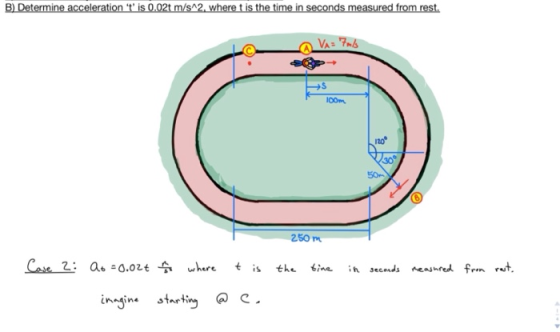
Distance to be traveled on straight track, d = 250 m
Now,
radius of the curvature, r = 50 m
From figure we can see angle covered is 120
Thus, distance to be traveled on curved path, d' =
(120/360)*2**r
= 1/3*2*3.14*50
= 104.66 m
Thus, total distance traveled, x = d + d' = 250 + 104.66
= 354.66 m
As we have,
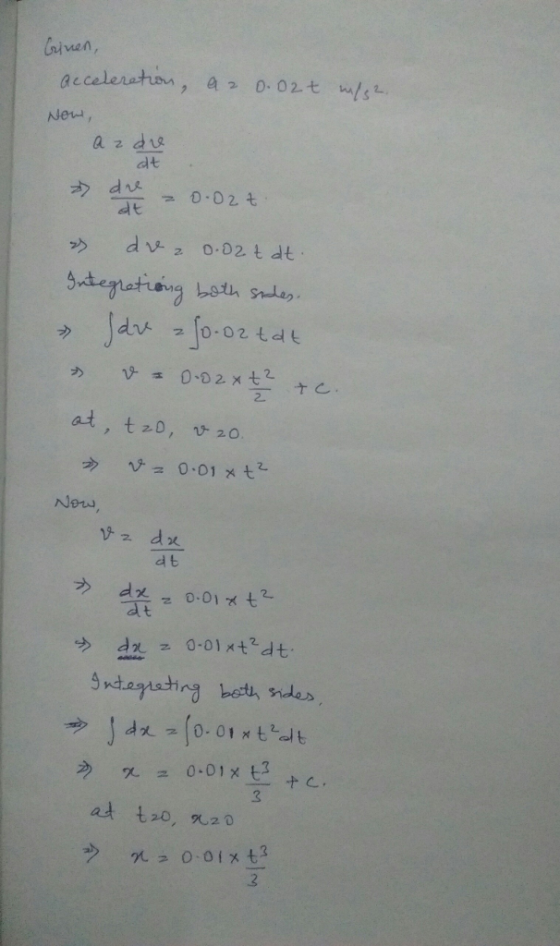
=> x = 0.0033 * t3
=> 354.66 = 0.0033 * t3
=> t3 = 354.66 / 0.0033 = 107472.7
=> t =
= 47.54 s
Now,
v = 0.01 * t2 = 0.01 * 47.542
= 22.6 m/s
and
a = 0.02*t = 0.02 * 47.54
= 0.95 m/s2
Add Answer to:
at = 0.02 m/s^2 where t is the time in seconds measured from
rest. Imagine starting...
A) Starting from rest, you accelerate at 6.0 m/s/s for 5 seconds. You then travel at...
A) Starting from rest, you accelerate at 6.0 m/s/s for 5 seconds. You then travel at constant speed for 10 seconds. What is the constant velocity you are moving at after 5 seconds? B) Starting from rest, you accelerate at 6.0 m/s/s for 5 seconds. You then travel at constant speed for 10 seconds. How far did you travel over the 15 seconds?
Not sure if these are right 2· The e motion of a particle is modelled by the equation s(e) 5+9t-6t2+t3, where s is measured in metres and t is time in seconds. a) When is the particle at rest? (2)...
 Not
sure if these are right
2· The e motion of a particle is modelled by the equation s(e) 5+9t-6t2+t3, where s is measured in metres and t is time in seconds. a) When is the particle at rest? (2) (3) When is the particle moving in a positive direction? b) vct) -124+30 Ct-1 Ct d-9-12t t3t2 ve) c) Draw a diagram to show the motion of the particle with respect to a distance axis, Indicate key time values Determine...
Not
sure if these are right
2· The e motion of a particle is modelled by the equation s(e) 5+9t-6t2+t3, where s is measured in metres and t is time in seconds. a) When is the particle at rest? (2) (3) When is the particle moving in a positive direction? b) vct) -124+30 Ct-1 Ct d-9-12t t3t2 ve) c) Draw a diagram to show the motion of the particle with respect to a distance axis, Indicate key time values Determine...
f(t), where s is measured in meters and t in seconds. Find the velocity and speed...
 f(t), where s is measured in meters and t in seconds. Find the velocity and speed when t = 3 A particle moves along a straight line with equation of motion s f(t) = 8030t - 4.5t2 velocity m/s speed m/s
f(t), where s is measured in meters and t in seconds. Find the velocity and speed when t = 3 A particle moves along a straight line with equation of motion s f(t) = 8030t - 4.5t2 velocity m/s...
f(t), where s is measured in meters and t in seconds. Find the velocity and speed when t = 3 A particle moves along a straight line with equation of motion s f(t) = 8030t - 4.5t2 velocity m/s speed m/s
f(t), where s is measured in meters and t in seconds. Find the velocity and speed when t = 3 A particle moves along a straight line with equation of motion s f(t) = 8030t - 4.5t2 velocity m/s...
A train leaves a station, starting from rest, at time t=0s. At time t= 36 s,...
 A train leaves a station, starting from rest, at time t=0s. At time t= 36 s, the train is traveling due west at 8 m/s. In this example, the 8 m/s is the train's instantaneous acceleration O average acceleration average velocity O instantaneous velocity average speed
The function s(t)=ť - 12t - 9 gives the distance from a starting point at time...
 The function s(t)=ť - 12t - 9 gives the distance from a starting point at time t of a particle moving along a line. Find the velocity and acceleration functions. Then find the velocity and acceleration at t= 0 and t=3. Assume that time is measured in seconds and distance is measured in centimeters. Velocity will be in centimeters per second (cm/sec) and acceleration in centimeters per second per second (cm/sec2). The velocity function is v(t) = (Simplify your answer.)
Using a time step of 0.02 seconds, find the momentum and position of the block 0.04...
 Using a time step of 0.02 seconds, find the momentum and
position of the block 0.04 seconds. Show all your work!
Problem: A block of mass M 10 kg is attached by a spring with stiffness ks 120 N/m to the wall at the top of a slippery ramp as shown in the figure. The spring's relaxed length is Lo 1 m. Use g 10 m/s2, if it is needed. At time t 0 the spring's length is L 2...
Using a time step of 0.02 seconds, find the momentum and
position of the block 0.04 seconds. Show all your work!
Problem: A block of mass M 10 kg is attached by a spring with stiffness ks 120 N/m to the wall at the top of a slippery ramp as shown in the figure. The spring's relaxed length is Lo 1 m. Use g 10 m/s2, if it is needed. At time t 0 the spring's length is L 2...
Starting from rest, a car accelerates at a constant rate of 2.6 m/s2 for a time...
Starting from rest, a car accelerates at a constant rate of 2.6 m/s2 for a time of 5 seconds. (a) Compute the velocity at 1 second? (b) Compute the velocity at 2 seconds? (c) Compute the velocity at 3 seconds? (d) Compute the velocity at 4 seconds? (e) Compute the velocity at 5 seconds? (f) Compute the distance traveled at 1 second? (g) Compute the distance traveled at 2 seconds? (h) Compute the distance traveled at 3 seconds? (i) Compute...
1) The velocity of a moving device is measured to be V(t) = t² + 3t...
1) The velocity of a moving device is measured to be V(t) = t² + 3t + 1, where t is time in seconds and the velocity is in m/s. Starting from t = 0 s, how far has the device moved after 1 min, in m? Provide your answer to one decimal place, and make sure to include units. 2) The velocity of a moving device is measured to be V(t) = t² + 3t + 1, where t...
The velocity ofa particle is defined by v (-2i+(3-20A, m/s where t is in seconds. If...
 The velocity ofa particle is defined by v (-2i+(3-20A, m/s where t is in seconds. If r 0 when t 0, determine the displacement of the particle during the time interval t As (-8/-4A, m As (-6i+-6A. m As (-10/-2A.m As-(-4, m 1 s and t 4 s. A motor gives a disk A an angular acceleration of aA (2t+3) rads, where t is in seconds. If the inidal angular velocity of the disk is Dg 5 rads, determine the...
An object velocity is measured to be v_x(t) = alpha -beta^2, where alpha = 4.00 m/s...
 An object velocity is measured to be v_x(t) = alpha -beta^2, where alpha = 4.00 m/s and beta = 2.00 m/s^2. At t = 0 the object is at x = 0. Calculate the object's position as a function of time. Calculate the object's acceleration as a function of time.
 Not
sure if these are right
2· The e motion of a particle is modelled by the equation s(e) 5+9t-6t2+t3, where s is measured in metres and t is time in seconds. a) When is the particle at rest? (2) (3) When is the particle moving in a positive direction? b) vct) -124+30 Ct-1 Ct d-9-12t t3t2 ve) c) Draw a diagram to show the motion of the particle with respect to a distance axis, Indicate key time values Determine...
Not
sure if these are right
2· The e motion of a particle is modelled by the equation s(e) 5+9t-6t2+t3, where s is measured in metres and t is time in seconds. a) When is the particle at rest? (2) (3) When is the particle moving in a positive direction? b) vct) -124+30 Ct-1 Ct d-9-12t t3t2 ve) c) Draw a diagram to show the motion of the particle with respect to a distance axis, Indicate key time values Determine...
 f(t), where s is measured in meters and t in seconds. Find the velocity and speed when t = 3 A particle moves along a straight line with equation of motion s f(t) = 8030t - 4.5t2 velocity m/s speed m/s
f(t), where s is measured in meters and t in seconds. Find the velocity and speed when t = 3 A particle moves along a straight line with equation of motion s f(t) = 8030t - 4.5t2 velocity m/s...
f(t), where s is measured in meters and t in seconds. Find the velocity and speed when t = 3 A particle moves along a straight line with equation of motion s f(t) = 8030t - 4.5t2 velocity m/s speed m/s
f(t), where s is measured in meters and t in seconds. Find the velocity and speed when t = 3 A particle moves along a straight line with equation of motion s f(t) = 8030t - 4.5t2 velocity m/s...
 A train leaves a station, starting from rest, at time t=0s. At time t= 36 s, the train is traveling due west at 8 m/s. In this example, the 8 m/s is the train's instantaneous acceleration O average acceleration average velocity O instantaneous velocity average speed
 The function s(t)=ť - 12t - 9 gives the distance from a starting point at time t of a particle moving along a line. Find the velocity and acceleration functions. Then find the velocity and acceleration at t= 0 and t=3. Assume that time is measured in seconds and distance is measured in centimeters. Velocity will be in centimeters per second (cm/sec) and acceleration in centimeters per second per second (cm/sec2). The velocity function is v(t) = (Simplify your answer.)
 Using a time step of 0.02 seconds, find the momentum and
position of the block 0.04 seconds. Show all your work!
Problem: A block of mass M 10 kg is attached by a spring with stiffness ks 120 N/m to the wall at the top of a slippery ramp as shown in the figure. The spring's relaxed length is Lo 1 m. Use g 10 m/s2, if it is needed. At time t 0 the spring's length is L 2...
Using a time step of 0.02 seconds, find the momentum and
position of the block 0.04 seconds. Show all your work!
Problem: A block of mass M 10 kg is attached by a spring with stiffness ks 120 N/m to the wall at the top of a slippery ramp as shown in the figure. The spring's relaxed length is Lo 1 m. Use g 10 m/s2, if it is needed. At time t 0 the spring's length is L 2...
 The velocity ofa particle is defined by v (-2i+(3-20A, m/s where t is in seconds. If r 0 when t 0, determine the displacement of the particle during the time interval t As (-8/-4A, m As (-6i+-6A. m As (-10/-2A.m As-(-4, m 1 s and t 4 s. A motor gives a disk A an angular acceleration of aA (2t+3) rads, where t is in seconds. If the inidal angular velocity of the disk is Dg 5 rads, determine the...
 An object velocity is measured to be v_x(t) = alpha -beta^2, where alpha = 4.00 m/s and beta = 2.00 m/s^2. At t = 0 the object is at x = 0. Calculate the object's position as a function of time. Calculate the object's acceleration as a function of time.
Most questions answered within 3 hours.
-
Where is the error in this code sequence?
String s1 = "Hello";
String s2 = "ello";...
asked 10 months ago -
Financial data for Joel de Paris, Inc., for last year
follow:
Joel de Paris, Inc.
Balance...
asked 10 months ago -
Consider this reaction:
Al2(SO4)3 (aq)+ BaCl3
(aq) Al2Cl6 (aq)- +
3BaSO4(s) . What is the...
asked 10 months ago -
Suppose that Savneet is considering increasing her
recent random sample from 20 car rentals to 40...
asked 10 months ago -
Trucks arrive at an unloading terminal at an average rate of 120
per hour.
Trucks arrive...
asked 10 months ago -
Why are methanol and ethanol completely soluble in water while
octanol is not very little soluble....
asked 10 months ago -
A facilities manager at a university reads in a research report
that the mean amount of...
asked 10 months ago -
When the CuSO4 is rehydrated by adding water to the anhydrous
compound, is this an endothermic...
asked 10 months ago -
A ray of sunlight is passing from diamond into crown glass; the
angle of incidence is...
asked 10 months ago -
A block of mass 0.249 kg is placed on top of a light, vertical
spring of...
asked 10 months ago -
how do the kidneys compensate in the presences of acidosis
a) trigger hyperventilate
b) reserve acid...
asked 10 months ago -
Question 501 pts
The rental rate of capital to the firm increases. Which of the
following...
asked 10 months ago