
Homework Answers
Add Answer to:
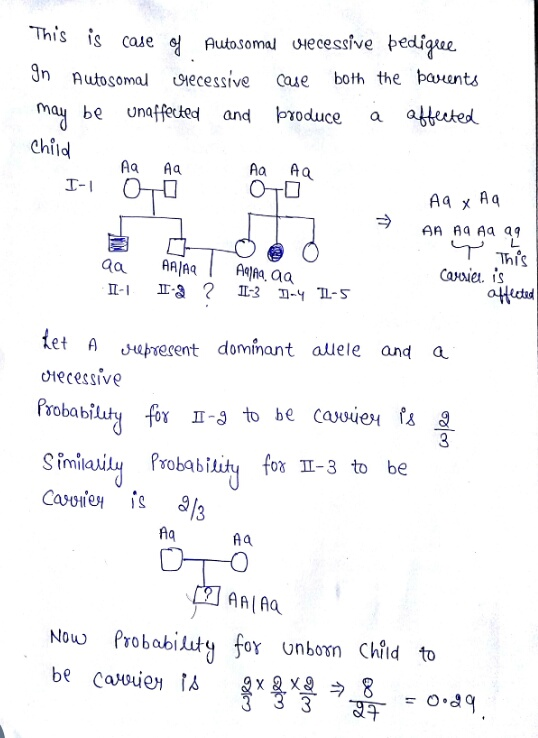
The following pedigree corresponds to a family affected by a rare autosomal recessive condition. What is...
A rare autosomal dominant condition affects the following family pedigree. What is the probability that the...
 A rare autosomal dominant condition affects the following family pedigree. What is the probability that the unborn child marked with the question mark is affected by the condition? Express the answer as a decimal fraction with two digits after the decimal point. Do not round the fraction. (i.e 1/3 = 0.33) Answer:
11. A rare autosomal dominant condition affects the following family pedigree
 11. A rare autosomal dominant condition affects the following family pedigree. What is the probability that the unborn child marked with the question mark is affected by the condition? Express the answer as a decimal fraction with two digits after the decimal point. Do not round the fraction. (.e 1/3 = 0.27) 12. Which of the following is not a necessary step in lytic bacteriophage infection cycle? Select one: a. Injection of the viral genome b. Viral protein is synthesized by the host cell c. The...
Comparing the HIV virus to the phages discussed in class...
 49.Comparing the HIV virus to the phages discussed in class... Select one: a. Phages can infect eukaryotes broadly, while HIV infects humans alone b. Both HIV and phages are encapsulated viruses that have phospholipid membranes surrounding their protein capsids c. HIV uses glycosylated, host-derived proteins, while phages use protein spikes, to interact with their host cells facilitating infection d. In the extracellular space, both HIV and phages utilize DNA as their genetic material e. HIV and virulent phages are capable of integrating into their respective host's...
A pedigree affected by a rare human autosomal recessive trait is shown below. ODO What is...
 A pedigree affected by a rare human autosomal recessive trait is shown below. ODO What is the probability that III-2 is a carrier? (enter your answer as a percentage; if the answer is 83% enter 83) Answer:
The given image shows the pedigree of a family with an autosomal recessive disorder. Analyze the...
 The given image shows the pedigree of a family with an autosomal
recessive disorder. Analyze the pedigree to determine the
probability of individual 12 being a carrier. Please write your
answer as a probability from 0 to 1. Probability:
The given image shows the pedigree of a family with an autosomal
recessive disorder. Analyze the pedigree to determine the
probability of individual 12 being a carrier. Please write your
answer as a probability from 0 to 1. Probability:
if 1/40,000 individuals are affected by an autosomal recessive disorder in a population in HWE, what is the probability a carrier and someone with no family history will have an affected child?
if 1/40,000 individuals are affected by an autosomal recessive disorder in a population in HWE, what is the probability a carrier and someone with no family history will have an affected child?
if 1/40,000 individuals are affected by an autosomal recessive disorder in a population in HWE, what...
if 1/40,000 individuals are affected by an autosomal recessive disorder in a population in HWE, what is the probability a carrier and someone with no family history will have an affected child?
Question 3 The following human pedigree shows a family affected by a specific disease. Assume that...
 Question 3 The following human pedigree shows a family affected by a specific disease. Assume that the individuals marked with an asterisk () do not carry any allele associated with the affected phenotype and that no other mutation spontaneously occurs. Also assume complete penetrance a) State the most likely mode of inheritance for this disease. Choose from: autosomal dominant, autosomal recessive, X-linked dominant, X-linked recessive b) Write all possible genotypes of the following individuals in the pedigree. Use the uppercase...
5) An exceedingly rare genetic condition known as congenital generalized hypertrichosis leads to excessive facial and...
5) An exceedingly rare genetic condition known as congenital generalized hypertrichosis leads to excessive facial and body hair. a) Suppose you are a genetic counselor whose client, a woman, has this condition. In the course of your interview, you learn that her sister and her father have similar symptoms, but neither her mother nor any of her four brothers has the disease. Draw a pedigree for this family. b) Based on the available information, decide whether this disease is dominant...
Consider the following pedigree of a rare X-linked recessive disease. a) If individuals A and B...
 Consider the following pedigree of a rare X-linked recessive disease. a) If individuals A and B have a child, what is the probability that the child will have the disease? b) If individuals C and D have a child, what is the probability that the child will have the disease? c) If the first child of C and D is normal, what is the probability that their second child will have the disease? d) If the first child of C...
 A rare autosomal dominant condition affects the following family pedigree. What is the probability that the unborn child marked with the question mark is affected by the condition? Express the answer as a decimal fraction with two digits after the decimal point. Do not round the fraction. (i.e 1/3 = 0.33) Answer:
 A pedigree affected by a rare human autosomal recessive trait is shown below. ODO What is the probability that III-2 is a carrier? (enter your answer as a percentage; if the answer is 83% enter 83) Answer:
 The given image shows the pedigree of a family with an autosomal
recessive disorder. Analyze the pedigree to determine the
probability of individual 12 being a carrier. Please write your
answer as a probability from 0 to 1. Probability:
The given image shows the pedigree of a family with an autosomal
recessive disorder. Analyze the pedigree to determine the
probability of individual 12 being a carrier. Please write your
answer as a probability from 0 to 1. Probability:
 Question 3 The following human pedigree shows a family affected by a specific disease. Assume that the individuals marked with an asterisk () do not carry any allele associated with the affected phenotype and that no other mutation spontaneously occurs. Also assume complete penetrance a) State the most likely mode of inheritance for this disease. Choose from: autosomal dominant, autosomal recessive, X-linked dominant, X-linked recessive b) Write all possible genotypes of the following individuals in the pedigree. Use the uppercase...
 Consider the following pedigree of a rare X-linked recessive disease. a) If individuals A and B have a child, what is the probability that the child will have the disease? b) If individuals C and D have a child, what is the probability that the child will have the disease? c) If the first child of C and D is normal, what is the probability that their second child will have the disease? d) If the first child of C...
Most questions answered within 3 hours.
-
Where is the error in this code sequence?
String s1 = "Hello";
String s2 = "ello";...
asked 11 months ago -
Financial data for Joel de Paris, Inc., for last year
follow:
Joel de Paris, Inc.
Balance...
asked 11 months ago -
Consider this reaction:
Al2(SO4)3 (aq)+ BaCl3
(aq) Al2Cl6 (aq)- +
3BaSO4(s) . What is the...
asked 11 months ago -
Suppose that Savneet is considering increasing her
recent random sample from 20 car rentals to 40...
asked 11 months ago -
Trucks arrive at an unloading terminal at an average rate of 120
per hour.
Trucks arrive...
asked 11 months ago -
Why are methanol and ethanol completely soluble in water while
octanol is not very little soluble....
asked 11 months ago -
A facilities manager at a university reads in a research report
that the mean amount of...
asked 11 months ago -
When the CuSO4 is rehydrated by adding water to the anhydrous
compound, is this an endothermic...
asked 11 months ago -
A ray of sunlight is passing from diamond into crown glass; the
angle of incidence is...
asked 11 months ago -
A block of mass 0.249 kg is placed on top of a light, vertical
spring of...
asked 11 months ago -
how do the kidneys compensate in the presences of acidosis
a) trigger hyperventilate
b) reserve acid...
asked 11 months ago -
Question 501 pts
The rental rate of capital to the firm increases. Which of the
following...
asked 11 months ago