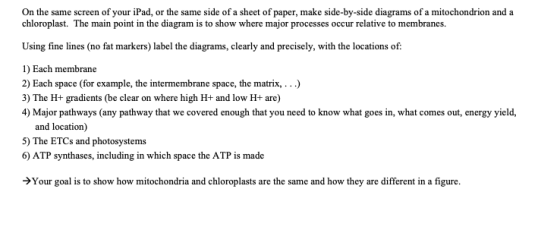
Be DETAILED and show everything that needs to be labeled and included.
Homework Answers
Okay, let us describe a bit and then present the diagrams.
Both organelles have 2 membranes and both of them undergo the electron transport chain in the inner membrane, in the case of mitochondria it is just called inner membrane but in chloroplast it is called thylakoid membrane and the photosystems are embedded in it.
In both of them, the intermembrane space is the one with the highest proton concentration in mitochondria, but in chloroplast this space is called stroma and the highest concentration is not in here but inside the inner membrane that is called lumen. The lumen of the chloroplast is equivalent to the mitochondria matrix, but in the case of mitochondria the matrix has the lower proton concentration.
Mitochondria undergoes Krebs cycle (occurs in matrix) and Electron Transport Chain (occurs in the inner membrane), while chloroplast undergoes photophosphorylation (occurs in the thylakoid membrane) and calvin benson cycle (occurs in stroma).
The mitochondria produces ATP into the matrix, while chloroplast produces ATP into the stroma.
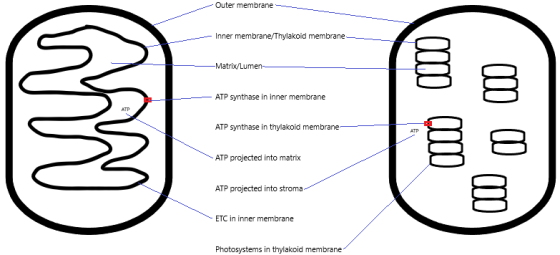
This is how the diagram looks. They do very similar/equivalent processes but they are kind of inverted to each other in terms of positions and locations
Add Answer to:
Be DETAILED and show everything that needs to be labeled and
included.
On the same screen...
On the same screen of your iPad, or the same side of a sheet of paper,...
 On the same screen of your iPad, or the same side of a sheet of paper, make side-by-side diagrams of a mitochondrion and a chloroplast. The main point in the diagram is to show where major processes occur relative to membranes. Using fine lines (no fat markers) label the diagrams, clearly and precisely, with the locations of: 1) Each membrane 2) Each space (for example, the intermembrane space, the matrix, ...) 3) The H+ gradients (be clear on where high...
Please help me with ALL of these questions. Thank you so much Question 7 0.3 pts...
 Please help me with ALL of these questions. Thank you so
much
Question 7 0.3 pts The chloroplast is a membrane-bound organelle very similar to the mitochondrion. Both organelles are thought to have been acquired through an endosymbiotic event where a bacterium was engulfed by an ancestral eukaryotic cell and accidentally retained over evolutionary time and evolved into specialized organelles. Which area of the chloroplast is most similar to the inner membrane of the mitochondria such that both areas in...
Please help me with ALL of these questions. Thank you so
much
Question 7 0.3 pts The chloroplast is a membrane-bound organelle very similar to the mitochondrion. Both organelles are thought to have been acquired through an endosymbiotic event where a bacterium was engulfed by an ancestral eukaryotic cell and accidentally retained over evolutionary time and evolved into specialized organelles. Which area of the chloroplast is most similar to the inner membrane of the mitochondria such that both areas in...
please label important parts. Cellular Respiration begins with biologycomer.com GLYCOLYSIS PYRUVATE FERMENTATION OXYGEN KREB'S CYCLE GLUCOSE...
 please label important parts.
Cellular Respiration begins with biologycomer.com GLYCOLYSIS PYRUVATE FERMENTATION OXYGEN KREB'S CYCLE GLUCOSE ETHANOL ACETYL-COA MITOCHONDRIAL MATRIX LACTIC ACID MITOCHONDRIAL CHRISTAE CARBON DIOXIDE CYTOPLASM ELECTRON TRANSPORT CHAIN ATP SNADH 2 FAOH 2 ATP 2 NADH 36 ATP which is broken down during which occurs in the 0 9900 30 coerrymes produces a net gain of results in 2 molecules of produces O in the can be used in that is used in requires releases which is oxidized,...
please label important parts.
Cellular Respiration begins with biologycomer.com GLYCOLYSIS PYRUVATE FERMENTATION OXYGEN KREB'S CYCLE GLUCOSE ETHANOL ACETYL-COA MITOCHONDRIAL MATRIX LACTIC ACID MITOCHONDRIAL CHRISTAE CARBON DIOXIDE CYTOPLASM ELECTRON TRANSPORT CHAIN ATP SNADH 2 FAOH 2 ATP 2 NADH 36 ATP which is broken down during which occurs in the 0 9900 30 coerrymes produces a net gain of results in 2 molecules of produces O in the can be used in that is used in requires releases which is oxidized,...
The inner membrane divides the mitochondrion into two internal compartments. The first compartment is the and...
 The inner membrane divides the mitochondrion into two internal compartments. The first compartment is the and outer membranes. The inner membrane encloses the mitochondrial mitochondrial DNA, ribosomes, and enzymes. Some of the metabolic steps of cellular respiration are catalyzed by enzymes in the matrix. Other proteins that function in respiration, including the enzyme that makes ATP, are built into the inner membrane. The highly folded cristae present a region between the inner space, a narrow a fluid-filled space with surface...
22. Lipids would produce with the carbohydrate of same weight. energy compared (a) more (b) less...
 22. Lipids would produce with the carbohydrate of same weight. energy compared (a) more (b) less c) the same amount 23. Where are the proteins of electron-transport chain located in mitochondria for the cellular respiration? (a) matrix (c) inner membrane (b) outer membrane (d) both membranes 24. The flow of protons during the light reaction of photosynthesis is from thylakoid space to stroma and back to thylakoid space through the ATPase? (a) True (b) False 25. Which of the following...
mestion Completion Status: Why did I suggest that the secret to life is electrons and protons?...
 mestion Completion Status: Why did I suggest that the secret to life is electrons and protons? A. Because redox reactions are necessary for all of the reactions in live cells and these redox reactions require both H+ and electrons B. Because electrons carry a negative charge and protons have a positive charge C. Because most (not all) cells need electron transport and H+ gradients to make ATP D. Because electrons are necessary for the electrical responses of the cell (like...
Cellular Metabolism Lab We will walk through the steps of Cellular Respiration in this activity. Please...
Cellular Metabolism Lab We will walk through the steps of Cellular Respiration in this activity. Please do not skip ahead or leave out steps. Fully taking the time to cut out, arrange the shapes, and answer the attached questions will help you to gain a deeper understanding of cellular respiration (the process of making energy, ATP, the major contributor to our overall metabolism). Pages 941-948 in you TEXTBOOK should help you answer the questions. Grading Notes: You can either 1)...
PLEASE INCLUDE THE LETTER ANSWER WITH THE EXPLANATION 1. 2. 3. 4. 5. 6. 7. 8....
 PLEASE INCLUDE THE LETTER ANSWER WITH THE EXPLANATION
1.
2. 3. 4. 5. 6.
7. 8. 9. 10.
Where in a mitochondrion is the proton gradient the smallest? o é o Across the outer mitochondrial membrane At the tips of the cristae furthest from the outer mitochondrial membrane At those parts of the cristae that are closest to the outer mitochondrial membrane There are no proton gradients in a mitochondrion Between the thylakoid lumen and the matrix o o The...
PLEASE INCLUDE THE LETTER ANSWER WITH THE EXPLANATION
1.
2. 3. 4. 5. 6.
7. 8. 9. 10.
Where in a mitochondrion is the proton gradient the smallest? o é o Across the outer mitochondrial membrane At the tips of the cristae furthest from the outer mitochondrial membrane At those parts of the cristae that are closest to the outer mitochondrial membrane There are no proton gradients in a mitochondrion Between the thylakoid lumen and the matrix o o The...
FILL THE BLANK The membranes of fishes that live in extreme cold have a high proportion...
FILL THE BLANK The membranes of fishes that live in extreme cold have a high proportion of _________________ hydrocarbon tails, enabling them to stay fluid.For example, cold-adapted organisms such as winter wheat increase the percentage of _________________ phospholipids in their membranes in the autumn to prevent the membranes from solidifying during winter.There are two major populations of membrane proteins: ___________ and _____________.Integral proteins penetrate the hydrophobic interior of the lipid bilayer, usually completely spanning the membrane as ________________ proteins.________________ proteins...
9 ) When viewed with an electron microscope, what gives the rough Endoplasmic Reticulum its rough...
9 ) When viewed with an electron microscope, what gives the rough Endoplasmic Reticulum its rough appearance? A) The nucleus B) Mitochondria C) Nucleosomes D) Ribosomes E)sugars 10 ) Which statement below describes the function of smooth endoplasmic reticulum? A) Packing and sorting of newly synthesized macromolecules B) Protein Synthesis C) Cellular Respiration D) Detoxification and hydrolysis of polysaccharide E) Photosynthesis 11 ) If a cell is in a hypotonic environment that means…….. Protein synthesis The solute concentration inside...
 On the same screen of your iPad, or the same side of a sheet of paper, make side-by-side diagrams of a mitochondrion and a chloroplast. The main point in the diagram is to show where major processes occur relative to membranes. Using fine lines (no fat markers) label the diagrams, clearly and precisely, with the locations of: 1) Each membrane 2) Each space (for example, the intermembrane space, the matrix, ...) 3) The H+ gradients (be clear on where high...
 Please help me with ALL of these questions. Thank you so
much
Question 7 0.3 pts The chloroplast is a membrane-bound organelle very similar to the mitochondrion. Both organelles are thought to have been acquired through an endosymbiotic event where a bacterium was engulfed by an ancestral eukaryotic cell and accidentally retained over evolutionary time and evolved into specialized organelles. Which area of the chloroplast is most similar to the inner membrane of the mitochondria such that both areas in...
Please help me with ALL of these questions. Thank you so
much
Question 7 0.3 pts The chloroplast is a membrane-bound organelle very similar to the mitochondrion. Both organelles are thought to have been acquired through an endosymbiotic event where a bacterium was engulfed by an ancestral eukaryotic cell and accidentally retained over evolutionary time and evolved into specialized organelles. Which area of the chloroplast is most similar to the inner membrane of the mitochondria such that both areas in...
 please label important parts.
Cellular Respiration begins with biologycomer.com GLYCOLYSIS PYRUVATE FERMENTATION OXYGEN KREB'S CYCLE GLUCOSE ETHANOL ACETYL-COA MITOCHONDRIAL MATRIX LACTIC ACID MITOCHONDRIAL CHRISTAE CARBON DIOXIDE CYTOPLASM ELECTRON TRANSPORT CHAIN ATP SNADH 2 FAOH 2 ATP 2 NADH 36 ATP which is broken down during which occurs in the 0 9900 30 coerrymes produces a net gain of results in 2 molecules of produces O in the can be used in that is used in requires releases which is oxidized,...
please label important parts.
Cellular Respiration begins with biologycomer.com GLYCOLYSIS PYRUVATE FERMENTATION OXYGEN KREB'S CYCLE GLUCOSE ETHANOL ACETYL-COA MITOCHONDRIAL MATRIX LACTIC ACID MITOCHONDRIAL CHRISTAE CARBON DIOXIDE CYTOPLASM ELECTRON TRANSPORT CHAIN ATP SNADH 2 FAOH 2 ATP 2 NADH 36 ATP which is broken down during which occurs in the 0 9900 30 coerrymes produces a net gain of results in 2 molecules of produces O in the can be used in that is used in requires releases which is oxidized,...
 The inner membrane divides the mitochondrion into two internal compartments. The first compartment is the and outer membranes. The inner membrane encloses the mitochondrial mitochondrial DNA, ribosomes, and enzymes. Some of the metabolic steps of cellular respiration are catalyzed by enzymes in the matrix. Other proteins that function in respiration, including the enzyme that makes ATP, are built into the inner membrane. The highly folded cristae present a region between the inner space, a narrow a fluid-filled space with surface...
 22. Lipids would produce with the carbohydrate of same weight. energy compared (a) more (b) less c) the same amount 23. Where are the proteins of electron-transport chain located in mitochondria for the cellular respiration? (a) matrix (c) inner membrane (b) outer membrane (d) both membranes 24. The flow of protons during the light reaction of photosynthesis is from thylakoid space to stroma and back to thylakoid space through the ATPase? (a) True (b) False 25. Which of the following...
 mestion Completion Status: Why did I suggest that the secret to life is electrons and protons? A. Because redox reactions are necessary for all of the reactions in live cells and these redox reactions require both H+ and electrons B. Because electrons carry a negative charge and protons have a positive charge C. Because most (not all) cells need electron transport and H+ gradients to make ATP D. Because electrons are necessary for the electrical responses of the cell (like...
 PLEASE INCLUDE THE LETTER ANSWER WITH THE EXPLANATION
1.
2. 3. 4. 5. 6.
7. 8. 9. 10.
Where in a mitochondrion is the proton gradient the smallest? o é o Across the outer mitochondrial membrane At the tips of the cristae furthest from the outer mitochondrial membrane At those parts of the cristae that are closest to the outer mitochondrial membrane There are no proton gradients in a mitochondrion Between the thylakoid lumen and the matrix o o The...
PLEASE INCLUDE THE LETTER ANSWER WITH THE EXPLANATION
1.
2. 3. 4. 5. 6.
7. 8. 9. 10.
Where in a mitochondrion is the proton gradient the smallest? o é o Across the outer mitochondrial membrane At the tips of the cristae furthest from the outer mitochondrial membrane At those parts of the cristae that are closest to the outer mitochondrial membrane There are no proton gradients in a mitochondrion Between the thylakoid lumen and the matrix o o The...
Most questions answered within 3 hours.
-
Where is the error in this code sequence?
String s1 = "Hello";
String s2 = "ello";...
asked 10 months ago -
Financial data for Joel de Paris, Inc., for last year
follow:
Joel de Paris, Inc.
Balance...
asked 10 months ago -
Consider this reaction:
Al2(SO4)3 (aq)+ BaCl3
(aq) Al2Cl6 (aq)- +
3BaSO4(s) . What is the...
asked 10 months ago -
Suppose that Savneet is considering increasing her
recent random sample from 20 car rentals to 40...
asked 10 months ago -
Trucks arrive at an unloading terminal at an average rate of 120
per hour.
Trucks arrive...
asked 10 months ago -
Why are methanol and ethanol completely soluble in water while
octanol is not very little soluble....
asked 10 months ago -
A facilities manager at a university reads in a research report
that the mean amount of...
asked 10 months ago -
When the CuSO4 is rehydrated by adding water to the anhydrous
compound, is this an endothermic...
asked 10 months ago -
A ray of sunlight is passing from diamond into crown glass; the
angle of incidence is...
asked 10 months ago -
A block of mass 0.249 kg is placed on top of a light, vertical
spring of...
asked 10 months ago -
how do the kidneys compensate in the presences of acidosis
a) trigger hyperventilate
b) reserve acid...
asked 10 months ago -
Question 501 pts
The rental rate of capital to the firm increases. Which of the
following...
asked 10 months ago