
Homework Answers
Answer: Spinach
Among vegetables there are many of them are a good sources of catalase among them spinach is also one of them. Others ares broccoli, zucchini, carrots, cucumber, avacado etc. the spinach aslo contain other enzymes such as DPNH-glyoxylate reductase and glycolate oxidase.
Apples: It contains very least amount of catalase. While the apples are put in the peroxide it produces only few bubbles.
Yeast solution: The main source of enzyme called zymase which are responsible for the production of carbon dioxide and ethanol from sugar fermentation. The yeast contain mainly two types of enzyme called invertase ans maltase
Wheat germ: These have a lipase enzymatic activity which result in the shelf life reduction.
Add Answer to:
The source of the catalase for the enzyme experiment was wheat germ yeast solution spinach apples
In the DNA extraction lab the source for the DNA was spinach apples fresh yeast solution...
 In the DNA extraction lab the source for the DNA was spinach apples fresh yeast solution wheat germ
Why do certain fruits and vegetables have more catalase enzyme than others? Spinach followed by carrots...
Why do certain fruits and vegetables have more catalase enzyme than others? Spinach followed by carrots resulted in the most catalase from the following: cucumbers, bananas, oranges, strawberries, spinach, and carrots.
In a sample, you used 0.5 g of wheat germ in 5 ml of enzyme extraction...
In a sample, you used 0.5 g of wheat germ in 5 ml of enzyme extraction buffer (total volume of 5.5 mL). After homogenization and centrifugation,you used a 250 µl aliquot of the wheat germ extract to determine the amount of acid phosphatase present. You found that 3.2 µg of acid phosphatase was present in the 250 µl aliquot. First off, what is the concentration of acid phosphatase in your extract? 12.8 ug/uL 0.0128 ug/uL 0.00058 ug/uL 0.5 ug/mL How...
Putting catalase enzyme in a pH 12 solution will have no effect denature (break down/change the...
 Putting catalase enzyme in a pH 12 solution will have no effect denature (break down/change the shape of) the enzyme speed up the reaction rate of catalase
Putting catalase enzyme in a pH 12 solution will have no effect denature (break down/change the...
 Putting catalase enzyme in a pH 12 solution will have no effect denature (break down/change the shape of) the enzyme speed up the reaction rate of catalase
10. Catalase is an enzyme that breaks down hydrogen peroxide into water and oxygen. A solution...
 10. Catalase is an enzyme that breaks down hydrogen peroxide into water and oxygen. A solution containing catalase would show a positive result when: * O The solution is tested using the grease spot test O Biuret's reagent is added to the solution O Ninhydrin is added to the solution O Lugol's lodine is added to the solution O Benedict's reagent is added to the solution O This is a required question
Experiment 2 – The effect of temperature on the activity of catalase In this lab you...
Experiment 2 – The effect of temperature on the activity of catalase In this lab you will determine the effect of temperature on catalase activity Materials Yeast Measuring spoon 2 clean test-tubes hydrogen peroxide solution 10 ml graduated cylinder 2 balloons 1 beakers Permanent marker and tape / wax pencil stopwatch or timer crushed ice in a beaker/bowl Thermometer Procedure With a permanent marker, label tubes 1- 2. Fill each tube with 10 ml hydrogen peroxide. Place tube 1...
1 of 1 Part D-A typical enzyme experiment A common enzyme studied in many introductory biology...
 1 of 1 Part D-A typical enzyme experiment A common enzyme studied in many introductory biology labs is catalase, which is found in high concentration in most cells, promoting the decomposition of hydrogen peroxide (H2O2) Hydrogen peroxide is formed as a by-product of chemical reactions and would soon kill cells if not immediately removed or broken down into its products--water and oxygen-as shown by the following equation Catalase 2 H2O, → 2 H2O + 0, You may be familiar with...
Please Help!!! The researchers set up the following experiment: 1. Each yeast strain is diluted in...
 Please Help!!!
The researchers set up the following experiment: 1. Each yeast strain is diluted in phosphate buffer solution so that there is the same concentration 2. Lysis buffer, which dissolves the cell membrane and releases the cytosol into the solution, is 3. ONPG is added to each tube. After 15 minutes, the researchers use a spectrophotometer to 4. The Ago is used to calculate the Activity Units of each tube, measured in velocity/mL. Activity of cells in each tube....
Please Help!!!
The researchers set up the following experiment: 1. Each yeast strain is diluted in phosphate buffer solution so that there is the same concentration 2. Lysis buffer, which dissolves the cell membrane and releases the cytosol into the solution, is 3. ONPG is added to each tube. After 15 minutes, the researchers use a spectrophotometer to 4. The Ago is used to calculate the Activity Units of each tube, measured in velocity/mL. Activity of cells in each tube....
An experiment was conducted to investigate enzyme activity. A small quantity of amylase solution was added...
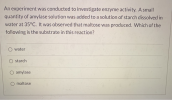 An experiment was conducted to investigate enzyme activity. A small quantity of amylase solution was added to a solution of starch dissolved in water at 35°C. It was observed that maltose was produced. Which of the following is the substrate in this reaction? water O starch O amylase O maltose
 In the DNA extraction lab the source for the DNA was spinach apples fresh yeast solution wheat germ
 Putting catalase enzyme in a pH 12 solution will have no effect denature (break down/change the shape of) the enzyme speed up the reaction rate of catalase
 Putting catalase enzyme in a pH 12 solution will have no effect denature (break down/change the shape of) the enzyme speed up the reaction rate of catalase
 10. Catalase is an enzyme that breaks down hydrogen peroxide into water and oxygen. A solution containing catalase would show a positive result when: * O The solution is tested using the grease spot test O Biuret's reagent is added to the solution O Ninhydrin is added to the solution O Lugol's lodine is added to the solution O Benedict's reagent is added to the solution O This is a required question
 1 of 1 Part D-A typical enzyme experiment A common enzyme studied in many introductory biology labs is catalase, which is found in high concentration in most cells, promoting the decomposition of hydrogen peroxide (H2O2) Hydrogen peroxide is formed as a by-product of chemical reactions and would soon kill cells if not immediately removed or broken down into its products--water and oxygen-as shown by the following equation Catalase 2 H2O, → 2 H2O + 0, You may be familiar with...
 Please Help!!!
The researchers set up the following experiment: 1. Each yeast strain is diluted in phosphate buffer solution so that there is the same concentration 2. Lysis buffer, which dissolves the cell membrane and releases the cytosol into the solution, is 3. ONPG is added to each tube. After 15 minutes, the researchers use a spectrophotometer to 4. The Ago is used to calculate the Activity Units of each tube, measured in velocity/mL. Activity of cells in each tube....
Please Help!!!
The researchers set up the following experiment: 1. Each yeast strain is diluted in phosphate buffer solution so that there is the same concentration 2. Lysis buffer, which dissolves the cell membrane and releases the cytosol into the solution, is 3. ONPG is added to each tube. After 15 minutes, the researchers use a spectrophotometer to 4. The Ago is used to calculate the Activity Units of each tube, measured in velocity/mL. Activity of cells in each tube....
 An experiment was conducted to investigate enzyme activity. A small quantity of amylase solution was added to a solution of starch dissolved in water at 35°C. It was observed that maltose was produced. Which of the following is the substrate in this reaction? water O starch O amylase O maltose
Most questions answered within 3 hours.
-
Where is the error in this code sequence?
String s1 = "Hello";
String s2 = "ello";...
asked 11 months ago -
Financial data for Joel de Paris, Inc., for last year
follow:
Joel de Paris, Inc.
Balance...
asked 11 months ago -
Consider this reaction:
Al2(SO4)3 (aq)+ BaCl3
(aq) Al2Cl6 (aq)- +
3BaSO4(s) . What is the...
asked 11 months ago -
Suppose that Savneet is considering increasing her
recent random sample from 20 car rentals to 40...
asked 11 months ago -
Trucks arrive at an unloading terminal at an average rate of 120
per hour.
Trucks arrive...
asked 11 months ago -
Why are methanol and ethanol completely soluble in water while
octanol is not very little soluble....
asked 11 months ago -
A facilities manager at a university reads in a research report
that the mean amount of...
asked 11 months ago -
When the CuSO4 is rehydrated by adding water to the anhydrous
compound, is this an endothermic...
asked 11 months ago -
A ray of sunlight is passing from diamond into crown glass; the
angle of incidence is...
asked 11 months ago -
A block of mass 0.249 kg is placed on top of a light, vertical
spring of...
asked 11 months ago -
how do the kidneys compensate in the presences of acidosis
a) trigger hyperventilate
b) reserve acid...
asked 11 months ago -
Question 501 pts
The rental rate of capital to the firm increases. Which of the
following...
asked 11 months ago