
Homework Answers
Add Answer to:
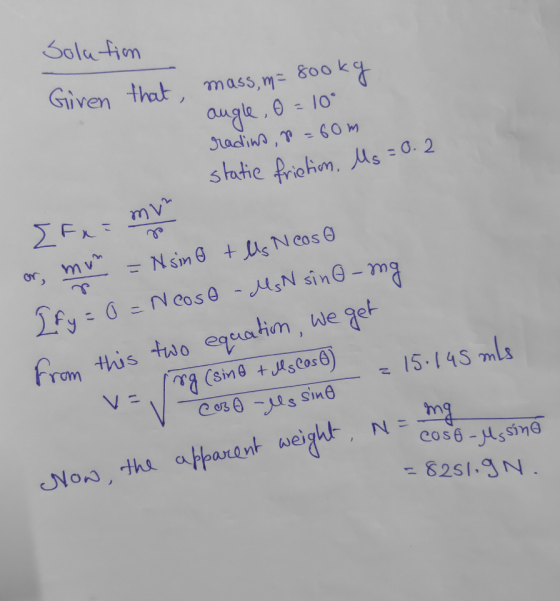
Problem #2 An 800 kg car is traveling on a circle of radius 60 meters on...
A car of mass M = 800 kg traveling at 55.0 km/hour enters a banked turn...
 A car of mass M = 800 kg traveling at 55.0 km/hour enters a
banked turn covered with ice. The road is banked at an angle ?, and
there is no friction between the road and the car's tires as shown
in(Figure 1) . Use g = 9.80 m/s2 throughout this problem.
Now, suppose that the curve is level (?=0) and that the ice has
melted, so that there is a coefficient of static friction ? between
the road and...
A car of mass M = 800 kg traveling at 55.0 km/hour enters a
banked turn covered with ice. The road is banked at an angle ?, and
there is no friction between the road and the car's tires as shown
in(Figure 1) . Use g = 9.80 m/s2 throughout this problem.
Now, suppose that the curve is level (?=0) and that the ice has
melted, so that there is a coefficient of static friction ? between
the road and...
A car of mass M = 1500 kg traveling at 55.0 km/hour enters a level turn...
A car of mass M = 1500 kg traveling at 55.0 km/hour enters a level turn (θ=0), and there is a coefficient of static friction μ between the road and the car's tires. What is μmin, the minimum value of the coefficient of static friction between the tires and the road required to prevent the car from slipping? Assume that the car's speed is still 55.0 km/hour and that the radius of the curve is 65.4 m .
please answer 2 questions pleaeeee #o: A 600-kg car traveling at 24.5 m/s is going around...
 please answer 2 questions pleaeeee
#o: A 600-kg car traveling at 24.5 m/s is going around a curve having a radius of 120 m that is banked at an angle of 20°. (a) Draw a free body diagram (b) What is the reaction of the road on the car? (c) Is the curve properly banked for the car's speed? (d) What is the minimum coefficient of static friction required between the road and the car's tires so the car does...
please answer 2 questions pleaeeee
#o: A 600-kg car traveling at 24.5 m/s is going around a curve having a radius of 120 m that is banked at an angle of 20°. (a) Draw a free body diagram (b) What is the reaction of the road on the car? (c) Is the curve properly banked for the car's speed? (d) What is the minimum coefficient of static friction required between the road and the car's tires so the car does...
A car of mass M = 1300 kg traveling at 65.0 km/hour enters a banked turn...
A car of mass M = 1300 kg traveling at 65.0 km/hour enters a banked turn covered with ice. The road is banked at an angle θ, and there is no friction between the road and the car's tires as shown in (Figure 1) . Use g = 9.80 m/s2 throughout this problem. r= 91.43 m. Now, suppose that the curve is level (θ=0) and that the ice has melted, so that there is a coefficient of static friction μ...
A particular unbanked turn in the road is shaped like a circle with a radius of...
A particular unbanked turn in the road is shaped like a circle with a radius of 30 meters. A car with a mass of 1500 kg can safely go around this turn at a maximum speed of 17 m/s. What is the coefficient of static friction between the car's tires and the road?
A curve of radius 70 m is banked so that a 1000 kg car traveling at...
A curve of radius 70 m is banked so that a 1000 kg car traveling at 60 km/h can round it even if the road is so icy that the coefficient of static friction is approximately zero. The acceleration of gravity is 9.81 m/s 2 . a) Find the minimum speed at which a car can travel around this curve without skidding if the coefficient of static friction between the road and the tires is 0.2 b) Find the maximum...
A 700 -kg car is traveling with speed of 90 km/h when the driver sees a...
A 700 -kg car is traveling with speed of 90 km/h when the driver sees a bear and slams on the brake. The car comes to stop in 6 seconds. What is the kinetic coefficient of friction between the car's tires and the surface of the road?
Consider again the problem of a car traveling along a banked turn. Sometimes roads have a...
Consider again the problem of a car traveling along a banked turn. Sometimes roads have a "reversed" banking angle. That is, the road is tilted "away" from the center of curvature of the road. If the coefficient of static friction between the tires and the road is μs = 0.4, the radius of curvature is 25 m, and the banking angle is 14°, what is the maximum speed at which a car can safely navigate such a turn?
A highway curve of radius 68.0 m is banked at 21.4 degree so that a car...
 A highway curve of radius 68.0 m is banked at 21.4 degree so that a car traveling at 26.4 m/s (95 km/hr) will utilize both banking and friction to keep it on the curve. Determine the minimum coefficient of static friction between the tires and the road to keep the car on the road at this speed on this curve.
nents D Question 5 8 pts us nts A car is traveling around a flat circular...
 nents D Question 5 8 pts us nts A car is traveling around a flat circular track with a radius of 24 meters. The coefficient of static friction between the tires and the road is 0.635 and the coefficient of kinetic friction is 0.488. Traveling at its maximum speed without going off the road, how long does it take for the car to circle the track 1 time? In your solution you must show: 1. A free body diagram indicating...
 A car of mass M = 800 kg traveling at 55.0 km/hour enters a
banked turn covered with ice. The road is banked at an angle ?, and
there is no friction between the road and the car's tires as shown
in(Figure 1) . Use g = 9.80 m/s2 throughout this problem.
Now, suppose that the curve is level (?=0) and that the ice has
melted, so that there is a coefficient of static friction ? between
the road and...
A car of mass M = 800 kg traveling at 55.0 km/hour enters a
banked turn covered with ice. The road is banked at an angle ?, and
there is no friction between the road and the car's tires as shown
in(Figure 1) . Use g = 9.80 m/s2 throughout this problem.
Now, suppose that the curve is level (?=0) and that the ice has
melted, so that there is a coefficient of static friction ? between
the road and...
 please answer 2 questions pleaeeee
#o: A 600-kg car traveling at 24.5 m/s is going around a curve having a radius of 120 m that is banked at an angle of 20°. (a) Draw a free body diagram (b) What is the reaction of the road on the car? (c) Is the curve properly banked for the car's speed? (d) What is the minimum coefficient of static friction required between the road and the car's tires so the car does...
please answer 2 questions pleaeeee
#o: A 600-kg car traveling at 24.5 m/s is going around a curve having a radius of 120 m that is banked at an angle of 20°. (a) Draw a free body diagram (b) What is the reaction of the road on the car? (c) Is the curve properly banked for the car's speed? (d) What is the minimum coefficient of static friction required between the road and the car's tires so the car does...
 A highway curve of radius 68.0 m is banked at 21.4 degree so that a car traveling at 26.4 m/s (95 km/hr) will utilize both banking and friction to keep it on the curve. Determine the minimum coefficient of static friction between the tires and the road to keep the car on the road at this speed on this curve.
 nents D Question 5 8 pts us nts A car is traveling around a flat circular track with a radius of 24 meters. The coefficient of static friction between the tires and the road is 0.635 and the coefficient of kinetic friction is 0.488. Traveling at its maximum speed without going off the road, how long does it take for the car to circle the track 1 time? In your solution you must show: 1. A free body diagram indicating...
Most questions answered within 3 hours.
-
Where is the error in this code sequence?
String s1 = "Hello";
String s2 = "ello";...
asked 11 months ago -
Financial data for Joel de Paris, Inc., for last year
follow:
Joel de Paris, Inc.
Balance...
asked 11 months ago -
Consider this reaction:
Al2(SO4)3 (aq)+ BaCl3
(aq) Al2Cl6 (aq)- +
3BaSO4(s) . What is the...
asked 11 months ago -
Suppose that Savneet is considering increasing her
recent random sample from 20 car rentals to 40...
asked 11 months ago -
Trucks arrive at an unloading terminal at an average rate of 120
per hour.
Trucks arrive...
asked 11 months ago -
Why are methanol and ethanol completely soluble in water while
octanol is not very little soluble....
asked 11 months ago -
A facilities manager at a university reads in a research report
that the mean amount of...
asked 11 months ago -
When the CuSO4 is rehydrated by adding water to the anhydrous
compound, is this an endothermic...
asked 11 months ago -
A ray of sunlight is passing from diamond into crown glass; the
angle of incidence is...
asked 11 months ago -
A block of mass 0.249 kg is placed on top of a light, vertical
spring of...
asked 11 months ago -
how do the kidneys compensate in the presences of acidosis
a) trigger hyperventilate
b) reserve acid...
asked 11 months ago -
Question 501 pts
The rental rate of capital to the firm increases. Which of the
following...
asked 11 months ago