
Homework Answers
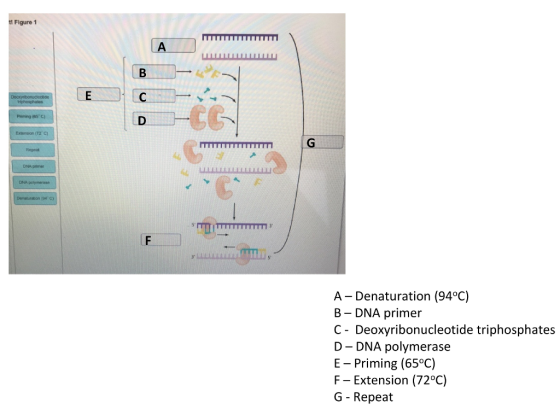
This represents the steps of PCR, polymerase chain reaction which is a molecular biology technique used to yield multiple copies of a DNA. This involves three steps - denturation (DNA separated into two strands), annealing (primers attach to template DNA) and extension (new DNA is formed) - all steps repeated (20-40 times usually). The major components in this process are DNA polymerase, DNA primers and DNTPs.
Add Answer to:
t! Figure 1 tes Priming (65 C) Extension (72 C) Repeat DNA primer Denaturation (94 C)...
THANK YOU!! Target Region Heated to 94°C DNA is denatured GGGCAACGTG CATCACTTTG Primers hybridize with template...
 THANK YOU!!
Target Region Heated to 94°C DNA is denatured GGGCAACGTG CATCACTTTG Primers hybridize with template Temperature is lowered After one round of PCR the number of double-stranded DNA molecules is doubled. TGG TCACTTTGGCAAIAGAATT Heat-stable DNA polymerase adds nucleotides to the 3' end of the primer Primer 1 Primer 2 Heated to 72°C 5 TGCCTGGCCCCATCACTTTGGCAA AGAATTC 5
THANK YOU!!
Target Region Heated to 94°C DNA is denatured GGGCAACGTG CATCACTTTG Primers hybridize with template Temperature is lowered After one round of PCR the number of double-stranded DNA molecules is doubled. TGG TCACTTTGGCAAIAGAATT Heat-stable DNA polymerase adds nucleotides to the 3' end of the primer Primer 1 Primer 2 Heated to 72°C 5 TGCCTGGCCCCATCACTTTGGCAA AGAATTC 5
Can someone help me figure out this concept map of Polymerase Chain Reaction. Microbiology Polymerase Chain...
 Can someone help me figure out this concept map of Polymerase
Chain Reaction.
Microbiology
Polymerase Chain Reaction Match the terms on the right to the correct box below Polymerase chain reaction which are amplifies Specific sequences of DNA involves the following three steps facilitated by use of Cooling to -65°C Denaturation Extension Primers Priming Raising temperature to -72 Raising temperature to -910 Repeated in multiple cycles Taq polymerase Target DNA Target DNA Thermocycler accomplished by accomplished by accomplished by separates...
Can someone help me figure out this concept map of Polymerase
Chain Reaction.
Microbiology
Polymerase Chain Reaction Match the terms on the right to the correct box below Polymerase chain reaction which are amplifies Specific sequences of DNA involves the following three steps facilitated by use of Cooling to -65°C Denaturation Extension Primers Priming Raising temperature to -72 Raising temperature to -910 Repeated in multiple cycles Taq polymerase Target DNA Target DNA Thermocycler accomplished by accomplished by accomplished by separates...
This PCR step is called annealing. The annealing step follows the denaturation step: it is usually...
 This PCR step is called annealing. The annealing step follows the denaturation step: it is usually the lowest temperature in the PCR. The temperature of this step varies with each PCR reaction because each primer has its own sequence and may not be an identical match to the DNA template strand. GC or CG have three hydrogen bonds and AT or TA have two hydrogen bonds. Higher annealing temperatures are more stringent and require a better match between primer and...
Solve y"' +94 = 0, v(65) = - 1, x' (65) = 9 g(t) = Preview...
 Solve y"' +94 = 0, v(65) = - 1, x' (65) = 9 g(t) = Preview The behavior of the solutions are: Steady oscillation Oscillating with increasing amplitude Oscillating with decreasing amplitude
1) You have four tubes with buffer, primer, DNA polymerase, template, and dNTP’s. In tube A,...
1) You have four tubes with buffer, primer, DNA polymerase, template, and dNTP’s. In tube A, you have added radioactive ddATP at a ratio of 1 ddATP/100 dATP. In tube T, you have added radioactive ddTTP at a ratio of 1 ddTTP/100 dTTP. In tube G, you have added radioactive ddGTP at a ratio of 1 ddGTP/100 dGTP. In tube C, you have added radioactive ddCTP at a ratio of 1 ddCTP/100 dCTP. Here is a picture of the template...
Now. you should be able to answer the following questions: • How the amplification will be...
 Now. you should be able to answer the following questions: • How the amplification will be done? - How you will determine your target sequence? How the amplification will be specific for certain segment? What are the requirements to carry PCR? • Suppose you perform a PCR that begins with one double-strand of the following DNA template: +5'-CTACCTGCGGGTTGACTGCTACCTTCCCGGGATGCCCAAAATTCTCGAG-3+ +3'-GATGGACGCCCAACTGACGATGGAAGGGCCCTACGGGTTTTAAGAGCTC-5'+ A. Draw one cycle of PCR reaction below the following diagram. B. Label the template DNA, the primers, and what is...
2. PCR amplification of the TAS2R38 gene a. The number of copies of the 303 bp sequence grows exp...
 2. PCR amplification of the TAS2R38 gene a. The number of copies of the 303 bp sequence grows exponentially (1-2-4-8-etc) after each cycle. The number of cycles we used is on page 97. What is the number of copies of the 303 bp fragment that will theoretically be present at the end of our reaction? b. Denaturation of the 303 bp segment of the TAS2R38 gene is a critical first step in the PCR perties of a DNA segment that...
Figure 1 illustrates a model of the molecules involved in DNA replication and their placement relative...
 Figure 1 illustrates a model of the molecules involved in DNA replication and their placement relative to each other. Topoisomerase Helicase NNNNNNN Sam 11UUU -RNA HHHHHHH5 Figure 1. Model including molecules involved in DNA replication Which of the following correctly explains where DNA replication will begin on the strand oriented 5' 3', reading from left to right? (A) DNA replication will be randomly initiated along the unwound portion of the DNA strand since base pairing will occur. DNA replication cannot...
Translate the following DNA sequence: DNA template: 3' G C T A C C G G...
Translate the following DNA sequence: DNA template: 3' G C T A C C G G A G T A A T A C T 5' What are the tRNA anticodons for the sequence? DNA template: 3' G C T A C C G G A G T A A T A C T 5' anticodon 1: 3' 5' anticodon 2: 3' 5' anticodon 3: . 3' 5' anticodon 4: 3' 5' anticodon 5: 3
Question 3 Please: Problem 1 is referenced below 3. Repeat problem 1 if the output y(t)...
 Question 3 Please: Problem 1 is referenced below
3. Repeat problem 1 if the output y(t) is the voltage across the resistor instead of across the capacitor and the input is as shown in Figure 3 (you can use MATLAB to find the inverse Fourier Transform). [7 points] x(1) 0.5 Figure 3 1. For the circuit shown in Figure 1, find y(t) if the input is x(t) = 5 + 7 cos(10 t) + 7sin(1000t) co y()= vc) X(t)= v(...
Question 3 Please: Problem 1 is referenced below
3. Repeat problem 1 if the output y(t) is the voltage across the resistor instead of across the capacitor and the input is as shown in Figure 3 (you can use MATLAB to find the inverse Fourier Transform). [7 points] x(1) 0.5 Figure 3 1. For the circuit shown in Figure 1, find y(t) if the input is x(t) = 5 + 7 cos(10 t) + 7sin(1000t) co y()= vc) X(t)= v(...
 THANK YOU!!
Target Region Heated to 94°C DNA is denatured GGGCAACGTG CATCACTTTG Primers hybridize with template Temperature is lowered After one round of PCR the number of double-stranded DNA molecules is doubled. TGG TCACTTTGGCAAIAGAATT Heat-stable DNA polymerase adds nucleotides to the 3' end of the primer Primer 1 Primer 2 Heated to 72°C 5 TGCCTGGCCCCATCACTTTGGCAA AGAATTC 5
THANK YOU!!
Target Region Heated to 94°C DNA is denatured GGGCAACGTG CATCACTTTG Primers hybridize with template Temperature is lowered After one round of PCR the number of double-stranded DNA molecules is doubled. TGG TCACTTTGGCAAIAGAATT Heat-stable DNA polymerase adds nucleotides to the 3' end of the primer Primer 1 Primer 2 Heated to 72°C 5 TGCCTGGCCCCATCACTTTGGCAA AGAATTC 5
 Can someone help me figure out this concept map of Polymerase
Chain Reaction.
Microbiology
Polymerase Chain Reaction Match the terms on the right to the correct box below Polymerase chain reaction which are amplifies Specific sequences of DNA involves the following three steps facilitated by use of Cooling to -65°C Denaturation Extension Primers Priming Raising temperature to -72 Raising temperature to -910 Repeated in multiple cycles Taq polymerase Target DNA Target DNA Thermocycler accomplished by accomplished by accomplished by separates...
Can someone help me figure out this concept map of Polymerase
Chain Reaction.
Microbiology
Polymerase Chain Reaction Match the terms on the right to the correct box below Polymerase chain reaction which are amplifies Specific sequences of DNA involves the following three steps facilitated by use of Cooling to -65°C Denaturation Extension Primers Priming Raising temperature to -72 Raising temperature to -910 Repeated in multiple cycles Taq polymerase Target DNA Target DNA Thermocycler accomplished by accomplished by accomplished by separates...
 This PCR step is called annealing. The annealing step follows the denaturation step: it is usually the lowest temperature in the PCR. The temperature of this step varies with each PCR reaction because each primer has its own sequence and may not be an identical match to the DNA template strand. GC or CG have three hydrogen bonds and AT or TA have two hydrogen bonds. Higher annealing temperatures are more stringent and require a better match between primer and...
 Solve y"' +94 = 0, v(65) = - 1, x' (65) = 9 g(t) = Preview The behavior of the solutions are: Steady oscillation Oscillating with increasing amplitude Oscillating with decreasing amplitude
 Now. you should be able to answer the following questions: • How the amplification will be done? - How you will determine your target sequence? How the amplification will be specific for certain segment? What are the requirements to carry PCR? • Suppose you perform a PCR that begins with one double-strand of the following DNA template: +5'-CTACCTGCGGGTTGACTGCTACCTTCCCGGGATGCCCAAAATTCTCGAG-3+ +3'-GATGGACGCCCAACTGACGATGGAAGGGCCCTACGGGTTTTAAGAGCTC-5'+ A. Draw one cycle of PCR reaction below the following diagram. B. Label the template DNA, the primers, and what is...
 2. PCR amplification of the TAS2R38 gene a. The number of copies of the 303 bp sequence grows exponentially (1-2-4-8-etc) after each cycle. The number of cycles we used is on page 97. What is the number of copies of the 303 bp fragment that will theoretically be present at the end of our reaction? b. Denaturation of the 303 bp segment of the TAS2R38 gene is a critical first step in the PCR perties of a DNA segment that...
 Figure 1 illustrates a model of the molecules involved in DNA replication and their placement relative to each other. Topoisomerase Helicase NNNNNNN Sam 11UUU -RNA HHHHHHH5 Figure 1. Model including molecules involved in DNA replication Which of the following correctly explains where DNA replication will begin on the strand oriented 5' 3', reading from left to right? (A) DNA replication will be randomly initiated along the unwound portion of the DNA strand since base pairing will occur. DNA replication cannot...
 Question 3 Please: Problem 1 is referenced below
3. Repeat problem 1 if the output y(t) is the voltage across the resistor instead of across the capacitor and the input is as shown in Figure 3 (you can use MATLAB to find the inverse Fourier Transform). [7 points] x(1) 0.5 Figure 3 1. For the circuit shown in Figure 1, find y(t) if the input is x(t) = 5 + 7 cos(10 t) + 7sin(1000t) co y()= vc) X(t)= v(...
Question 3 Please: Problem 1 is referenced below
3. Repeat problem 1 if the output y(t) is the voltage across the resistor instead of across the capacitor and the input is as shown in Figure 3 (you can use MATLAB to find the inverse Fourier Transform). [7 points] x(1) 0.5 Figure 3 1. For the circuit shown in Figure 1, find y(t) if the input is x(t) = 5 + 7 cos(10 t) + 7sin(1000t) co y()= vc) X(t)= v(...
Most questions answered within 3 hours.
-
Where is the error in this code sequence?
String s1 = "Hello";
String s2 = "ello";...
asked 10 months ago -
Financial data for Joel de Paris, Inc., for last year
follow:
Joel de Paris, Inc.
Balance...
asked 10 months ago -
Consider this reaction:
Al2(SO4)3 (aq)+ BaCl3
(aq) Al2Cl6 (aq)- +
3BaSO4(s) . What is the...
asked 10 months ago -
Suppose that Savneet is considering increasing her
recent random sample from 20 car rentals to 40...
asked 10 months ago -
Trucks arrive at an unloading terminal at an average rate of 120
per hour.
Trucks arrive...
asked 10 months ago -
Why are methanol and ethanol completely soluble in water while
octanol is not very little soluble....
asked 10 months ago -
A facilities manager at a university reads in a research report
that the mean amount of...
asked 10 months ago -
When the CuSO4 is rehydrated by adding water to the anhydrous
compound, is this an endothermic...
asked 10 months ago -
A ray of sunlight is passing from diamond into crown glass; the
angle of incidence is...
asked 10 months ago -
A block of mass 0.249 kg is placed on top of a light, vertical
spring of...
asked 10 months ago -
how do the kidneys compensate in the presences of acidosis
a) trigger hyperventilate
b) reserve acid...
asked 10 months ago -
Question 501 pts
The rental rate of capital to the firm increases. Which of the
following...
asked 10 months ago