![In class we derived the following equation 1/[A]_o](http://img.homeworklib.com/questions/f84c1340-92a0-11eb-a3d6-01b58d00f53b.png?x-oss-process=image/resize,w_560)
Homework Answers

Add Answer to:
In class we derived the following equation 1/[A]_o - [B]_o ln [B]_o [A]/[A]_o [B] = kt...
Derive the equation 1/[B] = 1/[B]_0 + kt from the instantaneous rate of reaction in terms...
 Derive the equation 1/[B] = 1/[B]_0 + kt from the instantaneous rate of reaction in terms of B and rate = k[B]^2. What are the units of k if concentration is expressed in molarity and time in seconds a. For a first order reaction? b. For a second order reaction? c. For a zero order reaction? d. For a reaction that follows the rate equation, rate = k[A] [B]^1/2? The rate law for a reaction only involves the reactant A...
ln(k) = -E_a/R 1/T + ln(A) A plot of ln (k)versus 1/T result in a straight...
 ln(k) = -E_a/R 1/T + ln(A) A plot of ln (k)versus 1/T result in a straight line with a slope = -E_a/R. The value of E_a can then be calculated using the value of R and to the slope of the line. This experiment uses the Arrhenius equation, which relates the temperature and specific reaction rate constant to determine the activation energy for the crystal violet reaction. The reaction will be performed at different temperatures. Once the order of reaction...
Problem 5. Consider the following second order linear differential equation f"(t)-f'(t) +f(t) kt ...
 Problem 5. Consider the following second order linear differential equation f"(t)-f'(t) +f(t) kt which models a forced oscillation in a damping material. For example, imagine moving your hand back and forth underwater. Write this equation as a set of coupled first order equations by doing the following: ·Define a new function g = f'(t). This gives you one of the two coupled equations. . Use the given ODE, g, and its derivatives to write the second first order equation. Both...
part b and c In class we derived a Fokker-Planck equation for the velocity distribution P(et)...
 part b and c
In class we derived a Fokker-Planck equation for the velocity distribution P(et) starting from the assumption of small random changes in velocity at each time step f.(t) where f(t) is chosen from a distribution WU: ). Einstein's original approach to Brownian motion had a different starting point, focusing on position differences at each time step x(t + Δt)-x(t) + E(t) where £(t) is a random displacement chosen from some distribution W(E). Underlying this ap- proach is...
part b and c
In class we derived a Fokker-Planck equation for the velocity distribution P(et) starting from the assumption of small random changes in velocity at each time step f.(t) where f(t) is chosen from a distribution WU: ). Einstein's original approach to Brownian motion had a different starting point, focusing on position differences at each time step x(t + Δt)-x(t) + E(t) where £(t) is a random displacement chosen from some distribution W(E). Underlying this ap- proach is...
Part 1 Match each of the following expressions (A, B, C, ...) with its closest equivalent...
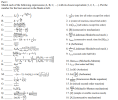 Part 1 Match each of the following expressions (A, B, C, ...) with its closest equivalent (1, 2, 3, ...). Put the number for the best answer in the blank at left. A. Ze (1 – ethet Ace kzkz [A] [M (k-1-[M]+k) a =) cisterna ISI. (n-1)k.a.t+1-1 Ln(2) 1-eb-Ao-a-Bok-t PaB-bAeb-Ap-a-Bo)kt kallo (e-kzt - e-kt) *2* 1 lin{B(A, – a ) (b.A, -a.B.) A (B-b-oll 1. An-1 (rate law all order except first order) 2. x (extent of reaction, mixed 2nd...
An irreversible reaction A + B products is studied under conditions where the initial concentrations...
An irreversible reaction A + B products is studied under conditions where the initial concentrations of A and B are equal. Under these circumstances, a graph of ln([A]) as a function of time is linear. What is the order in A? (A) Zeroth order B) First order (C) Second order (D) The order in A cannot be determined based on the information given. Doesn't the first order reaction kinetics say that the graph of ln[A] vs t gives a...
Derive time equation but for that first we have to derive acceleration using the following equations:...
Derive time equation but for that first we have to derive acceleration using the following equations: [1] mg*sin(θ) – fs = ma [2] Rfs = Iα [3] I = cmR2 [4] α = a/R Once we have derived acceleration in terms of sin(θ), g, and c , we are then asked to derive time based on kinematic equation. The time equation should be based on of y, c, g, and d. d=length of Ramp.y=Height of ramp.
1.3 Newtonion Form of the Thin Lens Equation Newton, being Newton, derived an alternative for of...
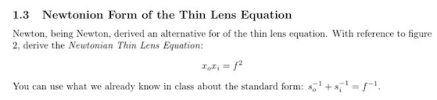 1.3 Newtonion Form of the Thin Lens Equation Newton, being Newton, derived an alternative for of the thin lens equation. With reference to figure 2, derive the Newtonian Thin Lens Equation: Toci You can use what we already know in class about the standard form: ss 1 f-1
(1 6 pts) We derived the thermodynamic eq. of state for dU in class. Use the...
 (1 6 pts) We derived the thermodynamic eq. of state for dU in class. Use the same approach 6V here to derive the thermodynamic eq. of state based on dH:p sowthat equal to nb for a gas obeying the equation of state nRT
1) A certain first order reaction has a rate constant of 0.038 min-1. How much of...
1) A certain first order reaction has a rate constant of 0.038 min-1. How much of the reactant will remain if the reaction is run for 2.5 hours and the initial concentration of the reactant is 0.35 M? 2)Which of the following correctly represents a first order integrated rate law? (Select all that are correct, there may be more than one.) A. [A]0 = [A]te-kt B. [A]t = [A]0ekt C. ln [A]t = ln [A]0 - kt D. [A]t =...
 Derive the equation 1/[B] = 1/[B]_0 + kt from the instantaneous rate of reaction in terms of B and rate = k[B]^2. What are the units of k if concentration is expressed in molarity and time in seconds a. For a first order reaction? b. For a second order reaction? c. For a zero order reaction? d. For a reaction that follows the rate equation, rate = k[A] [B]^1/2? The rate law for a reaction only involves the reactant A...
 ln(k) = -E_a/R 1/T + ln(A) A plot of ln (k)versus 1/T result in a straight line with a slope = -E_a/R. The value of E_a can then be calculated using the value of R and to the slope of the line. This experiment uses the Arrhenius equation, which relates the temperature and specific reaction rate constant to determine the activation energy for the crystal violet reaction. The reaction will be performed at different temperatures. Once the order of reaction...
 Problem 5. Consider the following second order linear differential equation f"(t)-f'(t) +f(t) kt which models a forced oscillation in a damping material. For example, imagine moving your hand back and forth underwater. Write this equation as a set of coupled first order equations by doing the following: ·Define a new function g = f'(t). This gives you one of the two coupled equations. . Use the given ODE, g, and its derivatives to write the second first order equation. Both...
 part b and c
In class we derived a Fokker-Planck equation for the velocity distribution P(et) starting from the assumption of small random changes in velocity at each time step f.(t) where f(t) is chosen from a distribution WU: ). Einstein's original approach to Brownian motion had a different starting point, focusing on position differences at each time step x(t + Δt)-x(t) + E(t) where £(t) is a random displacement chosen from some distribution W(E). Underlying this ap- proach is...
part b and c
In class we derived a Fokker-Planck equation for the velocity distribution P(et) starting from the assumption of small random changes in velocity at each time step f.(t) where f(t) is chosen from a distribution WU: ). Einstein's original approach to Brownian motion had a different starting point, focusing on position differences at each time step x(t + Δt)-x(t) + E(t) where £(t) is a random displacement chosen from some distribution W(E). Underlying this ap- proach is...
 Part 1 Match each of the following expressions (A, B, C, ...) with its closest equivalent (1, 2, 3, ...). Put the number for the best answer in the blank at left. A. Ze (1 – ethet Ace kzkz [A] [M (k-1-[M]+k) a =) cisterna ISI. (n-1)k.a.t+1-1 Ln(2) 1-eb-Ao-a-Bok-t PaB-bAeb-Ap-a-Bo)kt kallo (e-kzt - e-kt) *2* 1 lin{B(A, – a ) (b.A, -a.B.) A (B-b-oll 1. An-1 (rate law all order except first order) 2. x (extent of reaction, mixed 2nd...
 1.3 Newtonion Form of the Thin Lens Equation Newton, being Newton, derived an alternative for of the thin lens equation. With reference to figure 2, derive the Newtonian Thin Lens Equation: Toci You can use what we already know in class about the standard form: ss 1 f-1
 (1 6 pts) We derived the thermodynamic eq. of state for dU in class. Use the same approach 6V here to derive the thermodynamic eq. of state based on dH:p sowthat equal to nb for a gas obeying the equation of state nRT
Most questions answered within 3 hours.
-
Where is the error in this code sequence?
String s1 = "Hello";
String s2 = "ello";...
asked 10 months ago -
Financial data for Joel de Paris, Inc., for last year
follow:
Joel de Paris, Inc.
Balance...
asked 10 months ago -
Consider this reaction:
Al2(SO4)3 (aq)+ BaCl3
(aq) Al2Cl6 (aq)- +
3BaSO4(s) . What is the...
asked 10 months ago -
Suppose that Savneet is considering increasing her
recent random sample from 20 car rentals to 40...
asked 10 months ago -
Trucks arrive at an unloading terminal at an average rate of 120
per hour.
Trucks arrive...
asked 10 months ago -
Why are methanol and ethanol completely soluble in water while
octanol is not very little soluble....
asked 10 months ago -
A facilities manager at a university reads in a research report
that the mean amount of...
asked 10 months ago -
When the CuSO4 is rehydrated by adding water to the anhydrous
compound, is this an endothermic...
asked 10 months ago -
A ray of sunlight is passing from diamond into crown glass; the
angle of incidence is...
asked 10 months ago -
A block of mass 0.249 kg is placed on top of a light, vertical
spring of...
asked 10 months ago -
how do the kidneys compensate in the presences of acidosis
a) trigger hyperventilate
b) reserve acid...
asked 10 months ago -
Question 501 pts
The rental rate of capital to the firm increases. Which of the
following...
asked 10 months ago