
Homework Answers


Add Answer to:
4.( 5x2 points ) Implement a full subtractor a. Using two 8-to-1 Muxes. Connect X, Y,...
design and implement a full subtractor using two 8-to-1 MUXes. connect X,Y< and Bin to the...
design and implement a full subtractor using two 8-to-1 MUXes. connect X,Y< and Bin to the control inputs of the MUXes and connect 1 or 0 to each data input. Pleas answer as fast as possible and show all work show all work please
Implement a Full Adder by using two 4-to-1 MUXes and one inverter. Connect X and Y...
Implement a Full Adder by using two 4-to-1 MUXes and one inverter. Connect X and Y to the control inputs of the MUXes, and connect 1’s, 0’s, Cin, or C′in to each data input. I know (because it was solved by my instructor) that for Sum the inputs are C, C, C' and C. For the Cout the inputs are 0, C, C and 1. I just need an explanation how we get to this conclusion.
Problem 5 (15%) Implement a full subtractor using only AND, OR. and NOT gates. A full...
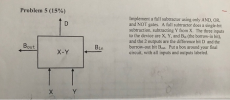 Problem 5 (15%) Implement a full subtractor using only AND, OR. and NOT gates. A full subtractor does a single-bit subtraction, subtracting Y from X. The three inputs to the device are X, Y, and Bin (the borrow-in bit), and the 2 outputs are the difference bit D and the borrow-out bit Bout. Put a box around your final circuit, with all inputs and outputs labeled. Bout x-y Bin
In quartus prime Implement a 4-bit adder/subtractor using structural VHDL. The circuit will have two 4-bit...
In quartus prime Implement a 4-bit adder/subtractor using structural VHDL. The circuit will have two 4-bit data inputs (A and B), a control line (add /sub), a 4-bit sum output (S), a carry-out bit (Cout), and an overflow flag. You need two VHDL files (fulladd.vhd) and (hybrid.vhd) to implement the design. VHDL code, fulladd.vhd, will implement a single-bit full adder. The VHDL file, hybrid.vhd, will create four instances of the single-bit full adder. Four XOR gates will be needed to...
A full subtractor can be built using two "Half Subtractor" devices and an OR gate. Design...
A full subtractor can be built using two "Half Subtractor" devices and an OR gate. Design and test a full subtractor (schematic diagram and truth table shown below). Write the expressions of the difference and the borrow beside the circuit. Input Output x y bi bi+1 d 0 0 0 0 0 0 0 1 1 1 0 1 0 1 1 0 1 1 1 0 1 0 0 0 1 1 0 1 0 0 1 1 0...
Implement the following bit sequential Adder-Subtractor design. X and Y are two operand inputs and Z...
 Implement the following bit sequential Adder-Subtractor design. X and Y are two operand inputs and Z is for the control signal i.e. Z is the selection bit. When Z has value 0, the circuit is an adder, meanwhile, the D flip-flop should be initialized to 0 for each addition. When Z has value 1, it performs subtraction, meanwhile, the D flip-flop should be initialized to 1 for each subtraction. Test your Adder-Subtractor circuit on the following operations and use the...
Problem 3 [10 points a) (5 points) Construct a circuit that takes as input a 3-bit number X-XXXo ...
 part c
Problem 3 [10 points a) (5 points) Construct a circuit that takes as input a 3-bit number X-XXXo and increments it by one. L.e. if the input is 101 the output should be 110. Use only half adders. b) Construct a circuit that takes as input a 3-bit number X-XXxo and decrements it by one 1. (5 points) Show the truth table of the circuit. Then use a decoder and additional gates to implement it. So Ys Y2...
part c
Problem 3 [10 points a) (5 points) Construct a circuit that takes as input a 3-bit number X-XXXo and increments it by one. L.e. if the input is 101 the output should be 110. Use only half adders. b) Construct a circuit that takes as input a 3-bit number X-XXxo and decrements it by one 1. (5 points) Show the truth table of the circuit. Then use a decoder and additional gates to implement it. So Ys Y2...
(32 pts) Adder/ Subtractor 11. (8 pts) Given a l-bit full adder (you can use the...
 (32 pts) Adder/ Subtractor 11. (8 pts) Given a l-bit full adder (you can use the box representation as below) show the circuitry required to make it into a 4-bit full adder and subtractor. 12. (12 pts) Show the hardware required to compute the 4 primary flags for your 4-bit add sub unit carry (C), zero (Z), overflow (V), and sign (N). 13.(12 pts) Show the results for the addition below. Also show the equivalent decimal numbers for each Ain...
Derive the Boolean expression of a combination logic from the following truth table, where A, B,...
 Derive the Boolean expression of a combination logic from the following truth table, where A, B, C are input variables and D is output. Draw the circuit diagram to implement it. Show your working steps. The full subtractor is a combinational circuit, which is used to perform subtraction of three input bits: the minuend X, subtrahend Y, and borrow in B_in. The full subtractor generates two outputs bits: the difference D and borrow out B_out. B_in is set when the...
Building and testing basic combinational circuits using Verilog HDL Description: Build and test t...
Building and testing basic combinational circuits using Verilog HDL Description: Build and test the following circuits using gate-level modeling in Verilog HDL. 1. 3-input majority function. 2. Conditional inverter (see the table below: x - control input, y - data input). Do NOT use XOR gates for the implementation. x y Output 0 y 1 y' 3. Two-input multiplexer (see the table below: x,y - data inputs, z - control input). z Output 0 x 1 y 4. 1-bit half...
 Problem 5 (15%) Implement a full subtractor using only AND, OR. and NOT gates. A full subtractor does a single-bit subtraction, subtracting Y from X. The three inputs to the device are X, Y, and Bin (the borrow-in bit), and the 2 outputs are the difference bit D and the borrow-out bit Bout. Put a box around your final circuit, with all inputs and outputs labeled. Bout x-y Bin
 Implement the following bit sequential Adder-Subtractor design. X and Y are two operand inputs and Z is for the control signal i.e. Z is the selection bit. When Z has value 0, the circuit is an adder, meanwhile, the D flip-flop should be initialized to 0 for each addition. When Z has value 1, it performs subtraction, meanwhile, the D flip-flop should be initialized to 1 for each subtraction. Test your Adder-Subtractor circuit on the following operations and use the...
 part c
Problem 3 [10 points a) (5 points) Construct a circuit that takes as input a 3-bit number X-XXXo and increments it by one. L.e. if the input is 101 the output should be 110. Use only half adders. b) Construct a circuit that takes as input a 3-bit number X-XXxo and decrements it by one 1. (5 points) Show the truth table of the circuit. Then use a decoder and additional gates to implement it. So Ys Y2...
part c
Problem 3 [10 points a) (5 points) Construct a circuit that takes as input a 3-bit number X-XXXo and increments it by one. L.e. if the input is 101 the output should be 110. Use only half adders. b) Construct a circuit that takes as input a 3-bit number X-XXxo and decrements it by one 1. (5 points) Show the truth table of the circuit. Then use a decoder and additional gates to implement it. So Ys Y2...
 (32 pts) Adder/ Subtractor 11. (8 pts) Given a l-bit full adder (you can use the box representation as below) show the circuitry required to make it into a 4-bit full adder and subtractor. 12. (12 pts) Show the hardware required to compute the 4 primary flags for your 4-bit add sub unit carry (C), zero (Z), overflow (V), and sign (N). 13.(12 pts) Show the results for the addition below. Also show the equivalent decimal numbers for each Ain...
 Derive the Boolean expression of a combination logic from the following truth table, where A, B, C are input variables and D is output. Draw the circuit diagram to implement it. Show your working steps. The full subtractor is a combinational circuit, which is used to perform subtraction of three input bits: the minuend X, subtrahend Y, and borrow in B_in. The full subtractor generates two outputs bits: the difference D and borrow out B_out. B_in is set when the...
Most questions answered within 3 hours.
-
Where is the error in this code sequence?
String s1 = "Hello";
String s2 = "ello";...
asked 11 months ago -
Financial data for Joel de Paris, Inc., for last year
follow:
Joel de Paris, Inc.
Balance...
asked 11 months ago -
Consider this reaction:
Al2(SO4)3 (aq)+ BaCl3
(aq) Al2Cl6 (aq)- +
3BaSO4(s) . What is the...
asked 11 months ago -
Suppose that Savneet is considering increasing her
recent random sample from 20 car rentals to 40...
asked 11 months ago -
Trucks arrive at an unloading terminal at an average rate of 120
per hour.
Trucks arrive...
asked 11 months ago -
Why are methanol and ethanol completely soluble in water while
octanol is not very little soluble....
asked 11 months ago -
A facilities manager at a university reads in a research report
that the mean amount of...
asked 11 months ago -
When the CuSO4 is rehydrated by adding water to the anhydrous
compound, is this an endothermic...
asked 11 months ago -
A ray of sunlight is passing from diamond into crown glass; the
angle of incidence is...
asked 11 months ago -
A block of mass 0.249 kg is placed on top of a light, vertical
spring of...
asked 11 months ago -
how do the kidneys compensate in the presences of acidosis
a) trigger hyperventilate
b) reserve acid...
asked 11 months ago -
Question 501 pts
The rental rate of capital to the firm increases. Which of the
following...
asked 11 months ago