
Homework Answers
Add Answer to:
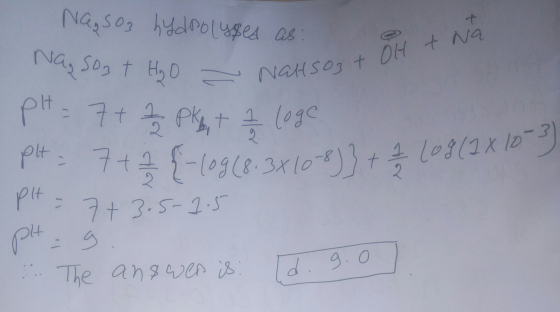
Consider the following reactions: SO32- (aq) + H2O(l) = HSO3_(aq) + OH-(aq) Kb1 = 8.3 x...
Consider the following reactions: Koi = 8.3 x 10⁻⁸ SO32-(aq) + H2O(1) = HSO:_(aq) + OH(aq)...
 Consider the following reactions: Koi = 8.3 x 10⁻⁸ SO32-(aq) + H2O(1) = HSO:_(aq) + OH(aq) HSO3- (aq) + H2O(1) = HSO3(aq) + OH-(aq) K12 = 7.6 x 10⁻¹³ What is the pH of 1.0 x 10⁻³ M Na2SO3? Select one: O a. 7.0 b. 9.0 C. 5.0 d. 13.0 o e. 10.5
Consider the following reaction. What is/are the spectator ion(s)? H2SO3(aq) + KOH(aq)-K2SO3(aq) + H2O(1) O K*(aq),...
 Consider the following reaction. What is/are the spectator ion(s)? H2SO3(aq) + KOH(aq)-K2SO3(aq) + H2O(1) O K*(aq), SO32- (aq) O H+(aq). SO,2- (aq) K*(aq) only OH(aq), OH- (aq) SO42- (aq) only O H*aq). K*(aq) « Previous
Part A. Which of the following is not a redox reaction? H2O(l) + NH3(g) NH4+(aq)...
 Part A. Which of the following is not a redox reaction?
H2O(l) + NH3(g) NH4+(aq) + OH–(aq)
2H2(g) + O2(g) 2H2O(l)
Zn(s) + H2SO4(aq) ZnSO4(aq) + H2(g)
FeSO4(aq) + K2Cr2O7(aq) + 7H2SO4(aq) Cr2(SO4)3(aq) + 3Fe2(SO4)3(aq) + K2SO4(aq)
+ 7H2O(l)
Cl2(g) + 2KBr(aq) Br2(l) + 2KCl(aq)
Part B. A 43.46 mL sample of Na2SO3 was titrated with 68.99 mL
of 0.128 M K2Cr2O7 solution in the presence of H2SO4. Calculate the
molarity of the Na2SO3 solution. Enter to 3 decimal...
Part A. Which of the following is not a redox reaction?
H2O(l) + NH3(g) NH4+(aq) + OH–(aq)
2H2(g) + O2(g) 2H2O(l)
Zn(s) + H2SO4(aq) ZnSO4(aq) + H2(g)
FeSO4(aq) + K2Cr2O7(aq) + 7H2SO4(aq) Cr2(SO4)3(aq) + 3Fe2(SO4)3(aq) + K2SO4(aq)
+ 7H2O(l)
Cl2(g) + 2KBr(aq) Br2(l) + 2KCl(aq)
Part B. A 43.46 mL sample of Na2SO3 was titrated with 68.99 mL
of 0.128 M K2Cr2O7 solution in the presence of H2SO4. Calculate the
molarity of the Na2SO3 solution. Enter to 3 decimal...
Important Info: Ka reaction: HC2H3O2(aq) + H2O(l) <-->C2H3O2 (aq) +H3O+(aq) HC2H3O(aq) +OH-(aq) -> C2H3O2-(aq) + H2O...
Important Info: Ka reaction: HC2H3O2(aq) + H2O(l) <-->C2H3O2 (aq) +H3O+(aq) HC2H3O(aq) +OH-(aq) -> C2H3O2-(aq) + H2O (l) A 1.0 L buffer solution is 0.280 M in HC2H302 (acetic acid) and 0.320 M in NaC2H302 (sodium acetate). Calculate the pH of the budder and he Ka for HC2H3O2 IS 1.8 X 10⁻⁵ Calculate the pH of te solution above after the addition of 0.0400 moles of solid NaOH. Assume no volume change upon the addition of base.
Which of the following chemical reactions represents the ionization of water? 0 H2O(l) H2O+(aq) + e-...
 Which of the following chemical reactions represents the ionization of water? 0 H2O(l) H2O+(aq) + e- O H+(aq) + OH-(aq)= H2O(l) O H2O(l)-H2O-(aq) 2H20 2H2(g)+ 02(8) O H2O(l)-H'(aq) + OH-(aq)
Part A - Combining Equilibrium Expressions Given the equilibrium constants for the following two reactions in...
 Part A - Combining Equilibrium Expressions Given the equilibrium constants for the following two reactions in aqueous solution at 25°C HNO2 (aq) = H+(aq) + NO2 (aq) Kc = 4.5 x 10⁻⁴ H2SO3(aq) = 2H+(aq) + SO32- (aq) Kc = 1.1 x 10⁻⁹ what is the value of K, for the reaction 2HNO2 (aq) + SO32- (aq) = H2SO3(aq) + 2NO2 (aq) O 4.9 10-13 O 5.4 x 10⁻³ O 1.8 x 10² O O 4.1 x 10⁵ 8.2 x...
Consider the neutralization reaction: OH- (aq) + HX(aq) → H2O(l) + X- (aq) Kc = 3.5...
Consider the neutralization reaction: OH- (aq) + HX(aq) → H2O(l) + X- (aq) Kc = 3.5 x 10⁶ . What is the Kb for X- ?
Phenol (C,H,OH), commonly called carbolic acid, is a weak organic acid. C, H, OH(aq) + H2O(l) = C, H50- (aq) + H2O...
 Phenol (C,H,OH), commonly called carbolic acid, is a weak organic acid. C, H, OH(aq) + H2O(l) = C, H50- (aq) + H2O + (aq) K. -1.3 x 10⁻¹⁰ If you dissolve 0.157 g of the acid in enough water to make 253 mL of solution, what is the equilibrium hydronium ion concentration [Bot]- What is the pH of the solution? pH-
C6H4(OH)2(aq) + H2O2(aq) ----> C6H4O2(aq) + 2 H2O(l) Given the entropies of the reactions below, calculate...
C6H4(OH)2(aq) + H2O2(aq) ----> C6H4O2(aq) + 2 H2O(l) Given the entropies of the reactions below, calculate the entropy of the chemical explosion at 37 C. 2 H2O2 (aq) ------> 2H2O(l) +O2(g) = +0.4501 kj/mole*k C6H4((OH)2(aq) ------> C6H4O2(aq) + H2(g) = + 0.5033 kj/mole*k 2 H2(g) + O2(g) -----> 2 H2O (l) = -0.327.2 kj/mole*k
Which of the following reactions has a net lonic equation of H^+ (aq)+OH^- (aq)-> H20(l) a)...
Which of the following reactions has a net lonic equation of H^+ (aq)+OH^- (aq)-> H20(l) a) 2NaOH(s)+CO2(g)-> Na2CO3 (s)+ H2O (l) b) NH3 (aq)+H2O(l)-> NH4OH(aq) c) KOH(aq)+ HClO4 (aq)-> H2O (l) +KClO4 (aq) d) MgH2 (s)+ 2H2O (l)->2H2(g)+Mg(OH)2 (aq) e) none of the above
 Consider the following reactions: Koi = 8.3 x 10⁻⁸ SO32-(aq) + H2O(1) = HSO:_(aq) + OH(aq) HSO3- (aq) + H2O(1) = HSO3(aq) + OH-(aq) K12 = 7.6 x 10⁻¹³ What is the pH of 1.0 x 10⁻³ M Na2SO3? Select one: O a. 7.0 b. 9.0 C. 5.0 d. 13.0 o e. 10.5
 Consider the following reaction. What is/are the spectator ion(s)? H2SO3(aq) + KOH(aq)-K2SO3(aq) + H2O(1) O K*(aq), SO32- (aq) O H+(aq). SO,2- (aq) K*(aq) only OH(aq), OH- (aq) SO42- (aq) only O H*aq). K*(aq) « Previous
 Part A. Which of the following is not a redox reaction?
H2O(l) + NH3(g) NH4+(aq) + OH–(aq)
2H2(g) + O2(g) 2H2O(l)
Zn(s) + H2SO4(aq) ZnSO4(aq) + H2(g)
FeSO4(aq) + K2Cr2O7(aq) + 7H2SO4(aq) Cr2(SO4)3(aq) + 3Fe2(SO4)3(aq) + K2SO4(aq)
+ 7H2O(l)
Cl2(g) + 2KBr(aq) Br2(l) + 2KCl(aq)
Part B. A 43.46 mL sample of Na2SO3 was titrated with 68.99 mL
of 0.128 M K2Cr2O7 solution in the presence of H2SO4. Calculate the
molarity of the Na2SO3 solution. Enter to 3 decimal...
Part A. Which of the following is not a redox reaction?
H2O(l) + NH3(g) NH4+(aq) + OH–(aq)
2H2(g) + O2(g) 2H2O(l)
Zn(s) + H2SO4(aq) ZnSO4(aq) + H2(g)
FeSO4(aq) + K2Cr2O7(aq) + 7H2SO4(aq) Cr2(SO4)3(aq) + 3Fe2(SO4)3(aq) + K2SO4(aq)
+ 7H2O(l)
Cl2(g) + 2KBr(aq) Br2(l) + 2KCl(aq)
Part B. A 43.46 mL sample of Na2SO3 was titrated with 68.99 mL
of 0.128 M K2Cr2O7 solution in the presence of H2SO4. Calculate the
molarity of the Na2SO3 solution. Enter to 3 decimal...
 Which of the following chemical reactions represents the ionization of water? 0 H2O(l) H2O+(aq) + e- O H+(aq) + OH-(aq)= H2O(l) O H2O(l)-H2O-(aq) 2H20 2H2(g)+ 02(8) O H2O(l)-H'(aq) + OH-(aq)
 Part A - Combining Equilibrium Expressions Given the equilibrium constants for the following two reactions in aqueous solution at 25°C HNO2 (aq) = H+(aq) + NO2 (aq) Kc = 4.5 x 10⁻⁴ H2SO3(aq) = 2H+(aq) + SO32- (aq) Kc = 1.1 x 10⁻⁹ what is the value of K, for the reaction 2HNO2 (aq) + SO32- (aq) = H2SO3(aq) + 2NO2 (aq) O 4.9 10-13 O 5.4 x 10⁻³ O 1.8 x 10² O O 4.1 x 10⁵ 8.2 x...
 Phenol (C,H,OH), commonly called carbolic acid, is a weak organic acid. C, H, OH(aq) + H2O(l) = C, H50- (aq) + H2O + (aq) K. -1.3 x 10⁻¹⁰ If you dissolve 0.157 g of the acid in enough water to make 253 mL of solution, what is the equilibrium hydronium ion concentration [Bot]- What is the pH of the solution? pH-
Most questions answered within 3 hours.
-
Where is the error in this code sequence?
String s1 = "Hello";
String s2 = "ello";...
asked 10 months ago -
Financial data for Joel de Paris, Inc., for last year
follow:
Joel de Paris, Inc.
Balance...
asked 10 months ago -
Consider this reaction:
Al2(SO4)3 (aq)+ BaCl3
(aq) Al2Cl6 (aq)- +
3BaSO4(s) . What is the...
asked 10 months ago -
Suppose that Savneet is considering increasing her
recent random sample from 20 car rentals to 40...
asked 10 months ago -
Trucks arrive at an unloading terminal at an average rate of 120
per hour.
Trucks arrive...
asked 10 months ago -
Why are methanol and ethanol completely soluble in water while
octanol is not very little soluble....
asked 10 months ago -
A facilities manager at a university reads in a research report
that the mean amount of...
asked 10 months ago -
When the CuSO4 is rehydrated by adding water to the anhydrous
compound, is this an endothermic...
asked 10 months ago -
A ray of sunlight is passing from diamond into crown glass; the
angle of incidence is...
asked 10 months ago -
A block of mass 0.249 kg is placed on top of a light, vertical
spring of...
asked 10 months ago -
how do the kidneys compensate in the presences of acidosis
a) trigger hyperventilate
b) reserve acid...
asked 10 months ago -
Question 501 pts
The rental rate of capital to the firm increases. Which of the
following...
asked 10 months ago