Order the steps in RT-PCR: 1. Add one primer complementary to the 3' end of the...
Order the steps in RT-PCR:
1. Add one primer complementary to the 3' end of the RNA of interest. Also add the RT enzyme (reverse transcriptase), dNTPs, and a buffer with Mg2+. Incubate the reaction appropriately.
2. Degrade the RNA strand with base, leaving just the cDNA.
3. cDNA is produced, which is single-stranded and complementary to the RNA of interest.
4. Double-stranded DNA for the region of interest is produced.
5. Add two primers (one forward and one reverse) located within the sequence of the RNA of interest. Also add DNA polymerase, dNTPs, and a buffer with Mg2+. Cycle temperatures appropriately.
6. Obtain an RNA sample.
Homework Answers
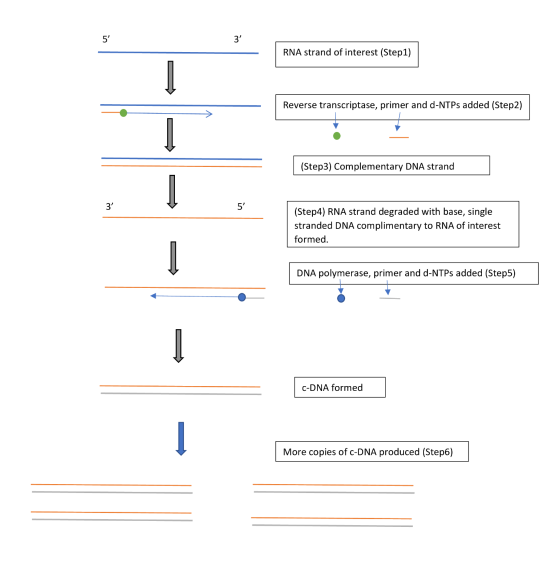
Answer: 6-1-3-2-5-4
1) Obtain an RNA sample.
2) Add one primer complementary to the 3' end of the RNA of interest. Also add the RT enzyme (reverse transcriptase), dNTPs, and a buffer with Mg2+. Incubate the reaction appropriately.
3) cDNA is produced, which is single-stranded and complementary to the RNA of interest.
4) Degrade the RNA strand with base, leaving just the cDNA.
5) Add two primers (one forward and one reverse) located within the sequence of the RNA of interest. Also add DNA polymerase, dNTPs, and a buffer with Mg2+. Cycle temperatures appropriately.
6) Double-stranded DNA for the region of interest is produced.
Follow the Figure for details:
Add Answer to:
Order the steps in RT-PCR:
1. Add one primer complementary to the 3' end of the...
Question 10 0.5 pts Order the steps in RT-PCR: • Add one primer complementary to the...
 Question 10 0.5 pts Order the steps in RT-PCR: • Add one primer complementary to the 3' end of the RNA of interest. Also add the RT enzyme (reverse transcriptase), dNTPs, and a buffer with Mg2+ Incubate the reaction appropriately. • Degrade the RNA strand with base, leaving just the cDNA. • cDNA is produced, which is single-stranded and complementary to the RNA of interest. • Double-stranded DNA for the region of interest is produced. • Add two primers (one...
Now. you should be able to answer the following questions: • How the amplification will be...
 Now. you should be able to answer the following questions: • How the amplification will be done? - How you will determine your target sequence? How the amplification will be specific for certain segment? What are the requirements to carry PCR? • Suppose you perform a PCR that begins with one double-strand of the following DNA template: +5'-CTACCTGCGGGTTGACTGCTACCTTCCCGGGATGCCCAAAATTCTCGAG-3+ +3'-GATGGACGCCCAACTGACGATGGAAGGGCCCTACGGGTTTTAAGAGCTC-5'+ A. Draw one cycle of PCR reaction below the following diagram. B. Label the template DNA, the primers, and what is...
Which of the following is the correct order of events in the polymerase chain reaction (PCR)?...
Which of the following is the correct order of events in the polymerase chain reaction (PCR)? See Section 20.2 (Page 468) cooling to allow primers to attach; heating to separate double-stranded DNA; elongation of DNA strand as nucleotides are added elongation of the DNA strand as nucleotides are added; cooling to allow primers to attach; heating to separate double-stranded DNA heating to separate double-stranded DNA; cooling to allow primers to attach; elongation of DNA strand as nucleotides are added heating...
The DNA primers used in PCR are a. complementary to DNA sequences at both ends of...
The DNA primers used in PCR are a. complementary to DNA sequences at both ends of the DNA sequence of interest. b. attached to the gene of interest by ligase. c. produced when a gene of interest is read by restriction enzymes. d. identical to the entire base sequence of one strand of the DNA.
S-CGT-3 GTG 3. Write in the following sequences to depict them hybridizing/annealing to complementary and antiparallel...
 S-CGT-3 GTG 3. Write in the following sequences to depict them hybridizing/annealing to complementary and antiparallel sequence in the exposed nucleotide chains. 5'-GTG-3 5-CGT-3 5'-ACG-3' | 5 -CAC-3" 5'-AAT[CGTATCAGCAGCAGTG|ACT-3 -3'-TTALGCATAGTCGTCGTCATGA-5'- 3. Two of the four above sequences can be used together as a "primer pair" to PCR amplify the bracketed sequence. In order to determine which two will work, recall that new polynucleotide chains can only be added to on the 3'end. Draw an arrow from the 3' end of...
pls help The DNA sequence below is 300 bases long. This is only one strand of...
 pls help
The DNA sequence below is 300 bases long. This is only one strand of DNA going from 5' starting at base 1081 to 3' ending at base 1380. The complementary strand is NOT shown. The sequence is broken up into 10 base sections to make counting easier. Design primers to amplify a DNA fragment that is 150bps in length. 1081 cagtatcagg tggtggcccc ttgcccccag tcagcaccct gacatcactg cacagtctgt 1141 ctgcctcgcc tgctccccac catggactca toatgacctc cctgcccagc gtcatgagtc 1201 tgggagagtc ctctctcctc ataggtcaaa ccgtacctgt...
pls help
The DNA sequence below is 300 bases long. This is only one strand of DNA going from 5' starting at base 1081 to 3' ending at base 1380. The complementary strand is NOT shown. The sequence is broken up into 10 base sections to make counting easier. Design primers to amplify a DNA fragment that is 150bps in length. 1081 cagtatcagg tggtggcccc ttgcccccag tcagcaccct gacatcactg cacagtctgt 1141 ctgcctcgcc tgctccccac catggactca toatgacctc cctgcccagc gtcatgagtc 1201 tgggagagtc ctctctcctc ataggtcaaa ccgtacctgt...
Where would you find histones? A. Part of the RNA polymerase complex that transcribes DNA. B....
Where would you find histones? A. Part of the RNA polymerase complex that transcribes DNA. B. In a virus, helping to "inject" foreign DNA into a cell. C. Bound to an enhancer to regulate transcription. D. Asscoiated with DNA to make chromatin. What is the role of DNA ligase during DNA replication? A. It unwinds the parental double helix. B. It synthesizes RNA nucleotides to make a primer. C. It joins lagging strand (Okazaki) fragments together. D. It stabilizes the...
Please help with all questions. I provided all the information that I have. The sequence below...
Please help with all questions. I provided all the information that I have. The sequence below represents the genomic DNA sequence of the first 440 bp of your gene of interest (exon 1 in blue). You want to amplify this full 440 bp region by PCR, for cloning into a plasmid vector. tgaagtccaactcctaagccagtgccagaagagccaaggacaggtacggctgtcatcacttagacctcaccctgtggagccacaccctagggttggccaatctactcccaggagcagggagggcaggagccagggctgggcataaaagtcagggcagagccatctattgcttacatttgcttctgacacaactgtgttcactagcaacctcaaacagacaccatggtgcatctgactcctgaggagaagtctgccgttactgccctgtggggcaaggtgaacgtggatgaagttggtggtgaggccctgggcaggttgctatcaaggttacaagacaggtttaaggagaccaatagaaactgggcatgtggagacagagaagactcttgggtttctgataggcactgactctctctgcctattggtctattttcccaccc 1.1 Design a 20 nucleotide forward & reverse primer set that will allow you to amplify the sequence above. (note - primers should be at the beginning...
1. cDNA has the same sequence as its template i) ________ but consists of ii) ________....
1. cDNA has the same sequence as its template i) ________ but consists of ii) ________. Question 1 options: i) mRNA; ii) dNTPs i) mRNA; ii) ddNTPs i) DNA; ii) dNTPs i) DNA; ii) ddNTPs i) mRNA; ii) rNTPs 2. Which of the following is an accurate description of the probes used in DNA microarrays? Question 2 options: cDNA copies of fragmented RNA isolated from samples cells More than one of these responses is correct Radiolabeled single stranded DNA fragments...
Carolina Savirana Craz 3/12/20 GECC-Polymerase Chain Reaction 1. What is the purpose of the polymerase chain...
 Carolina Savirana Craz 3/12/20 GECC-Polymerase Chain Reaction 1. What is the purpose of the polymerase chain reaction? a. To repair damaged DNA b. To make copies of entire chromosomes c. To make copies of specific regions of DNA d. To prepare cells for cell division 2. The polymerase chain reaction is most comparable to what cellular process? a. Mitosis b. Replication c. Transcription d. Translation 3. When enzymes are elongating (building) a newly synthesized DNA strand in PCR, new nucleotides...
 Question 10 0.5 pts Order the steps in RT-PCR: • Add one primer complementary to the 3' end of the RNA of interest. Also add the RT enzyme (reverse transcriptase), dNTPs, and a buffer with Mg2+ Incubate the reaction appropriately. • Degrade the RNA strand with base, leaving just the cDNA. • cDNA is produced, which is single-stranded and complementary to the RNA of interest. • Double-stranded DNA for the region of interest is produced. • Add two primers (one...
 Now. you should be able to answer the following questions: • How the amplification will be done? - How you will determine your target sequence? How the amplification will be specific for certain segment? What are the requirements to carry PCR? • Suppose you perform a PCR that begins with one double-strand of the following DNA template: +5'-CTACCTGCGGGTTGACTGCTACCTTCCCGGGATGCCCAAAATTCTCGAG-3+ +3'-GATGGACGCCCAACTGACGATGGAAGGGCCCTACGGGTTTTAAGAGCTC-5'+ A. Draw one cycle of PCR reaction below the following diagram. B. Label the template DNA, the primers, and what is...
 S-CGT-3 GTG 3. Write in the following sequences to depict them hybridizing/annealing to complementary and antiparallel sequence in the exposed nucleotide chains. 5'-GTG-3 5-CGT-3 5'-ACG-3' | 5 -CAC-3" 5'-AAT[CGTATCAGCAGCAGTG|ACT-3 -3'-TTALGCATAGTCGTCGTCATGA-5'- 3. Two of the four above sequences can be used together as a "primer pair" to PCR amplify the bracketed sequence. In order to determine which two will work, recall that new polynucleotide chains can only be added to on the 3'end. Draw an arrow from the 3' end of...
 pls help
The DNA sequence below is 300 bases long. This is only one strand of DNA going from 5' starting at base 1081 to 3' ending at base 1380. The complementary strand is NOT shown. The sequence is broken up into 10 base sections to make counting easier. Design primers to amplify a DNA fragment that is 150bps in length. 1081 cagtatcagg tggtggcccc ttgcccccag tcagcaccct gacatcactg cacagtctgt 1141 ctgcctcgcc tgctccccac catggactca toatgacctc cctgcccagc gtcatgagtc 1201 tgggagagtc ctctctcctc ataggtcaaa ccgtacctgt...
pls help
The DNA sequence below is 300 bases long. This is only one strand of DNA going from 5' starting at base 1081 to 3' ending at base 1380. The complementary strand is NOT shown. The sequence is broken up into 10 base sections to make counting easier. Design primers to amplify a DNA fragment that is 150bps in length. 1081 cagtatcagg tggtggcccc ttgcccccag tcagcaccct gacatcactg cacagtctgt 1141 ctgcctcgcc tgctccccac catggactca toatgacctc cctgcccagc gtcatgagtc 1201 tgggagagtc ctctctcctc ataggtcaaa ccgtacctgt...
 Carolina Savirana Craz 3/12/20 GECC-Polymerase Chain Reaction 1. What is the purpose of the polymerase chain reaction? a. To repair damaged DNA b. To make copies of entire chromosomes c. To make copies of specific regions of DNA d. To prepare cells for cell division 2. The polymerase chain reaction is most comparable to what cellular process? a. Mitosis b. Replication c. Transcription d. Translation 3. When enzymes are elongating (building) a newly synthesized DNA strand in PCR, new nucleotides...
Most questions answered within 3 hours.
-
Where is the error in this code sequence?
String s1 = "Hello";
String s2 = "ello";...
asked 10 months ago -
Financial data for Joel de Paris, Inc., for last year
follow:
Joel de Paris, Inc.
Balance...
asked 10 months ago -
Consider this reaction:
Al2(SO4)3 (aq)+ BaCl3
(aq) Al2Cl6 (aq)- +
3BaSO4(s) . What is the...
asked 10 months ago -
Suppose that Savneet is considering increasing her
recent random sample from 20 car rentals to 40...
asked 10 months ago -
Trucks arrive at an unloading terminal at an average rate of 120
per hour.
Trucks arrive...
asked 10 months ago -
Why are methanol and ethanol completely soluble in water while
octanol is not very little soluble....
asked 10 months ago -
A facilities manager at a university reads in a research report
that the mean amount of...
asked 10 months ago -
When the CuSO4 is rehydrated by adding water to the anhydrous
compound, is this an endothermic...
asked 10 months ago -
A ray of sunlight is passing from diamond into crown glass; the
angle of incidence is...
asked 10 months ago -
A block of mass 0.249 kg is placed on top of a light, vertical
spring of...
asked 10 months ago -
how do the kidneys compensate in the presences of acidosis
a) trigger hyperventilate
b) reserve acid...
asked 10 months ago -
Question 501 pts
The rental rate of capital to the firm increases. Which of the
following...
asked 10 months ago