Problem 9 (3 points): To describe evolution, answer the following questions: (a) Why is the three-dimensional...
Problem 9 (3 points): To describe evolution, answer the following questions:
(a) Why is the three-dimensional structure of proteins conserved in evolution while the amino acid sequence undergoes significant changes? (2 points).
(b) What are silent mutations? (1 point)
Homework Answers
Answer 9(a):
As we know, the proteins possess a three-dimensional structure by making specific arrangements. These arrangements are formed via beta strands, alpha helices, loops, etc. Sometimes as seen the structural arrangements includes motifs that perform some specific function. Although being smaller in number compared to genes, they are conserved by nature within different organisms. This becomes one of the reasons for conserving the proteins even when at primary level i.e., in amino acid sequence no homology often remains the same. This also resulted in limiting the proteins from varying much by posing these evolutionary constraints. By this, we can relate as why protein structures are more conserved than even when they undergo changes at primary level. This information gives a deeper look as to how protein conserves its nature and conserve its various biological properties within its one family.
Answer 9(b):
Silent mutations are those kinds of mutations where no significant effect can be seen on an organism’s behavior or phenotype. These are simply, neutral mutations in which the changes in amino acid do not cause a significant function of a protein. Usually, it is believed that silent mutations refer to deleting the effects of harmful mutations that otherwise might have caused. And, ultimately doesn’t impose any effect on the survival of living beings.
Add Answer to:
Problem 9 (3
points): To describe evolution, answer the
following questions:
(a) Why is the three-dimensional...
Use the following DNA sequence as the template strand to answer these questions. (8 points) 5’-...
Use the following DNA sequence as the template strand to answer these questions. (8 points) 5’- GAT CCT GCC TAA -3’ Draw the non-template DNA sequence, the mRNA sequence and the resulting peptide. Label the terminus of the DNA and peptide!! Draw a point mutation. Is this a transition mutation or transverse mutation? Did it change the amino acid sequence(draw out the peptide)? 4 bp insertion, and the resulting peptide. 2 bp deletion, and the resulting peptide. A copy number...
why the answer is B d start codon in groups of three bases Answer 3. The...
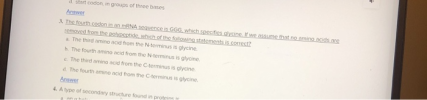 why the answer is B
d start codon in groups of three bases Answer 3. The fourth codon in an mRNA sequence is GGG which specifies glycine. If we assume that no omino Acids are removed from the polypeptide, which of the following statements is correct? a. The third amino acid from the N-terminus is glycine. h. The fourth amino acid from the N-terminus is glycine. The third amino acid from the C-terminus is glycine, d. The fourth amino acid...
why the answer is B
d start codon in groups of three bases Answer 3. The fourth codon in an mRNA sequence is GGG which specifies glycine. If we assume that no omino Acids are removed from the polypeptide, which of the following statements is correct? a. The third amino acid from the N-terminus is glycine. h. The fourth amino acid from the N-terminus is glycine. The third amino acid from the C-terminus is glycine, d. The fourth amino acid...
3. (1.8 points) The normal CFTR gene contains these six codons near the middle of the...
 3. (1.8 points) The normal CFTR gene contains these six codons near the middle of the transcript: AUU UCU VUA GCA AGA GCU... Al The corresponding amino acids in the normal CFTR protein are: (Use either the one-or three-letter amino acid codes A naint mutation changes the last nucleotide from U to C. At the DNA level, this is a transition transversion c) At the protein level, this is a (silent / missense / nonsense/frameshift ) mutation. D) Instead of...
Given the following mRNA sequence, 5'–CGCAAGGCCUAU–3?', answer the questions below. A link to a table of...
 Given the following mRNA sequence, 5'–CGCAAGGCCUAU–3?', answer the questions below. A link to a table of codons can
be found here.
Given the following mRNA sequence, 5'-CGCAAGGCCUAU-3', answer the questions below. A link to aa table of codons can be found here a) What amino acid sequence, using the three-letter designations for amino acids, is coded for by the mRNA? b) If a mutation converts AAG to CAG, what is the amino acid sequence? c) What will the amino acid...
Given the following mRNA sequence, 5'–CGCAAGGCCUAU–3?', answer the questions below. A link to a table of codons can
be found here.
Given the following mRNA sequence, 5'-CGCAAGGCCUAU-3', answer the questions below. A link to aa table of codons can be found here a) What amino acid sequence, using the three-letter designations for amino acids, is coded for by the mRNA? b) If a mutation converts AAG to CAG, what is the amino acid sequence? c) What will the amino acid...
xProteins Quiz x ipids Quiz x Lipids Quiz t/view do?attempt- 1&context 0a4ce60a0a0001dc4786cd79dbacf795 Question1 Select one answer...
 xProteins Quiz x ipids Quiz x Lipids Quiz t/view do?attempt- 1&context 0a4ce60a0a0001dc4786cd79dbacf795 Question1 Select one answer Where do peptide bonds form? A. Between adjacent carboxyl groups on amino acids. B. Between amino acids of two different protein chains. C. Between the carboxyl group of one amino acid and the amino group of another amino o points acid. D. Between adjacent amino groups on amino acids. Question2 Select one answer The following structure is the amino acid glutamic acid. Four atoms...
Help! All of it. Please help 3. Answer the following questions that are based on the...
 Help! All of it. Please help
3. Answer the following questions that are based on the information in the abstract shown below. Jin H, Zhou H, Liu H, Chan W, Adhikary L, Mahmood K, Lee MS, Kemble G. (2005)Two residues in the hemagglutinin of A/Fujian 411/02-like influenza viruses are responsible for antigenic drift from A/Panama/2007/99. Virology 336(1):113-9. The H3N2 vaccine strain (A/Panama/2007/99) for the 2003-2004 influenza season did not antigenically match the circulating A/Fujian/411/02-like H3N2 viruses and had reduced effectiveness...
Help! All of it. Please help
3. Answer the following questions that are based on the information in the abstract shown below. Jin H, Zhou H, Liu H, Chan W, Adhikary L, Mahmood K, Lee MS, Kemble G. (2005)Two residues in the hemagglutinin of A/Fujian 411/02-like influenza viruses are responsible for antigenic drift from A/Panama/2007/99. Virology 336(1):113-9. The H3N2 vaccine strain (A/Panama/2007/99) for the 2003-2004 influenza season did not antigenically match the circulating A/Fujian/411/02-like H3N2 viruses and had reduced effectiveness...
Please note that Questions 15 to 17 are connected questions. Question 15: The following shows a...
 Please note that Questions 15 to 17 are connected
questions.
Question 15:
The following shows a partial DNA sequence from the wild-type
(normal) allele for the human leukemia-linked apoptotic
gene.
5' ATGCGATTAATCGGTAAA 3' (non-template strand)
3' TACGCTAATTAGCCATTT 5' (template strand)
Please answer the following questions:
(a) If the bottom strand serves as the DNA template for
transcription, what is the resulting mRNA sequence?
The mRNA sequence is 5' 3'. (2
marks)
5' AUG CGA UUA AUC GGU AAA 3' ?
Please enter...
Please note that Questions 15 to 17 are connected
questions.
Question 15:
The following shows a partial DNA sequence from the wild-type
(normal) allele for the human leukemia-linked apoptotic
gene.
5' ATGCGATTAATCGGTAAA 3' (non-template strand)
3' TACGCTAATTAGCCATTT 5' (template strand)
Please answer the following questions:
(a) If the bottom strand serves as the DNA template for
transcription, what is the resulting mRNA sequence?
The mRNA sequence is 5' 3'. (2
marks)
5' AUG CGA UUA AUC GGU AAA 3' ?
Please enter...
(18 pts) Answer True or False for each of the following questions (a) An amino acid...
 (18 pts) Answer True or False for each of the following questions (a) An amino acid is in the zwitterionic form only if the pll is well below 7 (b) Salting out takes advantage of the fact that the solubility of proteins varies with concentration. (c) Proteins usually consists of amino acids of both L-isomers (d) Essentially all a-helices found in proteins are left-handed globular protein is thermodynamically the most stable structure. ( Isoclectric focusing can be used to separate...
Please answer all Questions QUESTION 1 25 points Swing Answer Which of the following is not a component of a trycer...
 Please answer all
Questions
QUESTION 1 25 points Swing Answer Which of the following is not a component of a tryceride? glycerol choline fatty acid QUESTION 2 25 points Save Answer Denaturation of proteins by heat can affect all but one of the following levels of structure primary structure O secondary structure O rary structure O quaternary structure Save Answer QUESTION 3 25 points The following fatty acids Osaturated an omega-3 monounsaturated O mega 6 QUESTION 4 25 points Save...
Please answer all
Questions
QUESTION 1 25 points Swing Answer Which of the following is not a component of a tryceride? glycerol choline fatty acid QUESTION 2 25 points Save Answer Denaturation of proteins by heat can affect all but one of the following levels of structure primary structure O secondary structure O rary structure O quaternary structure Save Answer QUESTION 3 25 points The following fatty acids Osaturated an omega-3 monounsaturated O mega 6 QUESTION 4 25 points Save...
3· The figure below shows the structure of the human version of the tinman gene (NKX2-5 is the ve...
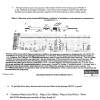 3· The figure below shows the structure of the human version of the tinman gene (NKX2-5 is the vertebrate homologue of tinman). It also shows the mutations found in the affected families and compares the homoebox sequence of the human gene to other similar genes. Figure 3 Structure of the human NKX2-5gene, positions of mutations, and sequence comparison to related gens: ATG TAG The 17Met ain19 Ter GAntp Structure of the human NKX2-5gene positions of mutations, and sequence comparison to...
 why the answer is B
d start codon in groups of three bases Answer 3. The fourth codon in an mRNA sequence is GGG which specifies glycine. If we assume that no omino Acids are removed from the polypeptide, which of the following statements is correct? a. The third amino acid from the N-terminus is glycine. h. The fourth amino acid from the N-terminus is glycine. The third amino acid from the C-terminus is glycine, d. The fourth amino acid...
why the answer is B
d start codon in groups of three bases Answer 3. The fourth codon in an mRNA sequence is GGG which specifies glycine. If we assume that no omino Acids are removed from the polypeptide, which of the following statements is correct? a. The third amino acid from the N-terminus is glycine. h. The fourth amino acid from the N-terminus is glycine. The third amino acid from the C-terminus is glycine, d. The fourth amino acid...
 3. (1.8 points) The normal CFTR gene contains these six codons near the middle of the transcript: AUU UCU VUA GCA AGA GCU... Al The corresponding amino acids in the normal CFTR protein are: (Use either the one-or three-letter amino acid codes A naint mutation changes the last nucleotide from U to C. At the DNA level, this is a transition transversion c) At the protein level, this is a (silent / missense / nonsense/frameshift ) mutation. D) Instead of...
 Given the following mRNA sequence, 5'–CGCAAGGCCUAU–3?', answer the questions below. A link to a table of codons can
be found here.
Given the following mRNA sequence, 5'-CGCAAGGCCUAU-3', answer the questions below. A link to aa table of codons can be found here a) What amino acid sequence, using the three-letter designations for amino acids, is coded for by the mRNA? b) If a mutation converts AAG to CAG, what is the amino acid sequence? c) What will the amino acid...
Given the following mRNA sequence, 5'–CGCAAGGCCUAU–3?', answer the questions below. A link to a table of codons can
be found here.
Given the following mRNA sequence, 5'-CGCAAGGCCUAU-3', answer the questions below. A link to aa table of codons can be found here a) What amino acid sequence, using the three-letter designations for amino acids, is coded for by the mRNA? b) If a mutation converts AAG to CAG, what is the amino acid sequence? c) What will the amino acid...
 xProteins Quiz x ipids Quiz x Lipids Quiz t/view do?attempt- 1&context 0a4ce60a0a0001dc4786cd79dbacf795 Question1 Select one answer Where do peptide bonds form? A. Between adjacent carboxyl groups on amino acids. B. Between amino acids of two different protein chains. C. Between the carboxyl group of one amino acid and the amino group of another amino o points acid. D. Between adjacent amino groups on amino acids. Question2 Select one answer The following structure is the amino acid glutamic acid. Four atoms...
 Help! All of it. Please help
3. Answer the following questions that are based on the information in the abstract shown below. Jin H, Zhou H, Liu H, Chan W, Adhikary L, Mahmood K, Lee MS, Kemble G. (2005)Two residues in the hemagglutinin of A/Fujian 411/02-like influenza viruses are responsible for antigenic drift from A/Panama/2007/99. Virology 336(1):113-9. The H3N2 vaccine strain (A/Panama/2007/99) for the 2003-2004 influenza season did not antigenically match the circulating A/Fujian/411/02-like H3N2 viruses and had reduced effectiveness...
Help! All of it. Please help
3. Answer the following questions that are based on the information in the abstract shown below. Jin H, Zhou H, Liu H, Chan W, Adhikary L, Mahmood K, Lee MS, Kemble G. (2005)Two residues in the hemagglutinin of A/Fujian 411/02-like influenza viruses are responsible for antigenic drift from A/Panama/2007/99. Virology 336(1):113-9. The H3N2 vaccine strain (A/Panama/2007/99) for the 2003-2004 influenza season did not antigenically match the circulating A/Fujian/411/02-like H3N2 viruses and had reduced effectiveness...
 Please note that Questions 15 to 17 are connected
questions.
Question 15:
The following shows a partial DNA sequence from the wild-type
(normal) allele for the human leukemia-linked apoptotic
gene.
5' ATGCGATTAATCGGTAAA 3' (non-template strand)
3' TACGCTAATTAGCCATTT 5' (template strand)
Please answer the following questions:
(a) If the bottom strand serves as the DNA template for
transcription, what is the resulting mRNA sequence?
The mRNA sequence is 5' 3'. (2
marks)
5' AUG CGA UUA AUC GGU AAA 3' ?
Please enter...
Please note that Questions 15 to 17 are connected
questions.
Question 15:
The following shows a partial DNA sequence from the wild-type
(normal) allele for the human leukemia-linked apoptotic
gene.
5' ATGCGATTAATCGGTAAA 3' (non-template strand)
3' TACGCTAATTAGCCATTT 5' (template strand)
Please answer the following questions:
(a) If the bottom strand serves as the DNA template for
transcription, what is the resulting mRNA sequence?
The mRNA sequence is 5' 3'. (2
marks)
5' AUG CGA UUA AUC GGU AAA 3' ?
Please enter...
 (18 pts) Answer True or False for each of the following questions (a) An amino acid is in the zwitterionic form only if the pll is well below 7 (b) Salting out takes advantage of the fact that the solubility of proteins varies with concentration. (c) Proteins usually consists of amino acids of both L-isomers (d) Essentially all a-helices found in proteins are left-handed globular protein is thermodynamically the most stable structure. ( Isoclectric focusing can be used to separate...
 Please answer all
Questions
QUESTION 1 25 points Swing Answer Which of the following is not a component of a tryceride? glycerol choline fatty acid QUESTION 2 25 points Save Answer Denaturation of proteins by heat can affect all but one of the following levels of structure primary structure O secondary structure O rary structure O quaternary structure Save Answer QUESTION 3 25 points The following fatty acids Osaturated an omega-3 monounsaturated O mega 6 QUESTION 4 25 points Save...
Please answer all
Questions
QUESTION 1 25 points Swing Answer Which of the following is not a component of a tryceride? glycerol choline fatty acid QUESTION 2 25 points Save Answer Denaturation of proteins by heat can affect all but one of the following levels of structure primary structure O secondary structure O rary structure O quaternary structure Save Answer QUESTION 3 25 points The following fatty acids Osaturated an omega-3 monounsaturated O mega 6 QUESTION 4 25 points Save...
 3· The figure below shows the structure of the human version of the tinman gene (NKX2-5 is the vertebrate homologue of tinman). It also shows the mutations found in the affected families and compares the homoebox sequence of the human gene to other similar genes. Figure 3 Structure of the human NKX2-5gene, positions of mutations, and sequence comparison to related gens: ATG TAG The 17Met ain19 Ter GAntp Structure of the human NKX2-5gene positions of mutations, and sequence comparison to...
Most questions answered within 3 hours.
-
Where is the error in this code sequence?
String s1 = "Hello";
String s2 = "ello";...
asked 10 months ago -
Financial data for Joel de Paris, Inc., for last year
follow:
Joel de Paris, Inc.
Balance...
asked 10 months ago -
Consider this reaction:
Al2(SO4)3 (aq)+ BaCl3
(aq) Al2Cl6 (aq)- +
3BaSO4(s) . What is the...
asked 10 months ago -
Suppose that Savneet is considering increasing her
recent random sample from 20 car rentals to 40...
asked 10 months ago -
Trucks arrive at an unloading terminal at an average rate of 120
per hour.
Trucks arrive...
asked 10 months ago -
Why are methanol and ethanol completely soluble in water while
octanol is not very little soluble....
asked 10 months ago -
A facilities manager at a university reads in a research report
that the mean amount of...
asked 10 months ago -
When the CuSO4 is rehydrated by adding water to the anhydrous
compound, is this an endothermic...
asked 10 months ago -
A ray of sunlight is passing from diamond into crown glass; the
angle of incidence is...
asked 10 months ago -
A block of mass 0.249 kg is placed on top of a light, vertical
spring of...
asked 10 months ago -
how do the kidneys compensate in the presences of acidosis
a) trigger hyperventilate
b) reserve acid...
asked 10 months ago -
Question 501 pts
The rental rate of capital to the firm increases. Which of the
following...
asked 10 months ago