1. You want to prepare a 1:50 dilution of your protein extract in a total volume...
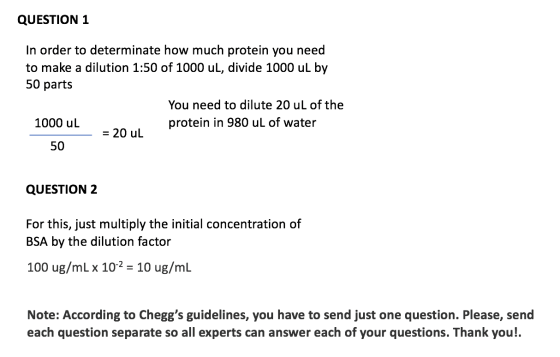
1. You want to prepare a 1:50 dilution of your protein extract in a total volume of 1000 uL. You will need ___ uL of protein extract and ___ uL of water.
2. You are provided with a solution of BSA that is 100 ug/mL and make a 10-2 dilution? What is the resulting concentration of the DILUTED BSA?
3.
Which of the following statements about enzymes is true?
Select one:
a. Enzymes increase the rate of a chemical reaction by raising the activation energy for the reaction
b. Enzymes react with their substrate (form chemical bonds), forming an enzyme-substrate complex, which irreversibly changes the enzyme
c. Enzymes work equally well at any temperature
d. Enzymes can typically bind many types of substrates
e. None of the above
4. A Bradford assay is one application of using a “standard curve.” One uses known concentrations of BSA (and their measured absorbance at 595 nm values) to calculate unknown concentrations of some solution of interest (i.e. our protein extract). For example, you measure the absorbance readings of known concentrations of BSA and make a “y vs. x” plot: Absorbance at 595 nm vs. Concentration (ug/mL). You obtain a regression equation of y = 0.096x + 0.0286. Suppose the Abs595 reading of a 1:10 dilution of a protein extract was 0.26. What is the protein concentration of the UNDILUTED protein extract?
Please answer all
Homework Answers
Add Answer to:
1. You want to prepare a 1:50 dilution of your protein extract
in a total volume...
1. You have generated the following standard curve after a Bradford Assay to measure Absorbance vs...
 1. You have generated the following standard curve after a Bradford Assay to measure Absorbance vs samples of known BSA concentrations. Now you need to determine the amount of protein in two mitochondria samples taken from fish, one taken from fish under normal conditions and the other taken from fish under oxidative stress. The absorbance reading for the normal fish fraction was A595=175, and the absorbance reading for the stressed fish fraction was A595= 275 Bradford Assay Standard Curve y...
Question 14 4 pts A protein assay was performed using the Bradford Reagent to determine the...
 Question 14 4 pts A protein assay was performed using the Bradford Reagent to determine the protein concentrations of a series of pet food extract samples. The BSA Standard Curve had a slope of 0.0173 Data obtained for the pet food are shown in the table below. Tubes 1-2 contained different volumes of the pet food extract. Tube # Volume Sample (UL) A(595) Volume Volume Water Reagent (3.0 (L) mL) 803 503 1 2 20 50 0.293 0.657 What is...
I forgot to put down that the observance (=OD) at 280nm is 0.679A Experiment 8: Bradford...
 I forgot to put down that the observance (=OD) at 280nm is
0.679A
Experiment 8: Bradford assay and UV-method for determination of protein concentrations Materials - An ice bucket with ice, your purified sample, three visible plastic cuvettes for Bradford assay, one UV plastic cuvette for UV-method, a piece of parafilm, a Vis-spec, a Lab Quest, Bradford reagent, white tape (share), a sharpie. Bradford assay (reference 21) 1. Add 990 uk Bradford assay reagent to a plastic cuvette 2. Blank...
I forgot to put down that the observance (=OD) at 280nm is
0.679A
Experiment 8: Bradford assay and UV-method for determination of protein concentrations Materials - An ice bucket with ice, your purified sample, three visible plastic cuvettes for Bradford assay, one UV plastic cuvette for UV-method, a piece of parafilm, a Vis-spec, a Lab Quest, Bradford reagent, white tape (share), a sharpie. Bradford assay (reference 21) 1. Add 990 uk Bradford assay reagent to a plastic cuvette 2. Blank...
Could you please help me figure this out. This is based on the 'protein concentration quantification'...
Could you please help me figure this out. This is based on the 'protein concentration quantification' lab we conducted in class. We did both the Lowry and Bradford Reagent methods. There were 3 unknown protein concentrations (unknown A = Lactase; unknown B= Insulin; unknown C= BSA). We used 0.5 ml of each protein sample for our unknowns. Below are my unknown concentrations for the Lowry method: Unknown A = 225.3 ug/ml Unknown B = 238.1 ug/ml Unknown C= 517.5 ug/ml...
Lab 5: Additional Dilution Problems You have a stock solution that contains 24 mg/ml of protein....
 Lab 5: Additional Dilution Problems You have a stock solution that contains 24 mg/ml of protein. You want to make a set of standards with the following concentrations: 12 mg/ml, 6 mg/ml, 3 mg/ml and 1.5 mg/ml You need a minimum of 500 ul of each standard after all dilutions are completed. Using the technique of serial dilution, explain how you would make your standards by filling in the chart below. Std 4 Std 1 12 Std 2 6 Std...
You have 0.5 mL sample of protein extract (absorbance 0.5930) with a concentration of 181.2 ug/mL....
You have 0.5 mL sample of protein extract (absorbance 0.5930) with a concentration of 181.2 ug/mL. How many ug (micrograms) of sample do you have?
1.How would you make 1 mL of a 1 to 25 dilution of yeast crude extract?...
1.How would you make 1 mL of a 1 to 25 dilution of yeast crude extract? 2. Enzyme activity measures: A)The number of polypeptide molecules B)The number of substrate molecule C)The energy used in the reaction D)The rate at which substrate is processed by the enzyme
2.(1 point) You have 125 μLof a protein sample. Of this, you dilute30μLinto 120μLof buffer. 50μL...
2.(1 point) You have 125 μLof a protein sample. Of this, you dilute30μLinto 120μLof buffer. 50μL of that dilution were used for a Bradford assay and produced an absorbance of 0.53.Using the standard curveyou built in the lab using BSA, find the protein concentration (in μg/μL) of the original protein sample. Show your work. (Hint: first find the dilution fold of the sample that was used for the assay.) Note: equation from standard curve: y=0.0093x + 0.1877 show all work.
You have a protein solution. You take 5 ml of the solution, and add 25 ml...
You have a protein solution. You take 5 ml of the solution, and add 25 ml of buffer. You then add 50 µl of the dilute protein solution to 50 µl of buffer and 2 ml of Coomassie solution. The resulting absorbance at 595 nm was 0.457. At the same time, you prepared a standard curve for the same protein using the same Coomassie assay protocol (100 µl of sample + 2 ml of coomassie reagent) The linear fit to...
If you are making a 1:10 dilution of a 10mg/ml BSA solution using 90ul of water...
If you are making a 1:10 dilution of a 10mg/ml BSA solution using 90ul of water as diluent, how much 10mg/ml of BSA would you add? What would be your final concentration of BSA? If you assayed both these solutions using the Bradford assay which one would have a higher O.D.?
 1. You have generated the following standard curve after a Bradford Assay to measure Absorbance vs samples of known BSA concentrations. Now you need to determine the amount of protein in two mitochondria samples taken from fish, one taken from fish under normal conditions and the other taken from fish under oxidative stress. The absorbance reading for the normal fish fraction was A595=175, and the absorbance reading for the stressed fish fraction was A595= 275 Bradford Assay Standard Curve y...
 Question 14 4 pts A protein assay was performed using the Bradford Reagent to determine the protein concentrations of a series of pet food extract samples. The BSA Standard Curve had a slope of 0.0173 Data obtained for the pet food are shown in the table below. Tubes 1-2 contained different volumes of the pet food extract. Tube # Volume Sample (UL) A(595) Volume Volume Water Reagent (3.0 (L) mL) 803 503 1 2 20 50 0.293 0.657 What is...
 I forgot to put down that the observance (=OD) at 280nm is
0.679A
Experiment 8: Bradford assay and UV-method for determination of protein concentrations Materials - An ice bucket with ice, your purified sample, three visible plastic cuvettes for Bradford assay, one UV plastic cuvette for UV-method, a piece of parafilm, a Vis-spec, a Lab Quest, Bradford reagent, white tape (share), a sharpie. Bradford assay (reference 21) 1. Add 990 uk Bradford assay reagent to a plastic cuvette 2. Blank...
I forgot to put down that the observance (=OD) at 280nm is
0.679A
Experiment 8: Bradford assay and UV-method for determination of protein concentrations Materials - An ice bucket with ice, your purified sample, three visible plastic cuvettes for Bradford assay, one UV plastic cuvette for UV-method, a piece of parafilm, a Vis-spec, a Lab Quest, Bradford reagent, white tape (share), a sharpie. Bradford assay (reference 21) 1. Add 990 uk Bradford assay reagent to a plastic cuvette 2. Blank...
 Lab 5: Additional Dilution Problems You have a stock solution that contains 24 mg/ml of protein. You want to make a set of standards with the following concentrations: 12 mg/ml, 6 mg/ml, 3 mg/ml and 1.5 mg/ml You need a minimum of 500 ul of each standard after all dilutions are completed. Using the technique of serial dilution, explain how you would make your standards by filling in the chart below. Std 4 Std 1 12 Std 2 6 Std...
Most questions answered within 3 hours.
-
Where is the error in this code sequence?
String s1 = "Hello";
String s2 = "ello";...
asked 11 months ago -
Financial data for Joel de Paris, Inc., for last year
follow:
Joel de Paris, Inc.
Balance...
asked 11 months ago -
Consider this reaction:
Al2(SO4)3 (aq)+ BaCl3
(aq) Al2Cl6 (aq)- +
3BaSO4(s) . What is the...
asked 11 months ago -
Suppose that Savneet is considering increasing her
recent random sample from 20 car rentals to 40...
asked 11 months ago -
Trucks arrive at an unloading terminal at an average rate of 120
per hour.
Trucks arrive...
asked 11 months ago -
Why are methanol and ethanol completely soluble in water while
octanol is not very little soluble....
asked 11 months ago -
A facilities manager at a university reads in a research report
that the mean amount of...
asked 11 months ago -
When the CuSO4 is rehydrated by adding water to the anhydrous
compound, is this an endothermic...
asked 11 months ago -
A ray of sunlight is passing from diamond into crown glass; the
angle of incidence is...
asked 11 months ago -
A block of mass 0.249 kg is placed on top of a light, vertical
spring of...
asked 11 months ago -
how do the kidneys compensate in the presences of acidosis
a) trigger hyperventilate
b) reserve acid...
asked 11 months ago -
Question 501 pts
The rental rate of capital to the firm increases. Which of the
following...
asked 11 months ago