
Homework Answers
(b)
The possible chromosomal arrangements that can result from a crossover in an individual heterozygous for the given two inverted chromosomes are shown below:
A-B-C-*-e-d-F-G-H
A-B-C-*-D-E-g-f-H
(c)
The possible chromosomal arrangements that can result from a crossover in an individual heterozygous for the given two inverted chromosomes are shown below:
A-B-c-*-D-E-F-G-H
A-B-C-*-e-d-F-G-H
A-B-C-*-D-F-G-e-H
Add Answer to:
b) Which chromosomal arrangements could result from a crossover in an individual heterozygous for the following...
b) Which chromosomal arrangements could result from a crossover in an individual heterozygous for the following...
 b) Which chromosomal arrangements could result from a crossover in an individual heterozygous for the following two inverted chromosomes? (* denotes the centromere; assume no double crossovers) A-B-C-*-D-E-F-G-H A-B-C-*-D-g-f-e-H A-B-C-*-D-E-F-G-H A-B-C-*-e-d-F-G-H A-B-C-*-D-e-B-A A-B-C-*-D-E-g-f-H A-B-C-*-D-F-G-e-H A-B-C-*-D-e-A-B A-B-C-*-D-E-f-g-D-*-C-B-A H-G-F-E-d-*-C-F-G-H H-G-F-e-H
An individual is heterozygous for an inversion. The non-inverted allele has genes in the following order:...
An individual is heterozygous for an inversion. The non-inverted allele has genes in the following order: A B ● C D E F G H I . The inverted allele has genes in the following order: A B ● C D G F E H I . If a crossover between F and G occurs during meiosis in this individual, which of the following is not a gamete that could be produced from this meiosis? a. A B ● C...
2, An individual is heterozygous for an inversion chromosome as shown below: A. Draw the looped...
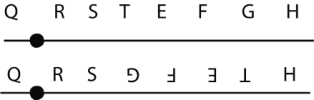 2, An individual is heterozygous for an inversion
chromosome as shown below:
A. Draw the looped arrangement of the chromosomes that
you would expect to see when they are paired for meiosis I.
(Although there are four strands present at meiosis I, only two are
shown here; you need only draw two strands).
B. Assume that a crossover
exchange takes place in the interval between T and E at meiosis I.
Draw the structure of the products you would expect...
2, An individual is heterozygous for an inversion
chromosome as shown below:
A. Draw the looped arrangement of the chromosomes that
you would expect to see when they are paired for meiosis I.
(Although there are four strands present at meiosis I, only two are
shown here; you need only draw two strands).
B. Assume that a crossover
exchange takes place in the interval between T and E at meiosis I.
Draw the structure of the products you would expect...
A chromosome with genetic markers A, B, C, D, E, F, G, H, I and J...
A chromosome with genetic markers A, B, C, D, E, F, G, H, I and J ( “*” represents the centromere ) is shown below: A B C D E * F G H I J Another chromosome is found to contain a b c d i h g f * e j If these two chromosomes are paired during meiosis, a single crossover takes place between F and G, and another single crossover takes place between H and I....
Given a chromosome with the gene order, A B C D ∙ E F G H,...
Given a chromosome with the gene order, A B C D ∙ E F G H, and an inverted chromosome with this gene order, A F E ∙ D C B G H, which of the following recombinant chromosomes would result from a crossover between C and D? A) A B C C B G H and H G F E ∙ D C B G H B) A B C D ∙ E F A and H ∙ G...
please show all steps and explain thoroughly ! thank you! 2. An individual is heterozygous for...
 please show all steps and explain thoroughly ! thank
you!
2. An individual is heterozygous for an inversion chromosome as shown below: Q R S T E F G H Q R S 9 3 1 H A. Draw the looped arrangement of the chromosomes that you would expect to see when they are paired for meiosis I. (Although there are four strands present at meiosis I, only two are shown here; you need only draw two strands). B. Assume...
please show all steps and explain thoroughly ! thank
you!
2. An individual is heterozygous for an inversion chromosome as shown below: Q R S T E F G H Q R S 9 3 1 H A. Draw the looped arrangement of the chromosomes that you would expect to see when they are paired for meiosis I. (Although there are four strands present at meiosis I, only two are shown here; you need only draw two strands). B. Assume...
1. A genetic cross in which the inheritance of two traits is observed is called a...
 1. A genetic cross in which the inheritance of two traits is observed is called a A) Dihybrid cross. B) Monohybrid cross C) Backeross D) Testcross 2. For single crossovers, the frequency of recombinant gametes is half the frequency of crossing over because A) A testeross between a homozygous and heterozygote produces 1/2 heterozygous and 1/2 homozygous progeny. B) The frequency of recombination is always 50%. C) Each crossover takes place between only two of the four chromatids of a...
Consider two non-homologous chromosomes whose normal sequence of segments and centromere locations are shown here. What...
 Consider two non-homologous chromosomes whose normal sequence of
segments and centromere locations are shown here. What kind of
changes are these? I think it's a translocation and i cannot tell
what the second one is.
Question 7: (2 points) Consider two non-homologous chromosomes whose normal sequences of segments and centromere locations are shown here. Chromosome 1 A B C D E F G H Chromosome 2 O R . S T U V Determine the type (or types) of chromosomal...
Consider two non-homologous chromosomes whose normal sequence of
segments and centromere locations are shown here. What kind of
changes are these? I think it's a translocation and i cannot tell
what the second one is.
Question 7: (2 points) Consider two non-homologous chromosomes whose normal sequences of segments and centromere locations are shown here. Chromosome 1 A B C D E F G H Chromosome 2 O R . S T U V Determine the type (or types) of chromosomal...
3. A phenotypically abnormal individual has a phenotypically normal father with an inversion on one copy of chromosome 7 and a normal mother without any changes in chromosome structure. The order of...
 3. A phenotypically abnormal individual has a phenotypically normal father with an inversion on one copy of chromosome 7 and a normal mother without any changes in chromosome structure. The order of genes along chromosome 7 in the father is as follows: normal chromosome 7) RTDM centromere P UXZC RTDUP centromere MXZC (inverted chromosome 7) The phenotypically abnormal offspring has a chromosome 7 with the following order of genes R TDM centromere P U D TR With a sketch (complete),...
d) An individual is heterozygous for the following reciprocally translocated chromosomes (* denotes the centromere): M-N-O-P-*-Q-R-S...
 d) An individual is heterozygous for the following reciprocally translocated chromosomes (* denotes the centromere): M-N-O-P-*-Q-R-S V-w-x-*-y-z V-W-P-*-Q-R-S M-N-O-x-*-y-z Which non-recombinant haploid gametes below will result in a deficiency or duplication of genetic material in the fertilized embryo? O Gamete A: M-N-O-P-*-Q-R- S M -N-O-x-*-y-z O Gamete B: M-N-O-P -Q-R- S V -W-X--y-z O Gamete C: M-N-O-x-*-y-z V-W-P--Q-R-S O Gamete D: V-W-P-*-Q-R-S V-W-X-*-y-z f) What is the frequency of each of these non-recombinant gametes? Number g) Which form of segregation...
 b) Which chromosomal arrangements could result from a crossover in an individual heterozygous for the following two inverted chromosomes? (* denotes the centromere; assume no double crossovers) A-B-C-*-D-E-F-G-H A-B-C-*-D-g-f-e-H A-B-C-*-D-E-F-G-H A-B-C-*-e-d-F-G-H A-B-C-*-D-e-B-A A-B-C-*-D-E-g-f-H A-B-C-*-D-F-G-e-H A-B-C-*-D-e-A-B A-B-C-*-D-E-f-g-D-*-C-B-A H-G-F-E-d-*-C-F-G-H H-G-F-e-H
 2, An individual is heterozygous for an inversion
chromosome as shown below:
A. Draw the looped arrangement of the chromosomes that
you would expect to see when they are paired for meiosis I.
(Although there are four strands present at meiosis I, only two are
shown here; you need only draw two strands).
B. Assume that a crossover
exchange takes place in the interval between T and E at meiosis I.
Draw the structure of the products you would expect...
2, An individual is heterozygous for an inversion
chromosome as shown below:
A. Draw the looped arrangement of the chromosomes that
you would expect to see when they are paired for meiosis I.
(Although there are four strands present at meiosis I, only two are
shown here; you need only draw two strands).
B. Assume that a crossover
exchange takes place in the interval between T and E at meiosis I.
Draw the structure of the products you would expect...
 please show all steps and explain thoroughly ! thank
you!
2. An individual is heterozygous for an inversion chromosome as shown below: Q R S T E F G H Q R S 9 3 1 H A. Draw the looped arrangement of the chromosomes that you would expect to see when they are paired for meiosis I. (Although there are four strands present at meiosis I, only two are shown here; you need only draw two strands). B. Assume...
please show all steps and explain thoroughly ! thank
you!
2. An individual is heterozygous for an inversion chromosome as shown below: Q R S T E F G H Q R S 9 3 1 H A. Draw the looped arrangement of the chromosomes that you would expect to see when they are paired for meiosis I. (Although there are four strands present at meiosis I, only two are shown here; you need only draw two strands). B. Assume...
 1. A genetic cross in which the inheritance of two traits is observed is called a A) Dihybrid cross. B) Monohybrid cross C) Backeross D) Testcross 2. For single crossovers, the frequency of recombinant gametes is half the frequency of crossing over because A) A testeross between a homozygous and heterozygote produces 1/2 heterozygous and 1/2 homozygous progeny. B) The frequency of recombination is always 50%. C) Each crossover takes place between only two of the four chromatids of a...
 Consider two non-homologous chromosomes whose normal sequence of
segments and centromere locations are shown here. What kind of
changes are these? I think it's a translocation and i cannot tell
what the second one is.
Question 7: (2 points) Consider two non-homologous chromosomes whose normal sequences of segments and centromere locations are shown here. Chromosome 1 A B C D E F G H Chromosome 2 O R . S T U V Determine the type (or types) of chromosomal...
Consider two non-homologous chromosomes whose normal sequence of
segments and centromere locations are shown here. What kind of
changes are these? I think it's a translocation and i cannot tell
what the second one is.
Question 7: (2 points) Consider two non-homologous chromosomes whose normal sequences of segments and centromere locations are shown here. Chromosome 1 A B C D E F G H Chromosome 2 O R . S T U V Determine the type (or types) of chromosomal...
 3. A phenotypically abnormal individual has a phenotypically normal father with an inversion on one copy of chromosome 7 and a normal mother without any changes in chromosome structure. The order of genes along chromosome 7 in the father is as follows: normal chromosome 7) RTDM centromere P UXZC RTDUP centromere MXZC (inverted chromosome 7) The phenotypically abnormal offspring has a chromosome 7 with the following order of genes R TDM centromere P U D TR With a sketch (complete),...
 d) An individual is heterozygous for the following reciprocally translocated chromosomes (* denotes the centromere): M-N-O-P-*-Q-R-S V-w-x-*-y-z V-W-P-*-Q-R-S M-N-O-x-*-y-z Which non-recombinant haploid gametes below will result in a deficiency or duplication of genetic material in the fertilized embryo? O Gamete A: M-N-O-P-*-Q-R- S M -N-O-x-*-y-z O Gamete B: M-N-O-P -Q-R- S V -W-X--y-z O Gamete C: M-N-O-x-*-y-z V-W-P--Q-R-S O Gamete D: V-W-P-*-Q-R-S V-W-X-*-y-z f) What is the frequency of each of these non-recombinant gametes? Number g) Which form of segregation...
Most questions answered within 3 hours.
-
Where is the error in this code sequence?
String s1 = "Hello";
String s2 = "ello";...
asked 10 months ago -
Financial data for Joel de Paris, Inc., for last year
follow:
Joel de Paris, Inc.
Balance...
asked 10 months ago -
Consider this reaction:
Al2(SO4)3 (aq)+ BaCl3
(aq) Al2Cl6 (aq)- +
3BaSO4(s) . What is the...
asked 10 months ago -
Suppose that Savneet is considering increasing her
recent random sample from 20 car rentals to 40...
asked 10 months ago -
Trucks arrive at an unloading terminal at an average rate of 120
per hour.
Trucks arrive...
asked 10 months ago -
Why are methanol and ethanol completely soluble in water while
octanol is not very little soluble....
asked 10 months ago -
A facilities manager at a university reads in a research report
that the mean amount of...
asked 10 months ago -
When the CuSO4 is rehydrated by adding water to the anhydrous
compound, is this an endothermic...
asked 10 months ago -
A ray of sunlight is passing from diamond into crown glass; the
angle of incidence is...
asked 10 months ago -
A block of mass 0.249 kg is placed on top of a light, vertical
spring of...
asked 10 months ago -
how do the kidneys compensate in the presences of acidosis
a) trigger hyperventilate
b) reserve acid...
asked 10 months ago -
Question 501 pts
The rental rate of capital to the firm increases. Which of the
following...
asked 10 months ago