Why is there a problem replicating the ends of linear DNA? Group of answer choices Leading...
Why is there a problem replicating the ends of linear DNA?
Group of answer choices
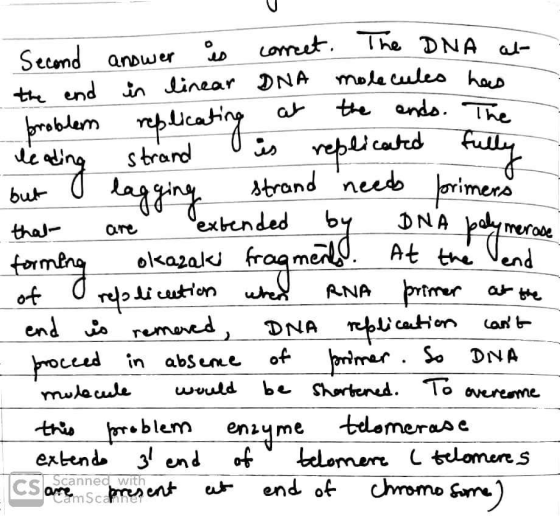
Leading strand synthesis primed at the replication origin of a linear DNA can’t remove and replace the primer.
Lagging strand synthesis primed at the ends of a linear DNA can’t be removed and replaced because there is no 3'-OH available.
Since replication only initiates at the ends of linear DNA, the priming of each leading strand leaves a primer at the end that cannot be removed.
Primase cannot copy telomere DNA.
Homework Answers
Add Answer to:
Why is there a problem replicating the ends of linear DNA?
Group of answer choices
Leading...
Note: Write 13 Conceptual Multiple Choice Questions and Included Your Answer Key for Two Pictures Below...
 Note: Write 13 Conceptual Multiple Choice Questions and
Included Your Answer Key for Two Pictures Below
Write 13 Conceptual Multiple Choice Ouestions and Included Your Answer Kev for Two Pictures Below Priming DNA synthesis Elongation of the new DNA strand Primase joins RNA DNA polymerase can only add dNTPs to a pre-existing strand Leading strand synthesis is continuous in the 5'->3' of DNA Leading strand Parental DNA Primase Okazaki fragments direction ONA polymerase adds DNA ONA polymerase DNA primase adds...
Note: Write 13 Conceptual Multiple Choice Questions and
Included Your Answer Key for Two Pictures Below
Write 13 Conceptual Multiple Choice Ouestions and Included Your Answer Kev for Two Pictures Below Priming DNA synthesis Elongation of the new DNA strand Primase joins RNA DNA polymerase can only add dNTPs to a pre-existing strand Leading strand synthesis is continuous in the 5'->3' of DNA Leading strand Parental DNA Primase Okazaki fragments direction ONA polymerase adds DNA ONA polymerase DNA primase adds...
Vocabulary: DNA Replication
Vocabulary: DNA Replication A. Helicase B. Primase C. Single Strand Binding Protein (SSB) D. Topoisomerase E. Origin of Replication F. DNA Polymerase G. Leading Strand H. Lagging strand I. DNA Ligase J. Okazaki Fragment K. Replication Fork L. RNA Primer M. Topoisomerase .1. Site where the replication of a DNA molecule begins. 2. The new continuous complementary DNA strand synthesized in the direction for the replication fork. 3. A discontinuously synthesized DNA strand that elongates in a direction away from the replication fork 4. Relaxes...
QUESTION 61 Which of the following is the reason for the linear replication problem? O A....
 QUESTION 61 Which of the following is the reason for the linear replication problem? O A. The lagging strand must be synthesized in small pieces. B. The RNA primer cannot be replaced on the 5' ends of a newly synthesized linear molecule. OC. The RNA primer cannot be replaced on the 3' ends of a newly synthesized linear molecule. D. DNA polymerase stops before finishing synthesis of the 3' ends of a newly synthesize linear molecule. OE. DNA polymerase stops...
Telomeres are long stretches of non-coding DNA at the ends of linear (eukaryotic chromosomes. A beneficial...
 Telomeres are long stretches of non-coding DNA at the ends of linear (eukaryotic chromosomes. A beneficial effect of having telomeres is that they -7 speed up the rate of cell proliferation. B)prevent shortening of the leading strand of the DNA during replication prevent shortening of the lagging strand of the DNA during replication D. eliminate the need for RNA primers during DNA replication E. help to splice out introns
Question 2a Deoxyribonucleic acid (DNA) is made up of nucleotides. Which part of the nucleotide stabilizes...
Question 2a Deoxyribonucleic acid (DNA) is made up of nucleotides. Which part of the nucleotide stabilizes the structure of DNA using weak van der Waals interactions (stacking) and using hydrogen bonds? (Note that covalent bonds are not included in that sentence.) a. the deoxyribose sugar b. the ribose sugar c. the phosphate d. the nitrogenous base e. the amino acid Question 2b This ability of the nitrogenous bases to exist in more than one form can lead to incorporation of...
1. The clamp loader loads the sliding clamp onto the DNA. Review the steps listed below....
1. The clamp loader loads the sliding clamp onto the DNA. Review the steps listed below. Which step would come SECOND? a) ATP binds to the y (gamma) subunits, which undergo a conformation change. b) Double-stranded DNA passes through the ß clamp. c) They (gamma) — p clamp —ATP complex binds primed DNA. d) Y (gamma) subunits bind to and open the clamp. e) Single-stranded DNA passes through the side of the ß clamp loader gap. 2. Which of the...
Where would you find histones? A. Part of the RNA polymerase complex that transcribes DNA. B....
Where would you find histones? A. Part of the RNA polymerase complex that transcribes DNA. B. In a virus, helping to "inject" foreign DNA into a cell. C. Bound to an enhancer to regulate transcription. D. Asscoiated with DNA to make chromatin. What is the role of DNA ligase during DNA replication? A. It unwinds the parental double helix. B. It synthesizes RNA nucleotides to make a primer. C. It joins lagging strand (Okazaki) fragments together. D. It stabilizes the...
Read thoroughly. View the two responses and answer the question below. Basically making a comparison and...
Read thoroughly. View the two responses and answer the question below. Basically making a comparison and stating similarities. Reflect on the Wright et al. (2014) paper. Did you and your classmates tend to make the same mistakes or different errors from the students that Wright interviewed? Please reference an aspect of the Wright paper in your replies. Discuss whether you and your peers, made some of the same errors or different ones when making your descriptions. Response 1: DNA replication...
Read thoroughly. View the two responses and answer the question below. Basically making a comparison and...
Read thoroughly. View the two responses and answer the question below. Basically making a comparison and stating similarities. Reflect on the Wright et al. (2014) paper. Did you and your classmates tend to make the same mistakes or different errors from the students that Wright interviewed? Please reference an aspect of the Wright paper in your replies. Discuss whether you and your peers, made some of the same errors or different ones when making your descriptions. Response 1: DNA replication...
Please answer all Question 1 (0.5 points) Why is there a lagging strand and a leading...
 Please answer all
Question 1 (0.5 points) Why is there a lagging strand and a leading strand during replication? O Because the helicase unwinds the dna in only one direction. Because DNA polymerase can only add nucleotides to the 3'end of a chain of nucleotides and replication proceeds in both directions. b) c) Because a primer must be laid down first. because DNA polymerase lacks proofreading ability. Save Question 2 (0.5 points) What step(s) in polymerase chain reaction are necessary...
Please answer all
Question 1 (0.5 points) Why is there a lagging strand and a leading strand during replication? O Because the helicase unwinds the dna in only one direction. Because DNA polymerase can only add nucleotides to the 3'end of a chain of nucleotides and replication proceeds in both directions. b) c) Because a primer must be laid down first. because DNA polymerase lacks proofreading ability. Save Question 2 (0.5 points) What step(s) in polymerase chain reaction are necessary...
 Note: Write 13 Conceptual Multiple Choice Questions and
Included Your Answer Key for Two Pictures Below
Write 13 Conceptual Multiple Choice Ouestions and Included Your Answer Kev for Two Pictures Below Priming DNA synthesis Elongation of the new DNA strand Primase joins RNA DNA polymerase can only add dNTPs to a pre-existing strand Leading strand synthesis is continuous in the 5'->3' of DNA Leading strand Parental DNA Primase Okazaki fragments direction ONA polymerase adds DNA ONA polymerase DNA primase adds...
Note: Write 13 Conceptual Multiple Choice Questions and
Included Your Answer Key for Two Pictures Below
Write 13 Conceptual Multiple Choice Ouestions and Included Your Answer Kev for Two Pictures Below Priming DNA synthesis Elongation of the new DNA strand Primase joins RNA DNA polymerase can only add dNTPs to a pre-existing strand Leading strand synthesis is continuous in the 5'->3' of DNA Leading strand Parental DNA Primase Okazaki fragments direction ONA polymerase adds DNA ONA polymerase DNA primase adds...
 QUESTION 61 Which of the following is the reason for the linear replication problem? O A. The lagging strand must be synthesized in small pieces. B. The RNA primer cannot be replaced on the 5' ends of a newly synthesized linear molecule. OC. The RNA primer cannot be replaced on the 3' ends of a newly synthesized linear molecule. D. DNA polymerase stops before finishing synthesis of the 3' ends of a newly synthesize linear molecule. OE. DNA polymerase stops...
 Telomeres are long stretches of non-coding DNA at the ends of linear (eukaryotic chromosomes. A beneficial effect of having telomeres is that they -7 speed up the rate of cell proliferation. B)prevent shortening of the leading strand of the DNA during replication prevent shortening of the lagging strand of the DNA during replication D. eliminate the need for RNA primers during DNA replication E. help to splice out introns
 Please answer all
Question 1 (0.5 points) Why is there a lagging strand and a leading strand during replication? O Because the helicase unwinds the dna in only one direction. Because DNA polymerase can only add nucleotides to the 3'end of a chain of nucleotides and replication proceeds in both directions. b) c) Because a primer must be laid down first. because DNA polymerase lacks proofreading ability. Save Question 2 (0.5 points) What step(s) in polymerase chain reaction are necessary...
Please answer all
Question 1 (0.5 points) Why is there a lagging strand and a leading strand during replication? O Because the helicase unwinds the dna in only one direction. Because DNA polymerase can only add nucleotides to the 3'end of a chain of nucleotides and replication proceeds in both directions. b) c) Because a primer must be laid down first. because DNA polymerase lacks proofreading ability. Save Question 2 (0.5 points) What step(s) in polymerase chain reaction are necessary...
Most questions answered within 3 hours.
-
Where is the error in this code sequence?
String s1 = "Hello";
String s2 = "ello";...
asked 10 months ago -
Financial data for Joel de Paris, Inc., for last year
follow:
Joel de Paris, Inc.
Balance...
asked 10 months ago -
Consider this reaction:
Al2(SO4)3 (aq)+ BaCl3
(aq) Al2Cl6 (aq)- +
3BaSO4(s) . What is the...
asked 10 months ago -
Suppose that Savneet is considering increasing her
recent random sample from 20 car rentals to 40...
asked 10 months ago -
Trucks arrive at an unloading terminal at an average rate of 120
per hour.
Trucks arrive...
asked 10 months ago -
Why are methanol and ethanol completely soluble in water while
octanol is not very little soluble....
asked 10 months ago -
A facilities manager at a university reads in a research report
that the mean amount of...
asked 10 months ago -
When the CuSO4 is rehydrated by adding water to the anhydrous
compound, is this an endothermic...
asked 10 months ago -
A ray of sunlight is passing from diamond into crown glass; the
angle of incidence is...
asked 10 months ago -
A block of mass 0.249 kg is placed on top of a light, vertical
spring of...
asked 10 months ago -
how do the kidneys compensate in the presences of acidosis
a) trigger hyperventilate
b) reserve acid...
asked 10 months ago -
Question 501 pts
The rental rate of capital to the firm increases. Which of the
following...
asked 10 months ago