6. Consider the enzyme HindIII cutting a DNA molecule of 40% GC a) What sequence does this...
6. Consider the enzyme HindIII cutting a DNA molecule of 40% GC
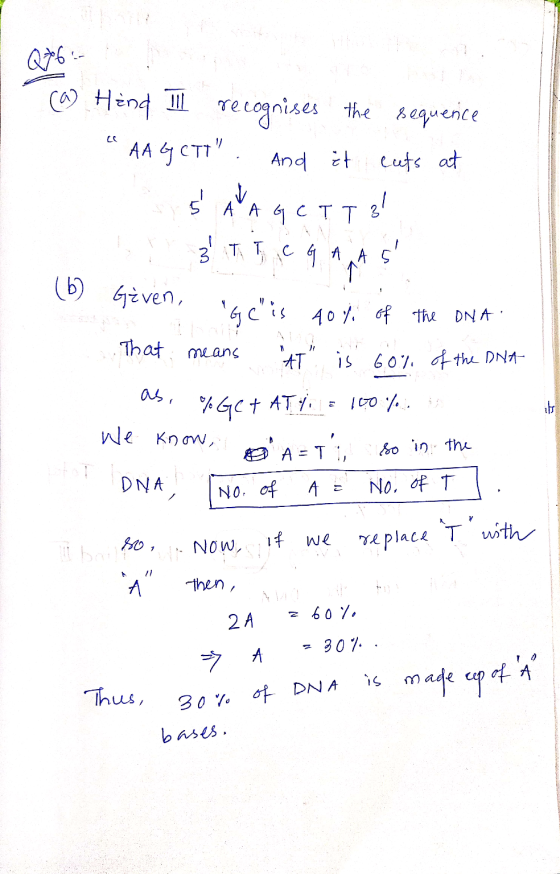
a) What sequence does this enzyme recognise?
b) What proportion of this DNA is made up of adenine bases?
c) How often would HindIII cut this molecule (in bp)?
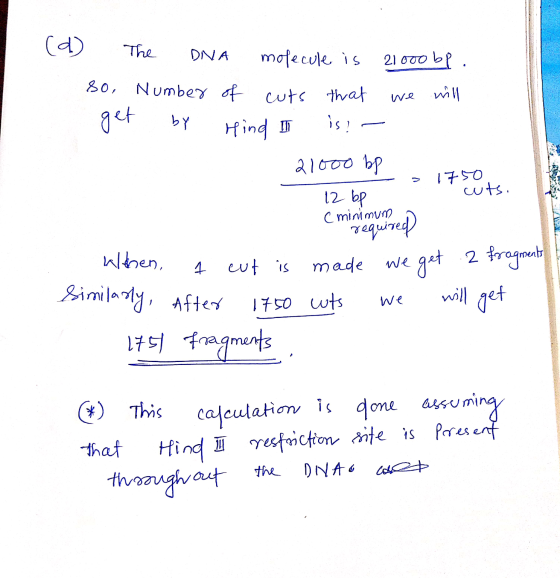
d) If this DNA molecule was 21,000 bp in length, how many fragments would be produced on average?
Could you please explain your reasoning for the answers so that i may actually understand it. so far I know HindIII enzyme recognises AAGCTT, but thats the extent of my understanding of what is actually being asked of me.
Homework Answers

Add Answer to:
6. Consider the enzyme HindIII cutting a DNA
molecule of 40% GC
a) What sequence does this...
The table shows where different restriction endonucleases (restriction enzymes) cleave DNA. The abbreviation R represents the...
 The table shows where different restriction endonucleases (restriction enzymes) cleave DNA. The abbreviation R represents the purines (adenine and guanine). The pyrimidines (cytosine, thymine, and uracil) are abbreviated as Y. The abbreviation W represents adenine or thymine. Enzyme EcoRI EcoRV Target sequence 5' GAATTC 3 3' CTTAAG 5 5' GATATC 3 3' CTATAG 5 5' GGCC 3' 3' CCGG 5 5' AAGCTT 3 3' TTCGAA 5 5' RGGWCCY 3 3' YCCWGGR 5 Cleavage 5G AATTC 3' 3' CTTAA G 5'...
Need Part C answered only. The table shows where different restriction endonucleases (restriction enzymes) cleave DNA....
 Need Part C answered only.
The table shows where different restriction endonucleases (restriction enzymes) cleave DNA. The abbreviation R represents the purines (adenine and guanine). The pyrimidines (cytosine, thymine, and uracil) are abbreviated as Y. The abbreviation W represents adenine or thymine. Enzyme EcoRI EcoRV Target sequence 5' GAATTC 3' 3' CTTAAG 5 5' GATATC 3 3' CTATAG 5 5' GGCC 3 3' CCGG 5 5' AAGCTT 3' 3' TTCGAA 5 5'RGGWCCY 3 3' YCCWGGR 5 Cleavage 5'G AATTC 3'...
Need Part C answered only.
The table shows where different restriction endonucleases (restriction enzymes) cleave DNA. The abbreviation R represents the purines (adenine and guanine). The pyrimidines (cytosine, thymine, and uracil) are abbreviated as Y. The abbreviation W represents adenine or thymine. Enzyme EcoRI EcoRV Target sequence 5' GAATTC 3' 3' CTTAAG 5 5' GATATC 3 3' CTATAG 5 5' GGCC 3 3' CCGG 5 5' AAGCTT 3' 3' TTCGAA 5 5'RGGWCCY 3 3' YCCWGGR 5 Cleavage 5'G AATTC 3'...
please answer question numbe 2. Restriction endonucleases are bacterial enzymes that recognize, bind, and cut DNA...
 please answer question numbe 2.
Restriction endonucleases are bacterial enzymes that recognize, bind, and cut DNA strands at specific recognition sequences. They evolved to protect bacteria from bacterial viruses and are very useful for a wide variety of molecular biology applications. Some of the more common ones include EcoRI which recognizes the 6 bp sequence 5 'GAATTC 3' and cleaves the phosphodiester backbone after the G. Hind III_(AAGCTT), BamHI (G|GATCC), Pstl (CTGCAG), Not! (GC|GGCCGC), Ndel (CATATG) Kpnl (GGTAC^C), Bgl II...
please answer question numbe 2.
Restriction endonucleases are bacterial enzymes that recognize, bind, and cut DNA strands at specific recognition sequences. They evolved to protect bacteria from bacterial viruses and are very useful for a wide variety of molecular biology applications. Some of the more common ones include EcoRI which recognizes the 6 bp sequence 5 'GAATTC 3' and cleaves the phosphodiester backbone after the G. Hind III_(AAGCTT), BamHI (G|GATCC), Pstl (CTGCAG), Not! (GC|GGCCGC), Ndel (CATATG) Kpnl (GGTAC^C), Bgl II...
Identify two restriction endonucleases that could be used to make sticky ends near the 5’ end of this DNA sequence (uppe...
 Identify two restriction
endonucleases that could be used to make sticky ends near the
5’ end of this DNA sequence (upper strand) so that
it could be incorporated into a new plasmid. You have a short list
of them in Table 9-2, and the specific, short sequences of bases
that other enzymes cut at are easily obtained from web resources.
You must cut as near to the 5' end as possible. Indicate the
specific sequences of bases for each endonuclease...
Identify two restriction
endonucleases that could be used to make sticky ends near the
5’ end of this DNA sequence (upper strand) so that
it could be incorporated into a new plasmid. You have a short list
of them in Table 9-2, and the specific, short sequences of bases
that other enzymes cut at are easily obtained from web resources.
You must cut as near to the 5' end as possible. Indicate the
specific sequences of bases for each endonuclease...
24. What would be the anticodon if the template strand of DNA Is ACC A UCC...
 24. What would be the anticodon if the template strand of DNA Is ACC A UCC B.) TGG UGG D. ACC E. TCC 25. Prior to protein synthesis, the DNA A. attracts tRNAs with appropriate amino acids. 6.) serves as a template for the production of mRNA. C. adheres to ribosomes for protein synthesis. D. contains anticodons that become codons. E. must first undergo replication. 26. The Human Genome Project has revealed that human DNA has approximately A. 30,000 bases...
 The table shows where different restriction endonucleases (restriction enzymes) cleave DNA. The abbreviation R represents the purines (adenine and guanine). The pyrimidines (cytosine, thymine, and uracil) are abbreviated as Y. The abbreviation W represents adenine or thymine. Enzyme EcoRI EcoRV Target sequence 5' GAATTC 3 3' CTTAAG 5 5' GATATC 3 3' CTATAG 5 5' GGCC 3' 3' CCGG 5 5' AAGCTT 3 3' TTCGAA 5 5' RGGWCCY 3 3' YCCWGGR 5 Cleavage 5G AATTC 3' 3' CTTAA G 5'...
 Need Part C answered only.
The table shows where different restriction endonucleases (restriction enzymes) cleave DNA. The abbreviation R represents the purines (adenine and guanine). The pyrimidines (cytosine, thymine, and uracil) are abbreviated as Y. The abbreviation W represents adenine or thymine. Enzyme EcoRI EcoRV Target sequence 5' GAATTC 3' 3' CTTAAG 5 5' GATATC 3 3' CTATAG 5 5' GGCC 3 3' CCGG 5 5' AAGCTT 3' 3' TTCGAA 5 5'RGGWCCY 3 3' YCCWGGR 5 Cleavage 5'G AATTC 3'...
Need Part C answered only.
The table shows where different restriction endonucleases (restriction enzymes) cleave DNA. The abbreviation R represents the purines (adenine and guanine). The pyrimidines (cytosine, thymine, and uracil) are abbreviated as Y. The abbreviation W represents adenine or thymine. Enzyme EcoRI EcoRV Target sequence 5' GAATTC 3' 3' CTTAAG 5 5' GATATC 3 3' CTATAG 5 5' GGCC 3 3' CCGG 5 5' AAGCTT 3' 3' TTCGAA 5 5'RGGWCCY 3 3' YCCWGGR 5 Cleavage 5'G AATTC 3'...
 please answer question numbe 2.
Restriction endonucleases are bacterial enzymes that recognize, bind, and cut DNA strands at specific recognition sequences. They evolved to protect bacteria from bacterial viruses and are very useful for a wide variety of molecular biology applications. Some of the more common ones include EcoRI which recognizes the 6 bp sequence 5 'GAATTC 3' and cleaves the phosphodiester backbone after the G. Hind III_(AAGCTT), BamHI (G|GATCC), Pstl (CTGCAG), Not! (GC|GGCCGC), Ndel (CATATG) Kpnl (GGTAC^C), Bgl II...
please answer question numbe 2.
Restriction endonucleases are bacterial enzymes that recognize, bind, and cut DNA strands at specific recognition sequences. They evolved to protect bacteria from bacterial viruses and are very useful for a wide variety of molecular biology applications. Some of the more common ones include EcoRI which recognizes the 6 bp sequence 5 'GAATTC 3' and cleaves the phosphodiester backbone after the G. Hind III_(AAGCTT), BamHI (G|GATCC), Pstl (CTGCAG), Not! (GC|GGCCGC), Ndel (CATATG) Kpnl (GGTAC^C), Bgl II...
 Identify two restriction
endonucleases that could be used to make sticky ends near the
5’ end of this DNA sequence (upper strand) so that
it could be incorporated into a new plasmid. You have a short list
of them in Table 9-2, and the specific, short sequences of bases
that other enzymes cut at are easily obtained from web resources.
You must cut as near to the 5' end as possible. Indicate the
specific sequences of bases for each endonuclease...
Identify two restriction
endonucleases that could be used to make sticky ends near the
5’ end of this DNA sequence (upper strand) so that
it could be incorporated into a new plasmid. You have a short list
of them in Table 9-2, and the specific, short sequences of bases
that other enzymes cut at are easily obtained from web resources.
You must cut as near to the 5' end as possible. Indicate the
specific sequences of bases for each endonuclease...
 24. What would be the anticodon if the template strand of DNA Is ACC A UCC B.) TGG UGG D. ACC E. TCC 25. Prior to protein synthesis, the DNA A. attracts tRNAs with appropriate amino acids. 6.) serves as a template for the production of mRNA. C. adheres to ribosomes for protein synthesis. D. contains anticodons that become codons. E. must first undergo replication. 26. The Human Genome Project has revealed that human DNA has approximately A. 30,000 bases...
Most questions answered within 3 hours.
-
Where is the error in this code sequence?
String s1 = "Hello";
String s2 = "ello";...
asked 10 months ago -
Financial data for Joel de Paris, Inc., for last year
follow:
Joel de Paris, Inc.
Balance...
asked 10 months ago -
Consider this reaction:
Al2(SO4)3 (aq)+ BaCl3
(aq) Al2Cl6 (aq)- +
3BaSO4(s) . What is the...
asked 10 months ago -
Suppose that Savneet is considering increasing her
recent random sample from 20 car rentals to 40...
asked 10 months ago -
Trucks arrive at an unloading terminal at an average rate of 120
per hour.
Trucks arrive...
asked 10 months ago -
Why are methanol and ethanol completely soluble in water while
octanol is not very little soluble....
asked 10 months ago -
A facilities manager at a university reads in a research report
that the mean amount of...
asked 10 months ago -
When the CuSO4 is rehydrated by adding water to the anhydrous
compound, is this an endothermic...
asked 10 months ago -
A ray of sunlight is passing from diamond into crown glass; the
angle of incidence is...
asked 10 months ago -
A block of mass 0.249 kg is placed on top of a light, vertical
spring of...
asked 10 months ago -
how do the kidneys compensate in the presences of acidosis
a) trigger hyperventilate
b) reserve acid...
asked 10 months ago -
Question 501 pts
The rental rate of capital to the firm increases. Which of the
following...
asked 10 months ago