
Homework Answers
Answer 3:
(a) Mechanism of gene expression:
Gene expression is the process by which genes are used as a code to make proteins for the cell. A gene is expressed in response to a signal, which can be generated within the cell or the signal may be external. Proteins are required to carry out life processes.
Gene expression mechanism can be represented using the Central Dogma as follows:

Gene expression involves two stages, transcription (DNA TO RNA) and translation (RNA TO PROTEINS).
Transcription:
The process by which DNA is used to make a RNA molecule is called transcription. It takes place in nucleus and involves the following steps :
- When there is a signal for gene expression, certain transcription factors (TFs) bind to the promoter region of the gene to be expressed.
- This activates the transcription apparatus and RNA polymerase, the main enzyme for transcription, begins synthesizing RNA molecule in the direction 5'-3' using 3'-5' DNA template. Upon encountering a termination signal, transcription is ended.
- The nascent RNA molecule is subject to various processing, like methyl capping of 5' end, addition of adenine residues at 3' tail (polyadenylation) and splicing of introns (non-coding sequence).
- The final RNA molecule produced as a result of processing is called mature RNA or mRNA. It contains exons (coding sequence).
The single stranded mRNA molecule then leaves nucleus and enters cytosol for the next stage of gene expression, i.e. translation.
Translation:
The process by which codons (sequence of three bases) of mRNA are used as a guide to add amino acid sequentially and form the desired protein is called translation. It involves the following steps :
- mRNA binds to ribosome, which is the site of translation.
- Codons present in mRNA are used to incorporate corresponding amino acid. The amino acid is carried by a tRNA molecule to the ribosomes.
- The first codon is AUG, and corresponding amino acid is methionine, which is a common feature of all proteins.
- Amino acids are joined together by peptide bonds. When various amino acids are joined in a chain, a polypeptide (protein) is formed.
- When a termination codon is encountered in mRNA, translation stops.
- Release factors allow the polypeptide to dissociate from the ribosomal machinery.
- The protein so formed may be subjected to further processing in ER and golgi before becoming fully functional.
Answer (b) :
Amino acids are coded by a sequence of three nucleotides which constitute a codon. A change in single nucleotide would mean a different codon, which may code for an entirely different amino acid.
The function of a protein is dependent on its 3D structure. This structure is ultimately dependent on the sequence of amino acids present in the polypeptide. Since, different amino acids possess different properties, thus a change of single nucleotide may result into a change in 3D structure of protein. A protein with altered structure serves different function.
Hence, two alleles that differ by a single nucleotide may lead to entirely different outputs.
Add Answer to:
3. The genome of living organisms includes coding and non-coding regions, plus the genetic material of...
39. The evolutiona factors, including the way genetic material is organized and replicated. Please complete this...
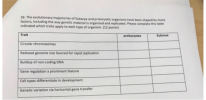 39. The evolutiona factors, including the way genetic material is organized and replicated. Please complete this table indicated which traits apply to each type of organism. [12 points) ry trajectories of Eukarya and prokaryotic organisms have been shaped by many Trait Circular chromosomes Reduced genome size favored for rapid replication Buildup of non-coding DNA Gene regulation a prominent feature Cell types differentiate in development Genetic variation via horizontal gene transfer prokaryotes Eukarya
Genetically Modified Organisms Genetically modified organisms (GMOs) are organisms in which the genetic material (DNA) has...
Genetically Modified Organisms Genetically modified organisms (GMOs) are organisms in which the genetic material (DNA) has been altered in a manner that does not occur naturally. The technology allows individual genes to be transferred from one organism into another, also between non-related species. 1. Describe two specific examples of a commercially used GMO. 2. What are the benefits of GM foods, in general? 3. What are the main issues of concern for human health? 4. Where do you stand on...
A cell's genome is its blueprint for life. However, what is the bare minimum number of...
A cell's genome is its blueprint for life. However, what is the bare minimum number of genes needed to sustain a free-living cell? This is a question that microbiologists at the J. Craig Venter Institute (JCVI) have attempted to answer ever since they sequenced the genomes of several Mycoplasma species in the 1990s. Because Mycoplasma species are parasitic bacteria, their genomes are already reduced in size and hence provide an excellent foundation for creating a "minimal cell." However, little did...
6) We discussed the technical parameter, genetic relatedness, in detail, including its specific meaning and its...
6) We discussed the technical parameter, genetic relatedness, in detail, including its specific meaning and its causal impact in the context of the evolution of social behavior. Which of the following is (are) a true statement about genetic relatedness? a. Genetic relatedness describes the statistical probability that an individual piece of design information in one individual is an exact copy of a piece in a second animal by virtue of having been inherited from a very recent common ancestor. b....
and w Two-dimensional gel electrophoresis separates proteins based on a. shape; charge Ob.size; concentration c. concentration;...
 and w Two-dimensional gel electrophoresis separates proteins based on a. shape; charge Ob.size; concentration c. concentration; shape O d. size, charge O e. size; shape Refer to the table. Several strains of a bacterium are sequenced to investigate the pan and core genomes. In the table, + denotes presence of the gene and denotes its absence. Gene Gene Gene Gene Gene Strain ! Strain 2 + Strain 3 + Strain 4 + + + + Strain 5 + + What...
QUESTION 1 In E. coll, what two promoter regions are recognized by the s70 subunit? the...
 QUESTION 1 In E. coll, what two promoter regions are recognized by the s70 subunit? the -10 and 35 regions the - 10 region and the Pribnow box the-10 and -70 regions the-35 and -70 regions QUESTION 2 Which protein must first bind to the origin of replication for DNA synthesis to begin? DNA polymerase DnaA helicase Single-strand binding protein Click Save and Submit to save and submit. Click Save All Answers to save all answers. 2 Ch 16 PPT...
25. Mendel's factors undergo segregation and independent assortment. How is this illustrated in the chromosomes during...
 25. Mendel's factors undergo segregation and independent assortment. How is this illustrated in the chromosomes during Meiosis I? 26. Explain how these inheritance patterns are considered non-Mendelian. Incomplete Dominance . Multiple Alleles • Codominance X-linked Linkage . Pedigrees - Genetic Disorders 27. What is non-disjunction and how does it affect the chromosome distribution during meiosis? 28. What is a karyotype and what does it allow you to do? 29. Fill in the circles and squares to illustrate the following inheritance...
The macromolecular complex that associates with each intron and splices it is called a(n). splicer acrosome...
 The macromolecular complex that associates with each intron and splices it is called a(n). splicer acrosome splice engine spliceosome splicing body Transcription in prokaryotes: 1. Requires consensus nucleotide sequences at position -35 and -10 in the promoter region of gene sequence. 2. Requires different sigma factors depending on the environmental stimulus. 3. Can produce a cDNA. All are correct. 3 1 Both 1 and 2 are correct. Which of the following statements about transcription factor TFIIH are correct: Two of...
2. A dominant allele H reduces the number of body bristles that Drosophila flies have, giving...
2. A dominant allele H reduces the number of body bristles that Drosophila flies have, giving rise to a “hairless” phenotype. In the homozygous condition, H is lethal. An independently assorting dominant allele S has no effect on bristle number except in the presence of H, in which case a single dose of S suppresses the hairless phenotype, thus restoring the "hairy" phenotype. However, S also is lethal in the homozygous (S/S) condition. What ratio of hairy to hairless flies...
42. Which statement is NOT true about DNA? a) DNA acts like an enzyme by binding...
 42. Which statement is NOT true about DNA? a) DNA acts like an enzyme by binding amino acids together using dehydration synthesis. b) Before cells divide both strands must be copied and one is provided for each new cell cm RNA is copied from a piece of DNA termed a gene. d) DNA is not always copied perfectly. Mistakes, mutations, occur and result in changed proteins, e) DNA functions as code for the synthesis of proteins. 43. A section of...
 39. The evolutiona factors, including the way genetic material is organized and replicated. Please complete this table indicated which traits apply to each type of organism. [12 points) ry trajectories of Eukarya and prokaryotic organisms have been shaped by many Trait Circular chromosomes Reduced genome size favored for rapid replication Buildup of non-coding DNA Gene regulation a prominent feature Cell types differentiate in development Genetic variation via horizontal gene transfer prokaryotes Eukarya
 and w Two-dimensional gel electrophoresis separates proteins based on a. shape; charge Ob.size; concentration c. concentration; shape O d. size, charge O e. size; shape Refer to the table. Several strains of a bacterium are sequenced to investigate the pan and core genomes. In the table, + denotes presence of the gene and denotes its absence. Gene Gene Gene Gene Gene Strain ! Strain 2 + Strain 3 + Strain 4 + + + + Strain 5 + + What...
 QUESTION 1 In E. coll, what two promoter regions are recognized by the s70 subunit? the -10 and 35 regions the - 10 region and the Pribnow box the-10 and -70 regions the-35 and -70 regions QUESTION 2 Which protein must first bind to the origin of replication for DNA synthesis to begin? DNA polymerase DnaA helicase Single-strand binding protein Click Save and Submit to save and submit. Click Save All Answers to save all answers. 2 Ch 16 PPT...
 25. Mendel's factors undergo segregation and independent assortment. How is this illustrated in the chromosomes during Meiosis I? 26. Explain how these inheritance patterns are considered non-Mendelian. Incomplete Dominance . Multiple Alleles • Codominance X-linked Linkage . Pedigrees - Genetic Disorders 27. What is non-disjunction and how does it affect the chromosome distribution during meiosis? 28. What is a karyotype and what does it allow you to do? 29. Fill in the circles and squares to illustrate the following inheritance...
 The macromolecular complex that associates with each intron and splices it is called a(n). splicer acrosome splice engine spliceosome splicing body Transcription in prokaryotes: 1. Requires consensus nucleotide sequences at position -35 and -10 in the promoter region of gene sequence. 2. Requires different sigma factors depending on the environmental stimulus. 3. Can produce a cDNA. All are correct. 3 1 Both 1 and 2 are correct. Which of the following statements about transcription factor TFIIH are correct: Two of...
 42. Which statement is NOT true about DNA? a) DNA acts like an enzyme by binding amino acids together using dehydration synthesis. b) Before cells divide both strands must be copied and one is provided for each new cell cm RNA is copied from a piece of DNA termed a gene. d) DNA is not always copied perfectly. Mistakes, mutations, occur and result in changed proteins, e) DNA functions as code for the synthesis of proteins. 43. A section of...
Most questions answered within 3 hours.
-
Where is the error in this code sequence?
String s1 = "Hello";
String s2 = "ello";...
asked 10 months ago -
Financial data for Joel de Paris, Inc., for last year
follow:
Joel de Paris, Inc.
Balance...
asked 10 months ago -
Consider this reaction:
Al2(SO4)3 (aq)+ BaCl3
(aq) Al2Cl6 (aq)- +
3BaSO4(s) . What is the...
asked 10 months ago -
Suppose that Savneet is considering increasing her
recent random sample from 20 car rentals to 40...
asked 10 months ago -
Trucks arrive at an unloading terminal at an average rate of 120
per hour.
Trucks arrive...
asked 10 months ago -
Why are methanol and ethanol completely soluble in water while
octanol is not very little soluble....
asked 10 months ago -
A facilities manager at a university reads in a research report
that the mean amount of...
asked 10 months ago -
When the CuSO4 is rehydrated by adding water to the anhydrous
compound, is this an endothermic...
asked 10 months ago -
A ray of sunlight is passing from diamond into crown glass; the
angle of incidence is...
asked 10 months ago -
A block of mass 0.249 kg is placed on top of a light, vertical
spring of...
asked 10 months ago -
how do the kidneys compensate in the presences of acidosis
a) trigger hyperventilate
b) reserve acid...
asked 10 months ago -
Question 501 pts
The rental rate of capital to the firm increases. Which of the
following...
asked 10 months ago