
Homework Answers
Add Answer to:
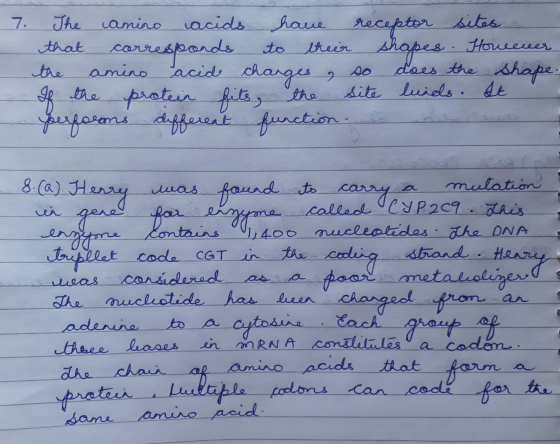
7. From what you understand about enzymes, explain why a change in an amino acid would...
DNA, Genes and Protein Synthesis Activity 13: Protein Synthesis is the process by which cells produce (synthesize) proteins. An overview of the process is shown in model 2 (below). Gone 2...
 DNA, Genes and Protein Synthesis Activity 13: Protein Synthesis is the process by which cells produce (synthesize) proteins. An overview of the process is shown in model 2 (below). Gone 2 Gene 1 Gene 3 DNA strand3 TRANSLATION Protein Trp Gly Model 2 ACTIVITY and QUESTIONS 1. Based on the information you can gather from model 1 complete the following sentences: a. The nucleotide Adenine (A) always pairs with the nucleotide b. The nucleotide Guanine (G) always pairs with the...
DNA exercises Ex. 1 Use the genetic code chart (Fig. 10.8A or the one in your...
 DNA exercises Ex. 1 Use the genetic code chart (Fig. 10.8A or the one in your LN) to translate the following mRNA sequences into amino acid sequences and answer the questions. mRNA nucleotide sequence (mRNA1) AUGGCAGACAAUAUUAAGUGA 1. What is the amino acid sequence? Mutation in the mRNA nucleotide sequence (mRNA2) AUGGCAGACCAUAUUAAGUGA 2. What is the new amino acid sequence? 3. How many bases were changed in mRNA2 compared to mRNA1? 4. What type of mutation was this? 5. How many...
Please help with 4-10! DNA, Genes,and Protein Synthesis Activity 13: 2. The bases that interact with each other are called complementary bases. this definition and your answers to 1 complete th...
 Please help with 4-10!
DNA, Genes,and Protein Synthesis Activity 13: 2. The bases that interact with each other are called complementary bases. this definition and your answers to 1 complete the following: a. Thiamine (T) is the complementary base of b. Cytosine (C) is the complementary base of c. Adenine (A) is the complementary base of d. Guanine (G) is the complementary base of Based on 3. Shown below is the nucleotide sequence for one strand of a stretch of...
Please help with 4-10!
DNA, Genes,and Protein Synthesis Activity 13: 2. The bases that interact with each other are called complementary bases. this definition and your answers to 1 complete the following: a. Thiamine (T) is the complementary base of b. Cytosine (C) is the complementary base of c. Adenine (A) is the complementary base of d. Guanine (G) is the complementary base of Based on 3. Shown below is the nucleotide sequence for one strand of a stretch of...
O ACTIVITY 5.4.1 Synthesis of a Protein: A Simulation Activity In this activity, you will be...
 O ACTIVITY 5.4.1 Synthesis of a Protein: A Simulation Activity In this activity, you will be provided with the DNA nucleotide sequence that codes for a hypothetical protein. The code will be provided to you in three fragments. You will have to tran- scribe the code into mRNA, remove an intron segment, and translate the mRNA into the protein. In addition, you will have to identify the beginning fragment the middle fragment, and the end fragment. Sequence A TCTTCCCTCCTAAACGTTCAACCGGTTCTTAATCCGC CGCCAGGGCCCCGCCCCTCAGAAGTTGGT...
c) The steps or rungs of the DNA ladder are composed of phosphate group 4 Deoxyribose...
 c) The steps or rungs of the DNA ladder are composed of phosphate group 4 Deoxyribose 15. Use Figure 2 and 3 of the lab to compare the genome of a human with a mouse, fruit fly and yeast. paired in a specific way. d) Adenine in one DNA strand always pain with thymine ) Bases in opposite strands of a DNA molecule are linked together by hydrogen in the other strand and bonds. Yeast Human Mouse Fruit Fly Number...
aus: 99 Consider the following DNA sequence: TTAGATCGTAAAGTGCAATGGGATCATATG What would be the mRNA transcribed from this...
 aus: 99 Consider the following DNA sequence: TTAGATCGTAAAGTGCAATGGGATCATATG What would be the mRNA transcribed from this DNA sequence? ots)? 10 AAU CUA G CA unU CAC Gui ACC CUA GUAU- How many codons does the sequence contain 21 th A How many amino acids make up this protein? (1 pt) List the amino acids, in order, that make up this protein using the chart provided. (5 pts) Referring to the mRNA strand constructed in Question #3, list the tRNA anti-codons...
The genetic code is "redundant" because: Question 1 options: Each amino acid is specified by only...
The genetic code is "redundant" because: Question 1 options: Each amino acid is specified by only a single codon Most amino acids are specified by multiple codons Codons are groups of four consecutive DNA bases Each codon can specify multiple amino acids Question 2 (1 point) A mutation in the DNA may not result in change in protein function because: Question 2 options: Many different amino acids share similar chemical properties, so can substitute for one another without altering function...
The genetic code is "redundant" because: Question 1 options: Each amino acid is specified by only...
The genetic code is "redundant" because: Question 1 options: Each amino acid is specified by only a single codon Most amino acids are specified by multiple codons Codons are groups of four consecutive DNA bases Each codon can specify multiple amino acids Question 2 (1 point) A mutation in the DNA may not result in change in protein function because: Question 2 options: Many different amino acids share similar chemical properties, so can substitute for one another without altering function...
50) During DNA DNA? replication, which of the following enzymes covalently connects segments of A) helicase...
 50) During DNA DNA? replication, which of the following enzymes covalently connects segments of A) helicase B) DNA polymerase III C) ligase D) DNA polymerase I E) primase 51) The nitrogenous base adenine is found in all members of which of the following groups of molecules? A) proteins, triglycerides, and testosterone B) proteins, ATP, and DNA C) ATP, RNA, and DNA D) glucose, ATP, and DNA E) proteins, carbohydrates, and ATP 52) A particular triplet of bases in the template...
QUESTION 11 Meselson and Stahl had obtained the resuk below, what would have been there conclusion...
 QUESTION 11 Meselson and Stahl had obtained the resuk below, what would have been there conclusion First Generation Replication Replication N4 14 NINIS NAS N15 DNA replication is conservative DNA replication is semi-conservative DNA replication is dispersive None of the above QUESTION 12 If one strand of DNA Is CGGTAC in the 5-3 direction, what is the corresponding complementary strand of DNA in the 53' direction? GCCTAG ©GTACG TAACGT GCCATG CATGGA QUESTION 13 Which of the following statements regarding the...
 DNA, Genes and Protein Synthesis Activity 13: Protein Synthesis is the process by which cells produce (synthesize) proteins. An overview of the process is shown in model 2 (below). Gone 2 Gene 1 Gene 3 DNA strand3 TRANSLATION Protein Trp Gly Model 2 ACTIVITY and QUESTIONS 1. Based on the information you can gather from model 1 complete the following sentences: a. The nucleotide Adenine (A) always pairs with the nucleotide b. The nucleotide Guanine (G) always pairs with the...
 DNA exercises Ex. 1 Use the genetic code chart (Fig. 10.8A or the one in your LN) to translate the following mRNA sequences into amino acid sequences and answer the questions. mRNA nucleotide sequence (mRNA1) AUGGCAGACAAUAUUAAGUGA 1. What is the amino acid sequence? Mutation in the mRNA nucleotide sequence (mRNA2) AUGGCAGACCAUAUUAAGUGA 2. What is the new amino acid sequence? 3. How many bases were changed in mRNA2 compared to mRNA1? 4. What type of mutation was this? 5. How many...
 Please help with 4-10!
DNA, Genes,and Protein Synthesis Activity 13: 2. The bases that interact with each other are called complementary bases. this definition and your answers to 1 complete the following: a. Thiamine (T) is the complementary base of b. Cytosine (C) is the complementary base of c. Adenine (A) is the complementary base of d. Guanine (G) is the complementary base of Based on 3. Shown below is the nucleotide sequence for one strand of a stretch of...
Please help with 4-10!
DNA, Genes,and Protein Synthesis Activity 13: 2. The bases that interact with each other are called complementary bases. this definition and your answers to 1 complete the following: a. Thiamine (T) is the complementary base of b. Cytosine (C) is the complementary base of c. Adenine (A) is the complementary base of d. Guanine (G) is the complementary base of Based on 3. Shown below is the nucleotide sequence for one strand of a stretch of...
 O ACTIVITY 5.4.1 Synthesis of a Protein: A Simulation Activity In this activity, you will be provided with the DNA nucleotide sequence that codes for a hypothetical protein. The code will be provided to you in three fragments. You will have to tran- scribe the code into mRNA, remove an intron segment, and translate the mRNA into the protein. In addition, you will have to identify the beginning fragment the middle fragment, and the end fragment. Sequence A TCTTCCCTCCTAAACGTTCAACCGGTTCTTAATCCGC CGCCAGGGCCCCGCCCCTCAGAAGTTGGT...
 c) The steps or rungs of the DNA ladder are composed of phosphate group 4 Deoxyribose 15. Use Figure 2 and 3 of the lab to compare the genome of a human with a mouse, fruit fly and yeast. paired in a specific way. d) Adenine in one DNA strand always pain with thymine ) Bases in opposite strands of a DNA molecule are linked together by hydrogen in the other strand and bonds. Yeast Human Mouse Fruit Fly Number...
 aus: 99 Consider the following DNA sequence: TTAGATCGTAAAGTGCAATGGGATCATATG What would be the mRNA transcribed from this DNA sequence? ots)? 10 AAU CUA G CA unU CAC Gui ACC CUA GUAU- How many codons does the sequence contain 21 th A How many amino acids make up this protein? (1 pt) List the amino acids, in order, that make up this protein using the chart provided. (5 pts) Referring to the mRNA strand constructed in Question #3, list the tRNA anti-codons...
 50) During DNA DNA? replication, which of the following enzymes covalently connects segments of A) helicase B) DNA polymerase III C) ligase D) DNA polymerase I E) primase 51) The nitrogenous base adenine is found in all members of which of the following groups of molecules? A) proteins, triglycerides, and testosterone B) proteins, ATP, and DNA C) ATP, RNA, and DNA D) glucose, ATP, and DNA E) proteins, carbohydrates, and ATP 52) A particular triplet of bases in the template...
 QUESTION 11 Meselson and Stahl had obtained the resuk below, what would have been there conclusion First Generation Replication Replication N4 14 NINIS NAS N15 DNA replication is conservative DNA replication is semi-conservative DNA replication is dispersive None of the above QUESTION 12 If one strand of DNA Is CGGTAC in the 5-3 direction, what is the corresponding complementary strand of DNA in the 53' direction? GCCTAG ©GTACG TAACGT GCCATG CATGGA QUESTION 13 Which of the following statements regarding the...
Most questions answered within 3 hours.
-
Where is the error in this code sequence?
String s1 = "Hello";
String s2 = "ello";...
asked 10 months ago -
Financial data for Joel de Paris, Inc., for last year
follow:
Joel de Paris, Inc.
Balance...
asked 10 months ago -
Consider this reaction:
Al2(SO4)3 (aq)+ BaCl3
(aq) Al2Cl6 (aq)- +
3BaSO4(s) . What is the...
asked 10 months ago -
Suppose that Savneet is considering increasing her
recent random sample from 20 car rentals to 40...
asked 10 months ago -
Trucks arrive at an unloading terminal at an average rate of 120
per hour.
Trucks arrive...
asked 10 months ago -
Why are methanol and ethanol completely soluble in water while
octanol is not very little soluble....
asked 10 months ago -
A facilities manager at a university reads in a research report
that the mean amount of...
asked 10 months ago -
When the CuSO4 is rehydrated by adding water to the anhydrous
compound, is this an endothermic...
asked 10 months ago -
A ray of sunlight is passing from diamond into crown glass; the
angle of incidence is...
asked 10 months ago -
A block of mass 0.249 kg is placed on top of a light, vertical
spring of...
asked 10 months ago -
how do the kidneys compensate in the presences of acidosis
a) trigger hyperventilate
b) reserve acid...
asked 10 months ago -
Question 501 pts
The rental rate of capital to the firm increases. Which of the
following...
asked 10 months ago