Suppose there is a genetic disorder caused by a single base change in a gene on...
Suppose there is a genetic disorder caused by a single base change in a gene on chromosome 11, which changes a cellular protein so that its function is altered. This mutation happens also to eliminate a cleavage site for a restriction endonuclease EcoRI (sequence: 5'-GAATTC-3'). If you isolated a portion of chromosome 11 DNA containing this defective gene, explain exactly how could you use restriction enzymes and gel electrophoresis to detect the base change. Please write 500 words or fewer.
Homework Answers
Procedure to identify mutation using restriction enzymes:
1. Design primers flanking the mutation
2. Perform PCR
3. Digest the PCR product with Eco RI
4. Run the products on an agarose gel
It is given that the mutation eliminates a site for Eco RI cleavage.
Since humans are diploid organisms, there are two copies of chromosomes.
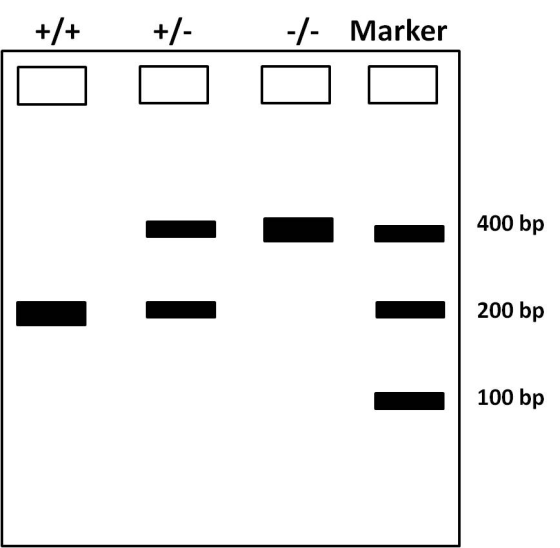
Assume that the size of PCR product = 400 bp and there is only one Eco RI site in the sequence.
Since WT (+/+) individuals contain sequences that are cleaved by Eco RI in both chromosomes, they produce a single band upon digestion (200 bp).
Similarly, heterozygous individuals (+/-) produce two bands (400 bp and 200 bp) upon digestion.
Homozygous individuals produce a single band of 400 bp.
Add Answer to:
Suppose there is a genetic disorder caused by a single base
change in a gene on...
Marfan syndrome, a human genetic disorder caused by a single gene, results in defective connective tissue....
 Marfan syndrome, a human genetic disorder caused by a single
gene, results in defective connective tissue. The symptoms of this
disorder range from skeletal issues to problems with the nervous
and cardiovascular systems. This is an example of
Question 17 2.1 pts Marfan syndrome, a human genetic disorder caused by a single gene, results in defective connective tissue. The symptoms of this disorder range from skeletal issues to problems with the nervous and cardiovascular systems. This is an example of...
Marfan syndrome, a human genetic disorder caused by a single
gene, results in defective connective tissue. The symptoms of this
disorder range from skeletal issues to problems with the nervous
and cardiovascular systems. This is an example of
Question 17 2.1 pts Marfan syndrome, a human genetic disorder caused by a single gene, results in defective connective tissue. The symptoms of this disorder range from skeletal issues to problems with the nervous and cardiovascular systems. This is an example of...
You are studying a disease that is known to be caused by a single nucleotide change...
You are studying a disease that is known to be caused by a single nucleotide change in a single gene, although the effect this change ultimately has on the protein's structure and function is unknown. You have DNA samples from multiple patients that you suspect of having this disease. What is the most efficient way to test the samples for the relevant mutation? Select one: a. PCR amplification followed by Sanger DNA sequencing b. PCR amplification followed by gel electrophoresis...
Polydactyly is a X-linked recessive disorder, which results in cats having extra toes in one or...
Polydactyly is a X-linked recessive disorder, which results in cats having extra toes in one or several of their paws. It results from a mutation in Gene T. Section of the wild type and polydactyly alleles contain the following sequence: Wild type Allele (T): AAAGTTCAAAGCTTGTTAGCATGAATTCGGTAGGATATAAGCTTAGGTAGGTAGTTCGTA Polydactyly Allele (t): AAAGTTCAAAGCTTGTTAGCATGAATTCGGTAGGATATAATCTTAGGTAGGTAGTTCGTA You are a geneticist and would like to test a litter of kittens. After isolating the DNA, you plan to cut it with a restriction enzyme and run the fragments on...
Protein P is synthesized in relatively high amounts in the human pancreas. This protein has been...
 Protein P is synthesized in relatively high amounts in the human pancreas. This protein has been isolated and purified, but its amino acid sequence has not been determined. We wish to clone the gene for protein P. (a) How can a probe be prepared to identify the gene for protein P? (b) If we have prepared a radioactive messenger RNA as our probe in part (a), how could we verify that it is the mRNA for protein P? (c) If...
2. The gene from question 1 is found to be mutated in a genetic disorder. The mutation is highlighted below in yellow....
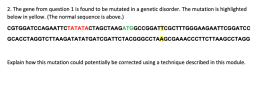 2. The gene from question 1 is found to be mutated in a genetic disorder. The mutation is highlighted below in yellow. (The normal sequence is above.) CGTGGATCCAGAATTCTATATACTAGCTAAGATGGCCGGATTCGCTTTGGGAAGAATTCGGATCC GCACCTAGGTCTTAAGATATATGATCGATTCTACGGGCCTAAGCGAAACCCTTCTTAAGCCTAGG Explain how this mutation could potentially be corrected using a technique described in this module. TABLE 3.1 COMMON RESTRICTION ENZYMES Source Restriction Site Enzyme Create Cohesive Ends A A·G·C·T-T HindⅢ 5 3' A-A-G-C T-T T-T-C-G-A A G-A-A-T-T-C G A-A-T-T-C EcoRI5 C-T-T-A-A G GvG-A-T.С.С G G-A-T-C- 3' BamH 5 3 C-C-T-A G-G...
Chapter 8: Microbial Genetics and Genetic Engineering Reading Assignment: Chapter 8 1. Describe the structure and...
 Chapter 8: Microbial Genetics and Genetic Engineering Reading Assignment: Chapter 8 1. Describe the structure and function of DNA in the microbial cell. List the chemical components of DNA including the nitrogen bases and the role of histones. 2. Define the following: genome, chromosome, gene, genotype, phenotype, and palindrome. 3. Describe the process of DNA replication in microbes. Explain the term semi-conservative replication 4. Describe the steps in protein synthesis. Compare and contrast transcription and translation. Describe the roles of...
Questions 9-12 deal with SSR loci in Sam's genome. Remember that SSRs (simple sequence repeats) are...
 Questions 9-12 deal with SSR loci in Sam's genome. Remember that SSRs (simple sequence repeats) are tandem (next to each other) repeats of short sequences (a few bp). Such tandem repeats are located at specific sites scattered throughout the genome. Individuals vary in the number of repeats at each site sites can have up to 100 repeats. Each locus with the same repeats is called an SSR ocus DNA was extracted from Sam's white blood cells and cut with a...
QUESTION 6 Assume you are studying a protein-coding gene, ACEX, which includes 4 exons as illustrated...
 QUESTION 6 Assume you are studying a protein-coding gene, ACEX, which includes 4 exons as illustrated in the gene map below. The 5' UTR and 3' UTR segments are each 25 bp long. Exons 1 thru 4 are 100, 200, 300, 400 bp long, respectively. Each intron is 200 bp each. The locations of the relevant EcoRI sites within the ACEX locus are indicated, but the location of other restriction enzyme sites (like BamHI) are not shown." EcoRI probe EcoRI...
Huntington's disease (HD) is a late-onset fatal genetic disorder that causes the progressive breakdown of nerve...
 Huntington's disease (HD) is a late-onset fatal genetic disorder that causes the progressive breakdown of nerve cells in the brain. The disease is caused by an autosomal dominant mutation whereby an expansion of a CAG trinucleotide repeat is observed in the gene Huntingtin (HTT. Where normal individuals have up to 35 copies of the triplet, individuals with repeat regions containing more than 35 repeats are susceptible to HD, and all disease alleles with 42 or more repeats are completely penetrant....
28) le M ore Ullowing experiments transformation C) UV light mutation experiment B) Yeast Complementation experiment...
 28) le M ore Ullowing experiments transformation C) UV light mutation experiment B) Yeast Complementation experiment D) Transduction experiment 26) It red-colored flowers (Rare dominant over white colored flowers and wrinkled seeds (Ware dominant over smooth seeds, then the genotype RRww would appear as A) red, smooth ) white, smooth mooth red, wrinkled red, wrinkled D) white,wrinkled 29) Which of the following techniques is commonly used by Csi agents to solve crime, paternity cases, and identify victims, by matching human...
 Marfan syndrome, a human genetic disorder caused by a single
gene, results in defective connective tissue. The symptoms of this
disorder range from skeletal issues to problems with the nervous
and cardiovascular systems. This is an example of
Question 17 2.1 pts Marfan syndrome, a human genetic disorder caused by a single gene, results in defective connective tissue. The symptoms of this disorder range from skeletal issues to problems with the nervous and cardiovascular systems. This is an example of...
Marfan syndrome, a human genetic disorder caused by a single
gene, results in defective connective tissue. The symptoms of this
disorder range from skeletal issues to problems with the nervous
and cardiovascular systems. This is an example of
Question 17 2.1 pts Marfan syndrome, a human genetic disorder caused by a single gene, results in defective connective tissue. The symptoms of this disorder range from skeletal issues to problems with the nervous and cardiovascular systems. This is an example of...
 Protein P is synthesized in relatively high amounts in the human pancreas. This protein has been isolated and purified, but its amino acid sequence has not been determined. We wish to clone the gene for protein P. (a) How can a probe be prepared to identify the gene for protein P? (b) If we have prepared a radioactive messenger RNA as our probe in part (a), how could we verify that it is the mRNA for protein P? (c) If...
 2. The gene from question 1 is found to be mutated in a genetic disorder. The mutation is highlighted below in yellow. (The normal sequence is above.) CGTGGATCCAGAATTCTATATACTAGCTAAGATGGCCGGATTCGCTTTGGGAAGAATTCGGATCC GCACCTAGGTCTTAAGATATATGATCGATTCTACGGGCCTAAGCGAAACCCTTCTTAAGCCTAGG Explain how this mutation could potentially be corrected using a technique described in this module. TABLE 3.1 COMMON RESTRICTION ENZYMES Source Restriction Site Enzyme Create Cohesive Ends A A·G·C·T-T HindⅢ 5 3' A-A-G-C T-T T-T-C-G-A A G-A-A-T-T-C G A-A-T-T-C EcoRI5 C-T-T-A-A G GvG-A-T.С.С G G-A-T-C- 3' BamH 5 3 C-C-T-A G-G...
 Chapter 8: Microbial Genetics and Genetic Engineering Reading Assignment: Chapter 8 1. Describe the structure and function of DNA in the microbial cell. List the chemical components of DNA including the nitrogen bases and the role of histones. 2. Define the following: genome, chromosome, gene, genotype, phenotype, and palindrome. 3. Describe the process of DNA replication in microbes. Explain the term semi-conservative replication 4. Describe the steps in protein synthesis. Compare and contrast transcription and translation. Describe the roles of...
 Questions 9-12 deal with SSR loci in Sam's genome. Remember that SSRs (simple sequence repeats) are tandem (next to each other) repeats of short sequences (a few bp). Such tandem repeats are located at specific sites scattered throughout the genome. Individuals vary in the number of repeats at each site sites can have up to 100 repeats. Each locus with the same repeats is called an SSR ocus DNA was extracted from Sam's white blood cells and cut with a...
 QUESTION 6 Assume you are studying a protein-coding gene, ACEX, which includes 4 exons as illustrated in the gene map below. The 5' UTR and 3' UTR segments are each 25 bp long. Exons 1 thru 4 are 100, 200, 300, 400 bp long, respectively. Each intron is 200 bp each. The locations of the relevant EcoRI sites within the ACEX locus are indicated, but the location of other restriction enzyme sites (like BamHI) are not shown." EcoRI probe EcoRI...
 Huntington's disease (HD) is a late-onset fatal genetic disorder that causes the progressive breakdown of nerve cells in the brain. The disease is caused by an autosomal dominant mutation whereby an expansion of a CAG trinucleotide repeat is observed in the gene Huntingtin (HTT. Where normal individuals have up to 35 copies of the triplet, individuals with repeat regions containing more than 35 repeats are susceptible to HD, and all disease alleles with 42 or more repeats are completely penetrant....
 28) le M ore Ullowing experiments transformation C) UV light mutation experiment B) Yeast Complementation experiment D) Transduction experiment 26) It red-colored flowers (Rare dominant over white colored flowers and wrinkled seeds (Ware dominant over smooth seeds, then the genotype RRww would appear as A) red, smooth ) white, smooth mooth red, wrinkled red, wrinkled D) white,wrinkled 29) Which of the following techniques is commonly used by Csi agents to solve crime, paternity cases, and identify victims, by matching human...
Most questions answered within 3 hours.
-
Where is the error in this code sequence?
String s1 = "Hello";
String s2 = "ello";...
asked 10 months ago -
Financial data for Joel de Paris, Inc., for last year
follow:
Joel de Paris, Inc.
Balance...
asked 10 months ago -
Consider this reaction:
Al2(SO4)3 (aq)+ BaCl3
(aq) Al2Cl6 (aq)- +
3BaSO4(s) . What is the...
asked 10 months ago -
Suppose that Savneet is considering increasing her
recent random sample from 20 car rentals to 40...
asked 10 months ago -
Trucks arrive at an unloading terminal at an average rate of 120
per hour.
Trucks arrive...
asked 10 months ago -
Why are methanol and ethanol completely soluble in water while
octanol is not very little soluble....
asked 10 months ago -
A facilities manager at a university reads in a research report
that the mean amount of...
asked 10 months ago -
When the CuSO4 is rehydrated by adding water to the anhydrous
compound, is this an endothermic...
asked 10 months ago -
A ray of sunlight is passing from diamond into crown glass; the
angle of incidence is...
asked 10 months ago -
A block of mass 0.249 kg is placed on top of a light, vertical
spring of...
asked 10 months ago -
how do the kidneys compensate in the presences of acidosis
a) trigger hyperventilate
b) reserve acid...
asked 10 months ago -
Question 501 pts
The rental rate of capital to the firm increases. Which of the
following...
asked 10 months ago