use flip flop , counter ,and some gats to design clock have ——>24 hours :59min:59 secand
Homework Answers
24h Digital Clock Circuit Design
The 4 blocks of a digital clock are
- 1 Hz clock generator to generate 1 PPS (pulse per second) signal to the seconds block.
- SECONDS block - contains a divide by 10 circuit followed by a divide by 6 circuit. Will generate a 1 PPM (pulse per minute) signal to the minutes block. The BCD outputs connect to the BCD to Seven Segment circuit to display the seconds values.
- MINUTES block - identical to the seconds block it contains 2 dividers; a divide by 10 followed by a divide by 6. Will generate a 1 PPH (pulse per hour) signal to the HOURS block. The BCD outputs connects to the BCD to Seven Segment circuit to display the minutes values.
- HOURS block - depending on whether it is a 12 or 24H clock, will have a divide 24 or divide by 12. For 24H, it will count from 00 to 23. For 12H, it will count from 00 to 11. The BCD outputs connects to the BCD to Seven Segment circuit to display the hours values.
The 74LS93 is used to implement the divide by 10 and divide by 6 circuits. The 74LS93 is a high-speed 4-bit ripple type counters partitioned into two sections. The counter has a divide-by-two section and divide-by-eight section which are triggered by a HIGH-to-LOW transition on the clock inputs.
Please go to truncated ripple counter to learn how the 74LS93 works.
Divide by 10 Counter
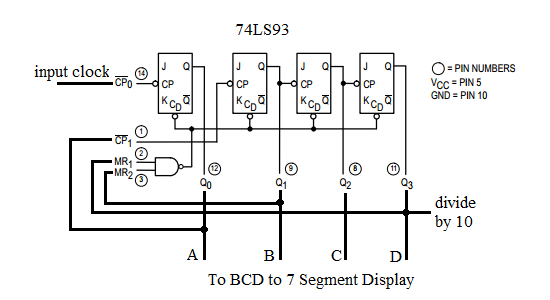
- In order to use all 4 bits of the counter, Q0 must be connected to CP1. Q0 is LSB and Q3 is MSB.
- The input clock is connected to CP0.
- To implement a divide by 10 or MOD10 counter, Q1 is connected to MR1 and Q3 is connected to MR2. With this connection, when the count reaches 10 (1010 binary), it resets to 0.
- The output frequency at Q3 is the input clock frequency divided by 10.
- To display the values, Q3..Q0 are connected to the respective D..A inputs of the BCD to 7 segment display.
Divide by 6 Counter
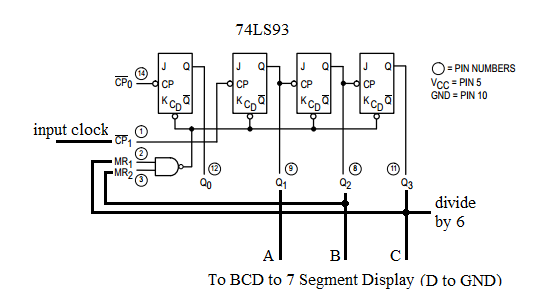
- Since only 3 bits are required Q0 is not used. Q1 is LSB and Q3 is MSB.
- The input clock is connected to CP1.
- To implement a divide by 6 or MOD6 counter, Q2 is connected to MR1 and Q3 is connected to MR2. With this connection, when the count reaches 6 (110 binary), it resets to 0.
- The output frequency at Q3 is the input clock frequency divided by 6.
- To display the values, Q3..Q1 are connected to the respective C..A inputs of the BCD to 7 segment display. D of the BCD to 7 segment display input is connected to GND.
HOURS block
The clock can be designed as a 24H or 12H clock. We will explain the steps to arrive at the combinational logic to obtain a 12H clock and we will leave it to the reader to design the 24H clock as an exercise. Click hints if you need help to design the 24H clock.
12H Clock
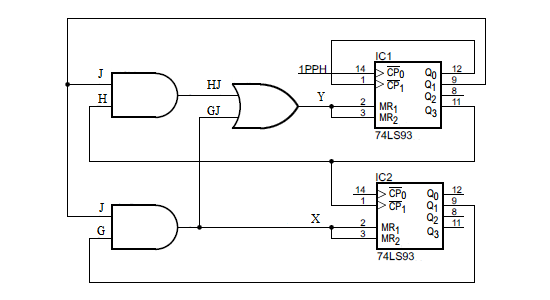
- In order to use all 4 bits of the IC1 (ones) counter, Q0 must be connected to CP1. Q0 is LSB and Q3 is MSB. The input clock is connected to CP0.
- Since less than 3 bits are required for IC2 (tens), Q0 is not
used. Q1 is LSB and Q3 is MSB. The input clock is connected to
CP1.
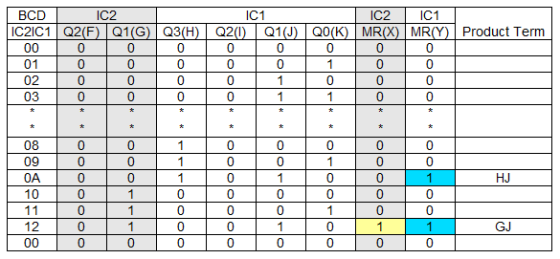
- The truth table of the counter is abbreviated - omitting those rows where the MR inputs to the counters are 0. Recall that for the 7493, a 1 to the MR will reset the counters to 0.
- To simplify the table, K is Q0 of IC1 (ones), G is Q0 of IC2 (tens) and so on.
- For the 12H clock, when the count in BCD reaches
- 0A, IC1 must be cleared (Y=1)
- 12, IC1 must be cleared (Y=1) and IC2 must be cleared (X=1)
- Using SOP (sum of products), we obtain
- Y = HJ + GJ where Y is the IC1 MR1, MR2 inputs connected together
- X = GJ where X is the IC2 MR1, MR2 inputs connected together
Simulate and Breadboard the 24H Clock circuit.
1 Hz Clock
The 1 Hz clock can be implemented using the schmitt trigger oscillator.
Limitations
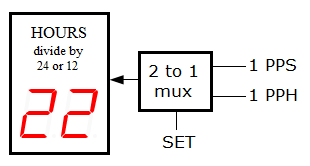
- The clock cannot be set to the correct time. Hint - use
additional logic to allow the 1 PPS clock to drive the MINUTES and
HOURS block depending on a button press. Below is the block diagram
of one solution using a 2 to 1 multiplexer. Depending on
SET, either the 1 PPS (Pulse Per Second) or the 1
PPH (Pulse Per Hour) clock drives the Hour circuit.
- The 12H clock counts from 00 to 11 rather than 01 to 12. Hint - use regular JK flip flops (74LS73) instead of the 74LS93 so on terminal count, the counter output is preset to 01.
Thank you for learning from electronics-course.com
We do not have a paywall as our mission is to provide everyone a quality foundational electronics education. With advertising revenues falling despite increasing numbers of learners, we need your help to maintain and improve the course, which takes time, money and hard work.
Add Answer to:
use flip flop , counter ,and some gats to design clock
have ——>24 hours :59min:59 secand
3. Design a counter with the following repeated binary sequence: 0,1,2,4,6. Use D flip-flop.
3. Design a counter with the following repeated binary sequence: 0,1,2,4,6. Use D flip-flop. 4. Design a counter to count with T flip-flops that goes through the following binary repeated sequence: 0,1,3,7,6,4. Find out the counter response towards the unused state. Illustrate the response with a state diagram. 5. Design a mod-7 counter (repeat binary sequence: 0,1,2,3,4,5,6) use JK flip-flop.
Design a double edge-triggered D flip-flop. The output of the flip-flop Q should "sample" the value...
 Design a double edge-triggered D flip-flop. The output of the flip-flop Q should "sample" the value of the input D on both rising (+ve) and falling (-ve) edges of the clock CLK. Design an FSM counter that counts the sequence: 00, 11, 01, 10,00, 11, ..
5.4 2um 4-34. Design a negative-edge-triggered flip-flop. The flip flop has three inputs; these are Data,...
 5.4 2um
4-34. Design a negative-edge-triggered flip-flop. The flip flop has three inputs; these are Data, Clock, and Enable. If, at the negative edge of the clock, the enable input equals to 0, then the state at Data input is stored in the flip-flop. If, at the negative edge of clock, Enable is in 1 state, then the current stored value in the flip-flop is held. Design the flip-flop using only SR latches, AND gates, and NOT gates.
4-34. Design...
5.4 2um
4-34. Design a negative-edge-triggered flip-flop. The flip flop has three inputs; these are Data, Clock, and Enable. If, at the negative edge of the clock, the enable input equals to 0, then the state at Data input is stored in the flip-flop. If, at the negative edge of clock, Enable is in 1 state, then the current stored value in the flip-flop is held. Design the flip-flop using only SR latches, AND gates, and NOT gates.
4-34. Design...
1. Design a synchronous 2-bit up-down counter using a T flip flop for the most significant bit an...
 1. Design a synchronous 2-bit up-down counter using a T flip flop for the most significant bit and an SR flip flop for the least significant bit; when the input X-1, it should count down and for X-0, it should count up. Use SOP.
1. Design a synchronous 2-bit up-down counter using a T flip flop for the most significant bit and an SR flip flop for the least significant bit; when the input X-1, it should count down and...
1. Design a synchronous 2-bit up-down counter using a T flip flop for the most significant bit and an SR flip flop for the least significant bit; when the input X-1, it should count down and for X-0, it should count up. Use SOP.
1. Design a synchronous 2-bit up-down counter using a T flip flop for the most significant bit and an SR flip flop for the least significant bit; when the input X-1, it should count down and...
Design a synchronous 2-bit up-down counter using a SR flip flop for the most significant bit and an T flip flop for the least significant bit;
Design a synchronous 2-bit up-down counter using a SR flip flop for the most significant bit and an T flip flop for the least significant bit; when the input X=0, it should count down and for X=1, it should count up. Use SOP
Use the gated SR latch design with only NAND gates to design a gated SR flip–flop....
Use the gated SR latch design with only NAND gates to design a gated SR flip–flop. The stored bit Q can only change on the positive edge (rising edge) of the clock cycle. Draw the circuit using only logic gates and create a symbol for the flip–flop you designed.
Modify the hours stage of figure 10-18 to keep military time (00-23 hours) SECTION 10-4/DIGITAL CLOCK...
 Modify the hours stage of figure 10-18 to keep military
time (00-23 hours)
SECTION 10-4/DIGITAL CLOCK PROJECT 763 AMPM tens hrs PM CLRN 74160 units hrs O] QB QC ENT QD ENP RCO units hrs 2] units-hrs[3] CLRN Tens of hours PRN Units of hours CLRN FIGURE 10-18 Detailed circuitry for the HOURS section to count tens of hours. The BCD counter is a 74160, which has two active- HIGH inputs, ENT and ENP, that are ANDed together internally to...
Modify the hours stage of figure 10-18 to keep military
time (00-23 hours)
SECTION 10-4/DIGITAL CLOCK PROJECT 763 AMPM tens hrs PM CLRN 74160 units hrs O] QB QC ENT QD ENP RCO units hrs 2] units-hrs[3] CLRN Tens of hours PRN Units of hours CLRN FIGURE 10-18 Detailed circuitry for the HOURS section to count tens of hours. The BCD counter is a 74160, which has two active- HIGH inputs, ENT and ENP, that are ANDed together internally to...
(b)(i) Using T flip-flop as main components, design a 3-bit synchronous counter that perform counting as...
 (b)(i) Using T flip-flop as main components, design a 3-bit synchronous counter that perform counting as the following sequence 0,2,4,6,1,3,5,7 then repeats (its sequence) [20 marks] (ii) Draw a complete circuit to show how the T flip-flops are interconnected and label it appropriately. Also show how the counter can be asynchronous reset. [5 marks] (iii) Draw a timing diagram for at least four clock cycles [8 marks)
hi i need answers for nos. 18-28. 1. In a counter, a flip-flop output 10. A...
 hi i need answers for nos. 18-28.
1. In a counter, a flip-flop output 10. A is a group of flip-flops, each one of which transition serves as a source for triggering other flip-flops, not by the common clock pulses. shares a common clock and is capable of storing one bit of information. A) RAM B) latch A ripple Cring (rather than signal transitions) are referred to as B synchronous D binary C) counter D) register 11. The Characteristic Equation...
hi i need answers for nos. 18-28.
1. In a counter, a flip-flop output 10. A is a group of flip-flops, each one of which transition serves as a source for triggering other flip-flops, not by the common clock pulses. shares a common clock and is capable of storing one bit of information. A) RAM B) latch A ripple Cring (rather than signal transitions) are referred to as B synchronous D binary C) counter D) register 11. The Characteristic Equation...
Design Problem: Use the JK Flip-Flop to design a circuit of a Synchronous Sequential Ring Counter...
Design Problem: Use the JK Flip-Flop to design a circuit of a Synchronous Sequential Ring Counter that goes through the following sequence: 9, 8, 7, 13, 0, 11, 2, 5, 10, 14 and repeat ( forward direction ) Note: Your design should account for what happens if the systems starts at one of the unused states. In this scenario, the system should point to 0. The system has only one input, x. If x = 1, then the sequence goes...
 Design a double edge-triggered D flip-flop. The output of the flip-flop Q should "sample" the value of the input D on both rising (+ve) and falling (-ve) edges of the clock CLK. Design an FSM counter that counts the sequence: 00, 11, 01, 10,00, 11, ..
 5.4 2um
4-34. Design a negative-edge-triggered flip-flop. The flip flop has three inputs; these are Data, Clock, and Enable. If, at the negative edge of the clock, the enable input equals to 0, then the state at Data input is stored in the flip-flop. If, at the negative edge of clock, Enable is in 1 state, then the current stored value in the flip-flop is held. Design the flip-flop using only SR latches, AND gates, and NOT gates.
4-34. Design...
5.4 2um
4-34. Design a negative-edge-triggered flip-flop. The flip flop has three inputs; these are Data, Clock, and Enable. If, at the negative edge of the clock, the enable input equals to 0, then the state at Data input is stored in the flip-flop. If, at the negative edge of clock, Enable is in 1 state, then the current stored value in the flip-flop is held. Design the flip-flop using only SR latches, AND gates, and NOT gates.
4-34. Design...
 1. Design a synchronous 2-bit up-down counter using a T flip flop for the most significant bit and an SR flip flop for the least significant bit; when the input X-1, it should count down and for X-0, it should count up. Use SOP.
1. Design a synchronous 2-bit up-down counter using a T flip flop for the most significant bit and an SR flip flop for the least significant bit; when the input X-1, it should count down and...
1. Design a synchronous 2-bit up-down counter using a T flip flop for the most significant bit and an SR flip flop for the least significant bit; when the input X-1, it should count down and for X-0, it should count up. Use SOP.
1. Design a synchronous 2-bit up-down counter using a T flip flop for the most significant bit and an SR flip flop for the least significant bit; when the input X-1, it should count down and...
 Modify the hours stage of figure 10-18 to keep military
time (00-23 hours)
SECTION 10-4/DIGITAL CLOCK PROJECT 763 AMPM tens hrs PM CLRN 74160 units hrs O] QB QC ENT QD ENP RCO units hrs 2] units-hrs[3] CLRN Tens of hours PRN Units of hours CLRN FIGURE 10-18 Detailed circuitry for the HOURS section to count tens of hours. The BCD counter is a 74160, which has two active- HIGH inputs, ENT and ENP, that are ANDed together internally to...
Modify the hours stage of figure 10-18 to keep military
time (00-23 hours)
SECTION 10-4/DIGITAL CLOCK PROJECT 763 AMPM tens hrs PM CLRN 74160 units hrs O] QB QC ENT QD ENP RCO units hrs 2] units-hrs[3] CLRN Tens of hours PRN Units of hours CLRN FIGURE 10-18 Detailed circuitry for the HOURS section to count tens of hours. The BCD counter is a 74160, which has two active- HIGH inputs, ENT and ENP, that are ANDed together internally to...
 (b)(i) Using T flip-flop as main components, design a 3-bit synchronous counter that perform counting as the following sequence 0,2,4,6,1,3,5,7 then repeats (its sequence) [20 marks] (ii) Draw a complete circuit to show how the T flip-flops are interconnected and label it appropriately. Also show how the counter can be asynchronous reset. [5 marks] (iii) Draw a timing diagram for at least four clock cycles [8 marks)
 hi i need answers for nos. 18-28.
1. In a counter, a flip-flop output 10. A is a group of flip-flops, each one of which transition serves as a source for triggering other flip-flops, not by the common clock pulses. shares a common clock and is capable of storing one bit of information. A) RAM B) latch A ripple Cring (rather than signal transitions) are referred to as B synchronous D binary C) counter D) register 11. The Characteristic Equation...
hi i need answers for nos. 18-28.
1. In a counter, a flip-flop output 10. A is a group of flip-flops, each one of which transition serves as a source for triggering other flip-flops, not by the common clock pulses. shares a common clock and is capable of storing one bit of information. A) RAM B) latch A ripple Cring (rather than signal transitions) are referred to as B synchronous D binary C) counter D) register 11. The Characteristic Equation...
Most questions answered within 3 hours.
-
Where is the error in this code sequence?
String s1 = "Hello";
String s2 = "ello";...
asked 10 months ago -
Financial data for Joel de Paris, Inc., for last year
follow:
Joel de Paris, Inc.
Balance...
asked 10 months ago -
Consider this reaction:
Al2(SO4)3 (aq)+ BaCl3
(aq) Al2Cl6 (aq)- +
3BaSO4(s) . What is the...
asked 10 months ago -
Suppose that Savneet is considering increasing her
recent random sample from 20 car rentals to 40...
asked 10 months ago -
Trucks arrive at an unloading terminal at an average rate of 120
per hour.
Trucks arrive...
asked 10 months ago -
Why are methanol and ethanol completely soluble in water while
octanol is not very little soluble....
asked 10 months ago -
A facilities manager at a university reads in a research report
that the mean amount of...
asked 10 months ago -
When the CuSO4 is rehydrated by adding water to the anhydrous
compound, is this an endothermic...
asked 10 months ago -
A ray of sunlight is passing from diamond into crown glass; the
angle of incidence is...
asked 10 months ago -
A block of mass 0.249 kg is placed on top of a light, vertical
spring of...
asked 10 months ago -
how do the kidneys compensate in the presences of acidosis
a) trigger hyperventilate
b) reserve acid...
asked 10 months ago -
Question 501 pts
The rental rate of capital to the firm increases. Which of the
following...
asked 10 months ago