Why is seed production beneficial gymnosperms and angiosperms?
Why is seed production beneficial gymnosperms and angiosperms?
Homework Answers
Answer
A seed is an embryonic plant enclosed in a protective outer covering . The formation of the seed is part of the process of reproduction in seed plants, including the gymnosperm and angiosperm plants. Seed, the characteristic reproductive body of both angiosperms (flowering plants) and gymnosperms (e.g., conifers, cycads, and ginkgos).
Seeds have been an important development in the reproduction and success of gymnosperm and angiosperm plants, relative to more primitive plants such as ferns, mosses and liverworts, which do not have seeds and use water-dependent means to propagate themselves. Seed plants now dominate biological niches on land, from forests to grasslands both in hot and cold climates.
Essentially, a seed consists of a miniature undeveloped plant (the embryo), which, alone or in the company of stored food for its early development after germination, is surrounded by a protective coat (the testa).seeds are eminently suited to perform a wide variety of functions the relationships of which are not always obvious: multiplication, perennation (surviving seasons of stress such as winter), dormancy (a state of arrested development), and dispersal. Pollination and the “seed habit” are considered the most important factors responsible for the overwhelming evolutionary success of the flowering plants
Seed ferns gave rise to the gymnosperms, allowing them to adapt to dry conditions. Seed fern produced their seeds along their branches without specialized structures. seed plants is that developed structures called cupules to enclose and protect the ovule (the female gametophyte and associated tissues) which develops into a seed upon fertilization.
Rather than being derived from gymnosperms, angiosperms form a sister clade (a species and its descendents) that developed in parallel with the gymnosperms. The two innovative structures of flowers and fruit represent an improved reproductive strategy that served to protect the embryo, while increasing genetic variability and range.
Which of the following are not a monophyletic group? angiosperms ferns gymnosperms lycophytes bryophytes ferns/horsetails and...
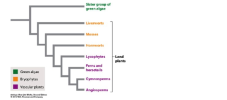 Which of the following are not a monophyletic group?
angiosperms
ferns
gymnosperms
lycophytes
bryophytes
ferns/horsetails and bryophytes
ferns/horsetails
Sister group of green algae Liverworts Mosses Hornworts Lycophytes Land plants Ferns and horsetails Green algae Bryophytes Gymnosperms Vascular plants Angiosperms De How We Seed Cation HO
Which of the following are not a monophyletic group?
angiosperms
ferns
gymnosperms
lycophytes
bryophytes
ferns/horsetails and bryophytes
ferns/horsetails
Sister group of green algae Liverworts Mosses Hornworts Lycophytes Land plants Ferns and horsetails Green algae Bryophytes Gymnosperms Vascular plants Angiosperms De How We Seed Cation HO
Question 4 1 pts Compare and contrast the fertilization processes of gymnosperms and angiosperms. Be sure...
 Question 4 1 pts Compare and contrast the fertilization processes of gymnosperms and angiosperms. Be sure your answer includes structures and/or events that are unique to each of these two groups of seed plants. HTML Editora BIVA-A I E x x - DC V V T 114 12pt . Paragraph O words
Describe the major differences and similarities between gymnosperms and angiosperms.
Describe the major differences and similarities between gymnosperms and angiosperms.
Compare and Contrast gymnosperms and angiosperms. Also explain which one holds tracheids or vessel elements and...
Compare and Contrast gymnosperms and angiosperms. Also explain which one holds tracheids or vessel elements and why?
Angiosperms and gymnosperms exhibit numerous unique adaptations which helped them adapt to life on land. Which...
 Angiosperms and gymnosperms exhibit numerous unique adaptations
which helped them adapt to life on land. Which of the following is
not an important adaptation unique to
these two groups?
Question 6 Angiosperms and lymnosperms exhibit numerous unique adaptations which helped them adat life on land. Which of the following is not an important adaptation unique to these two groups transport of water through vascular tissue protection and nourishment of the embryo within a seed dispersal of new plants by seeds...
Angiosperms and gymnosperms exhibit numerous unique adaptations
which helped them adapt to life on land. Which of the following is
not an important adaptation unique to
these two groups?
Question 6 Angiosperms and lymnosperms exhibit numerous unique adaptations which helped them adat life on land. Which of the following is not an important adaptation unique to these two groups transport of water through vascular tissue protection and nourishment of the embryo within a seed dispersal of new plants by seeds...
Describe the differences seen in the alteration of generations between gymnosperms, angiosperms and nonvascular plants.
Describe the differences seen in the alteration of generations between gymnosperms, angiosperms and nonvascular plants.
Why are there so many species of angiosperms? a. coevolution with pollinators and seed dispersers b....
Why are there so many species of angiosperms? a. coevolution with pollinators and seed dispersers b. the divergence of monocots and eudicots c. seeds and pollen allowed them to colonize drier habitats d. double fertilization I believe the correct answer is A. I'm just not 100% sure
14. What characteristic do gymnosperms and angiosperms have the ferns and other monilophytes do not?
14. What characteristic do gymnosperms and angiosperms have the ferns and other monilophytes do not?
d. bryophytes e. charophytes 12. Which group(s) protect their embryos! a. angiosperms b. pteridophytes C. gymnosperms...
 d. bryophytes e. charophytes 12. Which group(s) protect their embryos! a. angiosperms b. pteridophytes C. gymnosperms 13. Which group is the ancestor of all the others? a. angiosperms b. pteridophytes C. gymnosperms d. bryophytes e. charophytes
Two characteristics shared by gymnosperms and angiosperms that are absent from earlier plant groups and represent...
 Two characteristics shared by gymnosperms and angiosperms that are absent from earlier plant groups and represent key adaptations to life on dry land are a vascular system Magellated sperm and gametangla flowers and fruits pollen and seeds
 Which of the following are not a monophyletic group?
angiosperms
ferns
gymnosperms
lycophytes
bryophytes
ferns/horsetails and bryophytes
ferns/horsetails
Sister group of green algae Liverworts Mosses Hornworts Lycophytes Land plants Ferns and horsetails Green algae Bryophytes Gymnosperms Vascular plants Angiosperms De How We Seed Cation HO
Which of the following are not a monophyletic group?
angiosperms
ferns
gymnosperms
lycophytes
bryophytes
ferns/horsetails and bryophytes
ferns/horsetails
Sister group of green algae Liverworts Mosses Hornworts Lycophytes Land plants Ferns and horsetails Green algae Bryophytes Gymnosperms Vascular plants Angiosperms De How We Seed Cation HO
 Question 4 1 pts Compare and contrast the fertilization processes of gymnosperms and angiosperms. Be sure your answer includes structures and/or events that are unique to each of these two groups of seed plants. HTML Editora BIVA-A I E x x - DC V V T 114 12pt . Paragraph O words
 Angiosperms and gymnosperms exhibit numerous unique adaptations
which helped them adapt to life on land. Which of the following is
not an important adaptation unique to
these two groups?
Question 6 Angiosperms and lymnosperms exhibit numerous unique adaptations which helped them adat life on land. Which of the following is not an important adaptation unique to these two groups transport of water through vascular tissue protection and nourishment of the embryo within a seed dispersal of new plants by seeds...
Angiosperms and gymnosperms exhibit numerous unique adaptations
which helped them adapt to life on land. Which of the following is
not an important adaptation unique to
these two groups?
Question 6 Angiosperms and lymnosperms exhibit numerous unique adaptations which helped them adat life on land. Which of the following is not an important adaptation unique to these two groups transport of water through vascular tissue protection and nourishment of the embryo within a seed dispersal of new plants by seeds...
 d. bryophytes e. charophytes 12. Which group(s) protect their embryos! a. angiosperms b. pteridophytes C. gymnosperms 13. Which group is the ancestor of all the others? a. angiosperms b. pteridophytes C. gymnosperms d. bryophytes e. charophytes
 Two characteristics shared by gymnosperms and angiosperms that are absent from earlier plant groups and represent key adaptations to life on dry land are a vascular system Magellated sperm and gametangla flowers and fruits pollen and seeds
Most questions answered within 3 hours.
-
Where is the error in this code sequence?
String s1 = "Hello";
String s2 = "ello";...
asked 11 months ago -
Financial data for Joel de Paris, Inc., for last year
follow:
Joel de Paris, Inc.
Balance...
asked 11 months ago -
Consider this reaction:
Al2(SO4)3 (aq)+ BaCl3
(aq) Al2Cl6 (aq)- +
3BaSO4(s) . What is the...
asked 11 months ago -
Suppose that Savneet is considering increasing her
recent random sample from 20 car rentals to 40...
asked 11 months ago -
Trucks arrive at an unloading terminal at an average rate of 120
per hour.
Trucks arrive...
asked 11 months ago -
Why are methanol and ethanol completely soluble in water while
octanol is not very little soluble....
asked 11 months ago -
A facilities manager at a university reads in a research report
that the mean amount of...
asked 11 months ago -
When the CuSO4 is rehydrated by adding water to the anhydrous
compound, is this an endothermic...
asked 11 months ago -
A ray of sunlight is passing from diamond into crown glass; the
angle of incidence is...
asked 11 months ago -
A block of mass 0.249 kg is placed on top of a light, vertical
spring of...
asked 11 months ago -
how do the kidneys compensate in the presences of acidosis
a) trigger hyperventilate
b) reserve acid...
asked 11 months ago -
Question 501 pts
The rental rate of capital to the firm increases. Which of the
following...
asked 11 months ago