You are studying a human mRNA that you believe is controlled at the level of translation....
You are studying a human mRNA that you believe is controlled at the level of translation. You think that the 5’-UTR plays a role by binding to a protein that prevents the initiation of translation. To definitively determine the role of the 5’-UTR, you decide to clone the 5’UTR of the gene upstream of GFP open reading frame in a mammalian expression vector.
Question: Describe an experiment that you would perform using this vector to prove that the 5’ UTR plays a role in the control of translation; explain the result of the experiment would be if your initial hypothesis is correct.
Homework Answers
It is given that a given sequence
element located in the 5'-UTR is required for activation of
translation.
To confirm this, clone the sequence along with a reporter gene such
as GFP and transform into bacterial cells.
We have to use two constructs.
In the first construct, put the WT 5'-UTR sequence along with the
GFP
In the first construct, put the mutant version of the 5'-UTR
sequence along with the GFP
If 5-UTR is indeed required for
translational activation, we would observe high GFP signal from the
cells that are transfected with the WT construct.
Otherwise, there would not be any difference in GFP signal from
both constructs.
Add Answer to:
You are studying a human mRNA that you believe is controlled at
the level of translation....
You are studying a human protein, XYZ, that localizes to the nucleus in human cells. You...
 You are studying a human protein, XYZ, that localizes to the nucleus in human cells. You want to see if it will also localize to the nucleus in mouse cells. To do this, you clone a translational fusion of the jellyfish fluorescent protein, called GFP, to XYZ and put it into a plasmid. This means that XYZ and GFP are now translated as a single protein. Since XYZ is now fused to GFP, you can simply image GFP to see...
You perform an experiment in which you add a synthetic mRNA to a test tube that...
You perform an experiment in which you add a synthetic mRNA to a test tube that contains all components required for translation (it was just lacking the mRNA). You find that a polypeptide consisting of 122 amino acids is produced. Then you perform another experiment, this time adding the mRNA from a mutant version of the gene and find that a polypeptide consisting of 48 amino acids was produced. What is a likely explanation for this observation? A. The mutant...
Fluorescent Protein Gene Fusia for Subcellular Localization Imaging 5. (2 pts) You are studying the human...
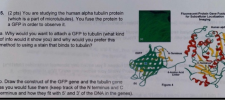 Fluorescent Protein Gene Fusia for Subcellular Localization Imaging 5. (2 pts) You are studying the human alpha tubulin protein (which is a part of microtubules). You fuse the protein to a GFP in order to observe it. a. Why would you want to attach a GFP to tubulin (what kind of info would it show you) and why would you prefer this method to using a stain that binds to tubulin? 26 Humana EOFI Se Termine A Acid Figure 4...
QUESTION 36 Ferritin is an intracellular protein that stores essential iron and releases it in a...
 QUESTION 36 Ferritin is an intracellular protein that stores essential iron and releases it in a controlled fashion when needed. Hereditary hyperferritinaemia-cataract syndrome (HHCS) is a relatively rare disorder with an autosomal dominant trait. The disease is characterized by increased L-ferritin in serum and tissues and early onset of bilateral cataracts. Iron metabolism is normal, and there is no tissue iron overload. HHCS can be caused by mutations in the 5' non-coding region of the ferritin gene. Which of the...
The abundance of mRNA in mammalian cells is measured to be: a)1% of total RNA content...
The abundance of mRNA in mammalian cells is measured to be: a)1% of total RNA content b)10% of total cell content c)80% of total RNA content d)The same as protein content 2. RNAi is used for one of the following purposes. a) To disrupt a DNA b) To clone a particular gene c) To verify the function of a gene d) To produce a new gene To successfully express a protein from a eukaryotic expression vector, the following is NOT...
1a. During translation termination: a. a release factor with an anticodon complementary to the stop mRNA...
1a. During translation termination: a. a release factor with an anticodon complementary to the stop mRNA codon bonds the A site b. Ribosomal complex dissociates releasing the mRNA c. all of the responses are correct. d. hydrolysis seperates the polypeptide from tRNA. --------------------------------------------------------------------------------------------------------------------------- 1b. Select the one NOT involved in the formation in the formation of a eukaryotic transcription initiation complex. a. spliceosome b. all are required c. RNA polymerase III d. transcription factors e. TATA box in a promoter...
molecular biology Section C (40 marks) Answer ALL questions from this Section 5. You have isolated total RNA from muscle cells and constructeda muscle cDNA library. You wish to study the regulatory r...
 molecular biology
Section C (40 marks) Answer ALL questions from this Section 5. You have isolated total RNA from muscle cells and constructeda muscle cDNA library. You wish to study the regulatory region of a muscle-specific cDNA gene (gene M) that you have previously identified. 6 (a) For your study, you need to isolate a genomic clone of gene M. Why isa cDNA clone of gene M not appropriate for your study? (2 marks) (b) Outline the steps you would...
molecular biology
Section C (40 marks) Answer ALL questions from this Section 5. You have isolated total RNA from muscle cells and constructeda muscle cDNA library. You wish to study the regulatory region of a muscle-specific cDNA gene (gene M) that you have previously identified. 6 (a) For your study, you need to isolate a genomic clone of gene M. Why isa cDNA clone of gene M not appropriate for your study? (2 marks) (b) Outline the steps you would...
5) Translation was originally sorted out using a variety of inhibitors of protein synthesis Inhibitors tend...
 5) Translation was originally sorted out using a variety of inhibitors of protein synthesis Inhibitors tend to interrupt the process at a particular step and a population of translating ribosomes will all stop in the same state. An allied technique is to identify temperature sensitive mutations in various accessory factors. When the population of ribosomes is shifted to the restrictive temperature, ribosomes will stall when they need the function of the mutant protein to continue By analyzing the structure of...
can you guys please give me the correct answers and explain why? 19. You clone your...
 can you guys please give me the correct answers and explain
why?
19. You clone your favorite E. coli gene including the promoter region, the open reading frame, and some flanking DNA. You determine the DNA sequence of the entire region and map the start site of transcription. You note the following sequence near the end o your gene. What is the likely function of this sequence? ...CCCAGCCCGCCTAATGAGCGGGCTTTTTTTTTTGAAGGTATAT... A. A polyadenylation signal B. A Rut site C. The ribosome binding...
can you guys please give me the correct answers and explain
why?
19. You clone your favorite E. coli gene including the promoter region, the open reading frame, and some flanking DNA. You determine the DNA sequence of the entire region and map the start site of transcription. You note the following sequence near the end o your gene. What is the likely function of this sequence? ...CCCAGCCCGCCTAATGAGCGGGCTTTTTTTTTTGAAGGTATAT... A. A polyadenylation signal B. A Rut site C. The ribosome binding...
1. You are a scientist studying a rare heritable disease, Pitt-Hopkins syndrome. This disease is caused...
1. You are a scientist studying a rare heritable disease, Pitt-Hopkins syndrome. This disease is caused by mutations in the basic helix-loop-helix transcription factor, TCF4. You sequence the TCF4 gene in your patients and identify several sequence variants. a) The TCF4 coding region and sites of mutations for several patients are shown here (lines between codons indicate the open reading frame). For each patient, identify the impact of the mutation on the coding sequence (1 mark each) and the likely...
 You are studying a human protein, XYZ, that localizes to the nucleus in human cells. You want to see if it will also localize to the nucleus in mouse cells. To do this, you clone a translational fusion of the jellyfish fluorescent protein, called GFP, to XYZ and put it into a plasmid. This means that XYZ and GFP are now translated as a single protein. Since XYZ is now fused to GFP, you can simply image GFP to see...
 Fluorescent Protein Gene Fusia for Subcellular Localization Imaging 5. (2 pts) You are studying the human alpha tubulin protein (which is a part of microtubules). You fuse the protein to a GFP in order to observe it. a. Why would you want to attach a GFP to tubulin (what kind of info would it show you) and why would you prefer this method to using a stain that binds to tubulin? 26 Humana EOFI Se Termine A Acid Figure 4...
 QUESTION 36 Ferritin is an intracellular protein that stores essential iron and releases it in a controlled fashion when needed. Hereditary hyperferritinaemia-cataract syndrome (HHCS) is a relatively rare disorder with an autosomal dominant trait. The disease is characterized by increased L-ferritin in serum and tissues and early onset of bilateral cataracts. Iron metabolism is normal, and there is no tissue iron overload. HHCS can be caused by mutations in the 5' non-coding region of the ferritin gene. Which of the...
 molecular biology
Section C (40 marks) Answer ALL questions from this Section 5. You have isolated total RNA from muscle cells and constructeda muscle cDNA library. You wish to study the regulatory region of a muscle-specific cDNA gene (gene M) that you have previously identified. 6 (a) For your study, you need to isolate a genomic clone of gene M. Why isa cDNA clone of gene M not appropriate for your study? (2 marks) (b) Outline the steps you would...
molecular biology
Section C (40 marks) Answer ALL questions from this Section 5. You have isolated total RNA from muscle cells and constructeda muscle cDNA library. You wish to study the regulatory region of a muscle-specific cDNA gene (gene M) that you have previously identified. 6 (a) For your study, you need to isolate a genomic clone of gene M. Why isa cDNA clone of gene M not appropriate for your study? (2 marks) (b) Outline the steps you would...
 5) Translation was originally sorted out using a variety of inhibitors of protein synthesis Inhibitors tend to interrupt the process at a particular step and a population of translating ribosomes will all stop in the same state. An allied technique is to identify temperature sensitive mutations in various accessory factors. When the population of ribosomes is shifted to the restrictive temperature, ribosomes will stall when they need the function of the mutant protein to continue By analyzing the structure of...
 can you guys please give me the correct answers and explain
why?
19. You clone your favorite E. coli gene including the promoter region, the open reading frame, and some flanking DNA. You determine the DNA sequence of the entire region and map the start site of transcription. You note the following sequence near the end o your gene. What is the likely function of this sequence? ...CCCAGCCCGCCTAATGAGCGGGCTTTTTTTTTTGAAGGTATAT... A. A polyadenylation signal B. A Rut site C. The ribosome binding...
can you guys please give me the correct answers and explain
why?
19. You clone your favorite E. coli gene including the promoter region, the open reading frame, and some flanking DNA. You determine the DNA sequence of the entire region and map the start site of transcription. You note the following sequence near the end o your gene. What is the likely function of this sequence? ...CCCAGCCCGCCTAATGAGCGGGCTTTTTTTTTTGAAGGTATAT... A. A polyadenylation signal B. A Rut site C. The ribosome binding...
Most questions answered within 3 hours.
-
Where is the error in this code sequence?
String s1 = "Hello";
String s2 = "ello";...
asked 11 months ago -
Financial data for Joel de Paris, Inc., for last year
follow:
Joel de Paris, Inc.
Balance...
asked 11 months ago -
Consider this reaction:
Al2(SO4)3 (aq)+ BaCl3
(aq) Al2Cl6 (aq)- +
3BaSO4(s) . What is the...
asked 11 months ago -
Suppose that Savneet is considering increasing her
recent random sample from 20 car rentals to 40...
asked 11 months ago -
Trucks arrive at an unloading terminal at an average rate of 120
per hour.
Trucks arrive...
asked 11 months ago -
Why are methanol and ethanol completely soluble in water while
octanol is not very little soluble....
asked 11 months ago -
A facilities manager at a university reads in a research report
that the mean amount of...
asked 11 months ago -
When the CuSO4 is rehydrated by adding water to the anhydrous
compound, is this an endothermic...
asked 11 months ago -
A ray of sunlight is passing from diamond into crown glass; the
angle of incidence is...
asked 11 months ago -
A block of mass 0.249 kg is placed on top of a light, vertical
spring of...
asked 11 months ago -
how do the kidneys compensate in the presences of acidosis
a) trigger hyperventilate
b) reserve acid...
asked 11 months ago -
Question 501 pts
The rental rate of capital to the firm increases. Which of the
following...
asked 11 months ago