Which of the following classes of antimicrobial drugs inhibits protein synthesis? Select ALL correct answers --...
Which of the following classes of antimicrobial drugs inhibits protein synthesis?
Select ALL correct answers -- there is more than one!
| Aminoglycosides |
| Oxazolidinones |
| Nitroimidazoles |
| Chloramphenicol |
| Pyrazinamides |
| Fluoroquinolones |
Homework Answers
Aminoglycosides work by inhibiting bacterial protein synthesis
Oxazolidinones also inhibit the protein synthesis by binding to ribosome
Nitroimidazoles kills bacteria by inhibiting nucleic acid bio synthesis
Chloramphinicol works by inhibiting peptidyl transferase activity hence inhibit protein synthesis.
Pyrazinamides inhibit pyrazinamidase enzyme that converts pyrazinamides to active form pyrazinoic acid
Fluoroquinolones works by inhibiting DNA gyrase and topoisomerase IV and inhibit protein synthesis
So option A,B and D are correct.
Add Answer to:
Which of the following classes of antimicrobial drugs inhibits
protein synthesis?
Select ALL correct answers --...
Which of the following classes of antimicrobial drugs inhibit nucleic acid synthesis? Select ALL correct answers...
Which of the following classes of antimicrobial drugs inhibit nucleic acid synthesis? Select ALL correct answers -- there is more than one! Rifamycins Pyrazinamides Oxazolidinones Fluoroquinolones Nitroimidazoles Sulfonamides
Which two antimicrobial drugs inhibit sequential steps in the synthesis of folic acid? penicillin and sulfamethoxazole...
Which two antimicrobial drugs inhibit sequential steps in the synthesis of folic acid? penicillin and sulfamethoxazole sulfamethoxazole and trimethoprim penicillin and gentamicin erythromycin and penicillin trimethoprim and synercid True/False: Viral infections are generally easier to treat than bacterial infections because viruses do not have a cellular structure. True False 1. Superinfection is most likely to result from a narrow spectrum antibiotic an extremely invasive, pathogenic organism that is antibiotic resistant the same organism re-infecting a patient after discontinuing antibiotic therapy...
73) All antimicrobial drugs act by: a) killing bacteria b) inhibiting protein synthesis c) stopping cell...
 73) All antimicrobial drugs act by: a) killing bacteria b) inhibiting protein synthesis c) stopping cell growth d) binding to a cellular target e) getting inside the bacteria
Which of the following are primary mechanisms through which microorganisms evade antimicrobial drugs? To be marked...
Which of the following are primary mechanisms through which microorganisms evade antimicrobial drugs? To be marked correct, you'll need to select all applicable statements, as there may be more than one correct answer. Drug target alterations Reducing drug concentration inside of the cell Drug inactivation Decreasing intracellular drug solubility
Which of the following may act as a target of drugs that inhibit protein synthesis? SELECT...
Which of the following may act as a target of drugs that inhibit protein synthesis? SELECT ALL THAT APPLY The tRNA docking site. The shape of the 30S ribosomal subunit. Interference with alanine-alanine bridges. Movement of the ribosome from one codon to the next. The enzymatic site of the 50S ribosomal subunit.
Which of the following agricultural practices may promote antimicrobial drug resistance? To be marked correct, you'll...
Which of the following agricultural practices may promote antimicrobial drug resistance? To be marked correct, you'll need to select all applicable statements, as there may be more than one correct answer. View Available Hint(s) Which of the following agricultural practices may promote antimicrobial drug resistance? To be marked correct, you'll need to select all applicable statements, as there may be more than one correct answer. Use of manure-based fertilizers Genetic engineering of cows to produce human hormones and other drugs...
12. Which of the following antimicrobial agents has the fewest side effects? a. Tetracycline b. Penicillin...
 12. Which of the following antimicrobial agents has the fewest side effects? a. Tetracycline b. Penicillin c. Chloramphenicol d. Erythromycin 13. Which of the following antibodies does not interfere with cell wall synthesis? a. Cephalosporins b. Natural penicillins c. Semisynthetic penicillins d. Macrolides e. Vancomycin 14. Which of the following would be selective against tubercle bacillus? a. b. e. d. e. Vancomycin- inhibits peptidoglycan synthesis Bacitracin- inhibits peptidoglycan synthesis Streptomycin- inhibits protein synthesis Ethambutol- inhibits mycolic acid synthesis Streptogramin- inhibits...
Please answer all... Thank you! Options: block specific metabolic reactions (competitive analogs), deterioration of a cell...
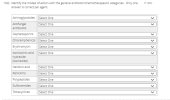 Please answer all... Thank you!
Options: block specific metabolic reactions (competitive
analogs), deterioration of a cell membrane (perhaps concomitant
with some cell wall damage), inhibit cell synthesis, inhibits DNA
synthesis, interfere with protein synthesis
(11 pts) 104) Identify the modes of action with the general antibiotic/chemotherapeutic categories. Only one answer is correct per agent Aminoglycosides Select One Antifungal Select One antibiotics Cephalosporins Select One Chloramphenicol Select One Erythromycin Select One Isonicotinic acid Select One hydrazide (Isoniazide) Nalidixic acid Select One...
Please answer all... Thank you!
Options: block specific metabolic reactions (competitive
analogs), deterioration of a cell membrane (perhaps concomitant
with some cell wall damage), inhibit cell synthesis, inhibits DNA
synthesis, interfere with protein synthesis
(11 pts) 104) Identify the modes of action with the general antibiotic/chemotherapeutic categories. Only one answer is correct per agent Aminoglycosides Select One Antifungal Select One antibiotics Cephalosporins Select One Chloramphenicol Select One Erythromycin Select One Isonicotinic acid Select One hydrazide (Isoniazide) Nalidixic acid Select One...
When the term parenteral is used in regards to drug administration, this applies to drugs administered...
When the term parenteral is used in regards to drug administration, this applies to drugs administered _____ (choose all that apply). Select one or more: a. intravenously b. orally c. intramuscularly d. topically Protein synthesis occurs in all living cells. Why, then, are some antimicrobial drugs that target protein synthesis selectively toxic to bacteria? Select one: a. The protein synthesis in human cells occurs less frequently than that in bacterial cells. b. The ribosomes found in human cells and those...
Racin inhibits protein synthesis by targeting which of the following steps during translation? a. depurination of...
Racin inhibits protein synthesis by targeting which of the following steps during translation? a. depurination of 28S rRNA b. translation termination c. translation initiation d. ribosome translocation e. binding the mRNA to the ribosome Please give reasoning behind answer. Thanks
 73) All antimicrobial drugs act by: a) killing bacteria b) inhibiting protein synthesis c) stopping cell growth d) binding to a cellular target e) getting inside the bacteria
 12. Which of the following antimicrobial agents has the fewest side effects? a. Tetracycline b. Penicillin c. Chloramphenicol d. Erythromycin 13. Which of the following antibodies does not interfere with cell wall synthesis? a. Cephalosporins b. Natural penicillins c. Semisynthetic penicillins d. Macrolides e. Vancomycin 14. Which of the following would be selective against tubercle bacillus? a. b. e. d. e. Vancomycin- inhibits peptidoglycan synthesis Bacitracin- inhibits peptidoglycan synthesis Streptomycin- inhibits protein synthesis Ethambutol- inhibits mycolic acid synthesis Streptogramin- inhibits...
 Please answer all... Thank you!
Options: block specific metabolic reactions (competitive
analogs), deterioration of a cell membrane (perhaps concomitant
with some cell wall damage), inhibit cell synthesis, inhibits DNA
synthesis, interfere with protein synthesis
(11 pts) 104) Identify the modes of action with the general antibiotic/chemotherapeutic categories. Only one answer is correct per agent Aminoglycosides Select One Antifungal Select One antibiotics Cephalosporins Select One Chloramphenicol Select One Erythromycin Select One Isonicotinic acid Select One hydrazide (Isoniazide) Nalidixic acid Select One...
Please answer all... Thank you!
Options: block specific metabolic reactions (competitive
analogs), deterioration of a cell membrane (perhaps concomitant
with some cell wall damage), inhibit cell synthesis, inhibits DNA
synthesis, interfere with protein synthesis
(11 pts) 104) Identify the modes of action with the general antibiotic/chemotherapeutic categories. Only one answer is correct per agent Aminoglycosides Select One Antifungal Select One antibiotics Cephalosporins Select One Chloramphenicol Select One Erythromycin Select One Isonicotinic acid Select One hydrazide (Isoniazide) Nalidixic acid Select One...
Most questions answered within 3 hours.
-
Where is the error in this code sequence?
String s1 = "Hello";
String s2 = "ello";...
asked 11 months ago -
Financial data for Joel de Paris, Inc., for last year
follow:
Joel de Paris, Inc.
Balance...
asked 11 months ago -
Consider this reaction:
Al2(SO4)3 (aq)+ BaCl3
(aq) Al2Cl6 (aq)- +
3BaSO4(s) . What is the...
asked 11 months ago -
Suppose that Savneet is considering increasing her
recent random sample from 20 car rentals to 40...
asked 11 months ago -
Trucks arrive at an unloading terminal at an average rate of 120
per hour.
Trucks arrive...
asked 11 months ago -
Why are methanol and ethanol completely soluble in water while
octanol is not very little soluble....
asked 11 months ago -
A facilities manager at a university reads in a research report
that the mean amount of...
asked 11 months ago -
When the CuSO4 is rehydrated by adding water to the anhydrous
compound, is this an endothermic...
asked 11 months ago -
A ray of sunlight is passing from diamond into crown glass; the
angle of incidence is...
asked 11 months ago -
A block of mass 0.249 kg is placed on top of a light, vertical
spring of...
asked 11 months ago -
how do the kidneys compensate in the presences of acidosis
a) trigger hyperventilate
b) reserve acid...
asked 11 months ago -
Question 501 pts
The rental rate of capital to the firm increases. Which of the
following...
asked 11 months ago