5’ctaagATGCCGATgtttaaaagACTAAAAGTTAAgtttcacagTTCAGGGCAACGGCGGTGAgtaaaa3’ 3’gattcTACGGCTAcaaattttcTGATTTTCAATTcaaagtgtcAAGTCCCGTTGCCGCCACTcatttt5’ (3) Point mutations can be transition, transversion, synonymous change, and/or non- synonymous change. What.
5’ctaagATGCCGATgtttaaaagACTAAAAGTTAAgtttcacagTTCAGGGCAACGGCGGTGAgtaaaa3’
3’gattcTACGGCTAcaaattttcTGATTTTCAATTcaaagtgtcAAGTCCCGTTGCCGCCACTcatttt5’
(3) Point mutations can be transition, transversion, synonymous change, and/or non-
synonymous change. What types do the following mutations belong to? For the
above DNA sequence (position index starts at 1 using the biologist’s notation),
(1). a mutation occurs at position 8, changing G to A. (2). a mutation occurs at
position 11, changing G to A. (3). a mutation occurs at position 15, changing t to
c. (4). a mutation occurs at position 12, changing A to C. (5). create a stop codon
by introducing a mutation, be it point mutation or indels (insertion/deletion). (10
points).
Homework Answers
mRNA will be formed from 3' to 5' DNA,
5’ ctaagAUGCCGAUguuuaaaagACUAAAAGUUAAguuucacagUUCAGGGCAACGGCGGUGAguaaaa 3' (mRNA)
Removal of introns and joining of exons,
5’ AUG CCG AUA CUA AAA GUU AAU UCA GGG CAA CGG CGG UGA 3'
Amino acids formed after translation,
N met pro ile leu lys val asn ser gly gln arg arg STOP C
Now you have to perform mutations on this sequence,
mRNA,
3' ctaagAUGCCGAUguuuaaaagACUAAAAGUUAAguuucacagUUCAGGGCAACGGCGGUGAguaaaa 3'
1. G to A at 8th position,
AUG to AUA
First amino acid will change from met to ile
Mis sense mutation
2. G to A at 11th position,
CCG to CCA
pro will remain pro
No change
Silent mutation
3. T to C at 15th position
This is occuring in intron, which do not participate in translation
No change
Silent mutation
4. A to C at 12th position
CUA to CUC
leu will remain leu
No change
Silent mutation
5. Change C to G at 46th position
UCA to UGA
Ser to STOP
Please rate.
Add Answer to:
5’ctaagATGCCGATgtttaaaagACTAAAAGTTAAgtttcacagTTCAGGGCAACGGCGGTGAgtaaaa3’
3’gattcTACGGCTAcaaattttcTGATTTTCAATTcaaagtgtcAAGTCCCGTTGCCGCCACTcatttt5’
(3) Point mutations can be transition, transversion, synonymous
change, and/or non-
synonymous change. What.
Exposure to various chemicals can cause DNA mutations. Sort the phrases below as transition, transversion, or...
 Exposure to various chemicals
can cause DNA mutations. Sort the phrases below as transition,
transversion, or insertion/deletion mutations. Note: If you answer
any part of this question incorrectly, a single red X will appear
indicating that you sorted one or more of the phrases
incorrectly.
Exposure to various chemicals can cause DNA mutations. Sort the phrases below as transition, transversion, or insertion/deletion mutations. Note: If you answer any part of this question incorrectly, a single red X will appear indicating...
Exposure to various chemicals
can cause DNA mutations. Sort the phrases below as transition,
transversion, or insertion/deletion mutations. Note: If you answer
any part of this question incorrectly, a single red X will appear
indicating that you sorted one or more of the phrases
incorrectly.
Exposure to various chemicals can cause DNA mutations. Sort the phrases below as transition, transversion, or insertion/deletion mutations. Note: If you answer any part of this question incorrectly, a single red X will appear indicating...
Use the Mutations interactive to determine which statements describe silent mutations. The adenine of the start...
 Use the Mutations interactive
to determine which statements describe silent mutations. The
adenine of the start codon is position +1.
a substitution from G to T in the arginine codon of the
antisense stand
a substitution of a G nucleotide at position +9 in the antisense
strand
a transition at position +6 in the sense strand
a transversion of A in the histidine codon of the antisense
strand
a single nucleotide deletion at position +12 in the antisense
strand
a...
Use the Mutations interactive
to determine which statements describe silent mutations. The
adenine of the start codon is position +1.
a substitution from G to T in the arginine codon of the
antisense stand
a substitution of a G nucleotide at position +9 in the antisense
strand
a transition at position +6 in the sense strand
a transversion of A in the histidine codon of the antisense
strand
a single nucleotide deletion at position +12 in the antisense
strand
a...
Why is an insertion or deletion more likely to result in a damaging mutation than a...
Why is an insertion or deletion more likely to result in a damaging mutation than a point mutation? 1.Point mutations only change two or three nucleotides 2.Point mutations never change the amino acid that is called for in the protein 3.Insertions/deletions change all codons that follow them, unless they are indels of 3, 6, 9, etc 4.Point mutations cannot result in a stop codon, whereas insertions and deletions can.
Mutations Worksheet-Dcletlon, Inserilon & Substitution
 Mutations Worksheet-Dcletlon, Inserilon & SubstitutionThere are several types of mutations:> DELETION (a base is lost/deleted)> INSERTION (an extra base is added/inserted)- Deletion\& insertion may cause what's called a FRAMESHIFT mutation, meaning the reading "frame"changes, thus changing the amino acid sequence from this point forward > SUBSTITUTION (one base is substituted for another)- If a substitution changes the amino acid, it's called a MISSENSE mutation- If a substitution does not change the amino add, it's called a SILENT mutation- If a...
#1 Mutation 1. A chromosomes has the following segments, where represents the centromere: MNOPQRST Give the...
 #1
Mutation 1. A chromosomes has the following segments, where represents the centromere: MNOPQRST Give the chromosome sequences that would result from the following mutations: a. Deletion of MN Pericentric inversion of NOP C. Inversion of RS, followed by tandem duplication of QRST b. 2. Which type(s) of chromosomal mutations: a. Increase the amount of genetic material in a particular chromosome? b. Increase the amount of genetic material in the entire genome? c. Decrease the amount of genetic material in...
#1
Mutation 1. A chromosomes has the following segments, where represents the centromere: MNOPQRST Give the chromosome sequences that would result from the following mutations: a. Deletion of MN Pericentric inversion of NOP C. Inversion of RS, followed by tandem duplication of QRST b. 2. Which type(s) of chromosomal mutations: a. Increase the amount of genetic material in a particular chromosome? b. Increase the amount of genetic material in the entire genome? c. Decrease the amount of genetic material in...
Question 6 (1 point) The following DNA sequence 5'-TGCGATCC-3' is mutated to 5'-TGCGAGCC-3'. This is an...
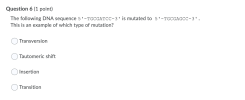 Question 6 (1 point) The following DNA sequence 5'-TGCGATCC-3' is mutated to 5'-TGCGAGCC-3'. This is an example of which type of mutation? Transversion O Tautomeric shift O Insertion Transition
*Hint: You will have one of each type. Types of Mutations? Point - Missense Frameshift -...
 *Hint: You will have one of each type. Types of Mutations? Point - Missense Frameshift - Insertion Point - Nonsense Frameshift Deletion Point - Silent Original DNA Sequence: TACACCTTGGCGACT mRNA Sequence: AUG Amino Acid Sequence: Mutated DNA Sequence #1: TACATCTTGGCGACT What's the mRNA sequence? (Circle the change) AUG TALAALLA What will be the amino acid sequence? Will there likely be effects?_ What kind of mutation is this? Mutated DNA Sequence 12: TACGAC CTTGGCGACT What's the mRNA sequence? (Circle the change)...
Point mutations-nucleotide substitutions o Show what would happen if 3. codon #2 in previous DNA sequence...
 Point mutations-nucleotide substitutions o Show what would happen if 3. codon #2 in previous DNA sequence got changed to ACA (original = ACG) 4. codon #2 got changed to ACC 5. codon #2 got changed to ACT o Explain the consequences of each mutation in #3-5 (how would it change the outcome?) o Use this sequence of nucleotides (DNA): 3'TACACGGCCCTTGGAAAACACACT5 1. Transcribe the DNA 2. Translate the DNA using genetic code dictionary
1) Which of the following mutations could result in a frameshift? A) a base insertion B)...
1) Which of the following mutations could result in a frameshift? A) a base insertion B) a base deletion C) a base substitution D) either A or B E) A, B, and C 2) Which of the following point mutations would be most likely to result in a non-functioning protein? A) a single base substitution in an intron B) a single base deletion near the end of the coding sequence C) a single base deletion in the codon following the...
*Template Strand of DNA 3. The following shows the first portion of a DNA strand of...
 *Template Strand of DNA 3. The following shows the first portion of a DNA strand of a gene that is 2,500 base pairs long. AUG TACȚTCCCGGAGCCC--- TAAG LLL ODRAL a. What is the amino acid sequence encoded for by this strand starting with the T nucleotide on the left? Met b. Give an example of a synonymous substitution (a silent mutation) that could occur in the second codon of the DNA strand. c. Give an example of a nonsense mutation...
 Exposure to various chemicals
can cause DNA mutations. Sort the phrases below as transition,
transversion, or insertion/deletion mutations. Note: If you answer
any part of this question incorrectly, a single red X will appear
indicating that you sorted one or more of the phrases
incorrectly.
Exposure to various chemicals can cause DNA mutations. Sort the phrases below as transition, transversion, or insertion/deletion mutations. Note: If you answer any part of this question incorrectly, a single red X will appear indicating...
Exposure to various chemicals
can cause DNA mutations. Sort the phrases below as transition,
transversion, or insertion/deletion mutations. Note: If you answer
any part of this question incorrectly, a single red X will appear
indicating that you sorted one or more of the phrases
incorrectly.
Exposure to various chemicals can cause DNA mutations. Sort the phrases below as transition, transversion, or insertion/deletion mutations. Note: If you answer any part of this question incorrectly, a single red X will appear indicating...
 Use the Mutations interactive
to determine which statements describe silent mutations. The
adenine of the start codon is position +1.
a substitution from G to T in the arginine codon of the
antisense stand
a substitution of a G nucleotide at position +9 in the antisense
strand
a transition at position +6 in the sense strand
a transversion of A in the histidine codon of the antisense
strand
a single nucleotide deletion at position +12 in the antisense
strand
a...
Use the Mutations interactive
to determine which statements describe silent mutations. The
adenine of the start codon is position +1.
a substitution from G to T in the arginine codon of the
antisense stand
a substitution of a G nucleotide at position +9 in the antisense
strand
a transition at position +6 in the sense strand
a transversion of A in the histidine codon of the antisense
strand
a single nucleotide deletion at position +12 in the antisense
strand
a...
 Mutations Worksheet-Dcletlon, Inserilon & SubstitutionThere are several types of mutations:> DELETION (a base is lost/deleted)> INSERTION (an extra base is added/inserted)- Deletion\& insertion may cause what's called a FRAMESHIFT mutation, meaning the reading "frame"changes, thus changing the amino acid sequence from this point forward > SUBSTITUTION (one base is substituted for another)- If a substitution changes the amino acid, it's called a MISSENSE mutation- If a substitution does not change the amino add, it's called a SILENT mutation- If a...
 #1
Mutation 1. A chromosomes has the following segments, where represents the centromere: MNOPQRST Give the chromosome sequences that would result from the following mutations: a. Deletion of MN Pericentric inversion of NOP C. Inversion of RS, followed by tandem duplication of QRST b. 2. Which type(s) of chromosomal mutations: a. Increase the amount of genetic material in a particular chromosome? b. Increase the amount of genetic material in the entire genome? c. Decrease the amount of genetic material in...
#1
Mutation 1. A chromosomes has the following segments, where represents the centromere: MNOPQRST Give the chromosome sequences that would result from the following mutations: a. Deletion of MN Pericentric inversion of NOP C. Inversion of RS, followed by tandem duplication of QRST b. 2. Which type(s) of chromosomal mutations: a. Increase the amount of genetic material in a particular chromosome? b. Increase the amount of genetic material in the entire genome? c. Decrease the amount of genetic material in...
 Question 6 (1 point) The following DNA sequence 5'-TGCGATCC-3' is mutated to 5'-TGCGAGCC-3'. This is an example of which type of mutation? Transversion O Tautomeric shift O Insertion Transition
 *Hint: You will have one of each type. Types of Mutations? Point - Missense Frameshift - Insertion Point - Nonsense Frameshift Deletion Point - Silent Original DNA Sequence: TACACCTTGGCGACT mRNA Sequence: AUG Amino Acid Sequence: Mutated DNA Sequence #1: TACATCTTGGCGACT What's the mRNA sequence? (Circle the change) AUG TALAALLA What will be the amino acid sequence? Will there likely be effects?_ What kind of mutation is this? Mutated DNA Sequence 12: TACGAC CTTGGCGACT What's the mRNA sequence? (Circle the change)...
 Point mutations-nucleotide substitutions o Show what would happen if 3. codon #2 in previous DNA sequence got changed to ACA (original = ACG) 4. codon #2 got changed to ACC 5. codon #2 got changed to ACT o Explain the consequences of each mutation in #3-5 (how would it change the outcome?) o Use this sequence of nucleotides (DNA): 3'TACACGGCCCTTGGAAAACACACT5 1. Transcribe the DNA 2. Translate the DNA using genetic code dictionary
 *Template Strand of DNA 3. The following shows the first portion of a DNA strand of a gene that is 2,500 base pairs long. AUG TACȚTCCCGGAGCCC--- TAAG LLL ODRAL a. What is the amino acid sequence encoded for by this strand starting with the T nucleotide on the left? Met b. Give an example of a synonymous substitution (a silent mutation) that could occur in the second codon of the DNA strand. c. Give an example of a nonsense mutation...
Most questions answered within 3 hours.
-
Where is the error in this code sequence?
String s1 = "Hello";
String s2 = "ello";...
asked 11 months ago -
Financial data for Joel de Paris, Inc., for last year
follow:
Joel de Paris, Inc.
Balance...
asked 11 months ago -
Consider this reaction:
Al2(SO4)3 (aq)+ BaCl3
(aq) Al2Cl6 (aq)- +
3BaSO4(s) . What is the...
asked 11 months ago -
Suppose that Savneet is considering increasing her
recent random sample from 20 car rentals to 40...
asked 11 months ago -
Trucks arrive at an unloading terminal at an average rate of 120
per hour.
Trucks arrive...
asked 11 months ago -
Why are methanol and ethanol completely soluble in water while
octanol is not very little soluble....
asked 11 months ago -
A facilities manager at a university reads in a research report
that the mean amount of...
asked 11 months ago -
When the CuSO4 is rehydrated by adding water to the anhydrous
compound, is this an endothermic...
asked 11 months ago -
A ray of sunlight is passing from diamond into crown glass; the
angle of incidence is...
asked 11 months ago -
A block of mass 0.249 kg is placed on top of a light, vertical
spring of...
asked 11 months ago -
how do the kidneys compensate in the presences of acidosis
a) trigger hyperventilate
b) reserve acid...
asked 11 months ago -
Question 501 pts
The rental rate of capital to the firm increases. Which of the
following...
asked 11 months ago