5. What happens to the DNA that is degraded by the RecBCD complex? It is replaced...
5. What happens to the DNA that is degraded by the RecBCD complex?
It is replaced by RecA.
It is replaced by DNA polymerase activity.
It is permanently lost.
It is unknown.
Homework Answers
First option
RecBCD is a complex present in E.coli. It helps the bacterium to repair its degraded DNA. But this enzyme is unique because it can also degrade DNA, but not the DNA of E.coli, it degrades foreign DNA and protects the DNA of the bacterium.
RecBCD is an exonuclease. It works in the presence of either abundant ATP or abundant magnesium ions. With both these cofactors it has a different mechanism of action. With ATP, it first cleaves the DNA near chi terminus (present near 3') and with magnesium ions, it cleaves both the strands of DNA. When RecBCD completes it role and degrades the DNA, the DNA is then taken over by RecA.
If you find the answer useful then please hit the like button.
Add Answer to:
5. What happens to the DNA that is degraded by the RecBCD
complex?
It is replaced...
After transformation, what will be the fate of DNA from the vector alone ligation reaction? A....
After transformation, what will be the fate of DNA from the vector alone ligation reaction? A. replicated by cellular enzymes B. degraded by cellular proteases C. integrated into bacterial chromosome through site specific recombination D. degraded by RecBCD E. integrated into bacterial chromosome through homologous recombination
What is the consequence of a transition mutation in double-stranded DNA? A purine is replaced by...
What is the consequence of a transition mutation in double-stranded DNA? A purine is replaced by another purine, or a pyrimidine is replaced by another pyrimidine. A base pair is lost within the DNA of a gene, which causes a reading frameshift. The parent, but not its offspring, will be affected by the mutation. A base pair is added to the DNA within a gene, which causes a reading frameshift. A purine is replaced by a pyrimidine, or a pyrimidine...
What would be the effects on DNA replication if mutation of DNA polymerase III caused it...
What would be the effects on DNA replication if mutation of DNA polymerase III caused it to lose each of the following activities: 1. 5' to 3' polymerase activity 2. 3' to 5' exonuclease activity:
What happens during Anaphase, and what molecule must be degraded to allow Anaphase to progress? Explain...
What happens during Anaphase, and what molecule must be degraded to allow Anaphase to progress? Explain the difference between events of Anaphase A and Anaphase B. Why must we have cellular division as well as programmed cell death (apoptosis)?
Flag this Question 21: DNA replication is always 5' to 3'. Explain what 5' to 3'...
Flag this Question 21: DNA replication is always 5' to 3'. Explain what 5' to 3' means with respect to nucleotide subunits. Explain what activity of DNA polymerase necessitates that replication be 5' to 3' rather than 3' to 5'? What problems do you envision with 3’ to 5’ direction of DNA chain growth? (NOTE: Please site the sources) Keyboard Shortcuts
QUESTION 10 If an enzyme degraded linker DNA, what would be an immediate consequence? O A....
 QUESTION 10 If an enzyme degraded linker DNA, what would be an immediate consequence? O A. DNA helix would be unable to form O B. nucleosomes would be unable to form a chromatin fiber OC. chromatin fibers would not condense O D.nucleosomes would be unable to form QUESTION 11 This characteristic of DNA allows the molecule to be a template which specifies the sequence of nucleotides in the opposite strand O A. The backbone is phosphate and sugars O B....
What happens to a cell if the DNA were destroyed? What happens to a cell if...
What happens to a cell if the DNA were destroyed? What happens to a cell if it’s RNA is destroyed?
Question 5 4 pts Which of the following statements in NOT true about DNA replication? DNA...
 Question 5 4 pts Which of the following statements in NOT true about DNA replication? DNA replication involves synthesis of multiple RNA primers DNA ligase is needed for successful DNA replication DNA replication requires deoxyribonucleotide triphosphates High fidelity of DNA replication is ensured by 5-3 exonuclease activity of DNA polymerase ! High fidelity of DNA replication is ensured by 3-5 exonuclease activity of DNA polymerases Next
Examine the image of a set of DNA sequences. What happens that influences viral DNA variation?...
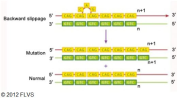 Examine the image of a set of DNA sequences.
What happens that influences viral DNA variation?
completion of the viral DNA
creation of an extra copy of the viral DNA
deletion of the viral DNA
point mutation within the viral DNA
n+1 5 3' Backward slippage 5 n+1 Mutation 3' 5' 3' n+1 5 Normal t 3' 5 2012 FLVS
Examine the image of a set of DNA sequences.
What happens that influences viral DNA variation?
completion of the viral DNA
creation of an extra copy of the viral DNA
deletion of the viral DNA
point mutation within the viral DNA
n+1 5 3' Backward slippage 5 n+1 Mutation 3' 5' 3' n+1 5 Normal t 3' 5 2012 FLVS
what is genetic basis of mutators? 1 defects of homologous recombination 2 chemical or physicalagent that...
what is genetic basis of mutators? 1 defects of homologous recombination 2 chemical or physicalagent that cause mution 3 recA- 4 DNA polymerase mutants 5 mismatch repair mutant
 QUESTION 10 If an enzyme degraded linker DNA, what would be an immediate consequence? O A. DNA helix would be unable to form O B. nucleosomes would be unable to form a chromatin fiber OC. chromatin fibers would not condense O D.nucleosomes would be unable to form QUESTION 11 This characteristic of DNA allows the molecule to be a template which specifies the sequence of nucleotides in the opposite strand O A. The backbone is phosphate and sugars O B....
 Question 5 4 pts Which of the following statements in NOT true about DNA replication? DNA replication involves synthesis of multiple RNA primers DNA ligase is needed for successful DNA replication DNA replication requires deoxyribonucleotide triphosphates High fidelity of DNA replication is ensured by 5-3 exonuclease activity of DNA polymerase ! High fidelity of DNA replication is ensured by 3-5 exonuclease activity of DNA polymerases Next
 Examine the image of a set of DNA sequences.
What happens that influences viral DNA variation?
completion of the viral DNA
creation of an extra copy of the viral DNA
deletion of the viral DNA
point mutation within the viral DNA
n+1 5 3' Backward slippage 5 n+1 Mutation 3' 5' 3' n+1 5 Normal t 3' 5 2012 FLVS
Examine the image of a set of DNA sequences.
What happens that influences viral DNA variation?
completion of the viral DNA
creation of an extra copy of the viral DNA
deletion of the viral DNA
point mutation within the viral DNA
n+1 5 3' Backward slippage 5 n+1 Mutation 3' 5' 3' n+1 5 Normal t 3' 5 2012 FLVS
Most questions answered within 3 hours.
-
Where is the error in this code sequence?
String s1 = "Hello";
String s2 = "ello";...
asked 11 months ago -
Financial data for Joel de Paris, Inc., for last year
follow:
Joel de Paris, Inc.
Balance...
asked 11 months ago -
Consider this reaction:
Al2(SO4)3 (aq)+ BaCl3
(aq) Al2Cl6 (aq)- +
3BaSO4(s) . What is the...
asked 11 months ago -
Suppose that Savneet is considering increasing her
recent random sample from 20 car rentals to 40...
asked 11 months ago -
Trucks arrive at an unloading terminal at an average rate of 120
per hour.
Trucks arrive...
asked 11 months ago -
Why are methanol and ethanol completely soluble in water while
octanol is not very little soluble....
asked 11 months ago -
A facilities manager at a university reads in a research report
that the mean amount of...
asked 11 months ago -
When the CuSO4 is rehydrated by adding water to the anhydrous
compound, is this an endothermic...
asked 11 months ago -
A ray of sunlight is passing from diamond into crown glass; the
angle of incidence is...
asked 11 months ago -
A block of mass 0.249 kg is placed on top of a light, vertical
spring of...
asked 11 months ago -
how do the kidneys compensate in the presences of acidosis
a) trigger hyperventilate
b) reserve acid...
asked 11 months ago -
Question 501 pts
The rental rate of capital to the firm increases. Which of the
following...
asked 11 months ago