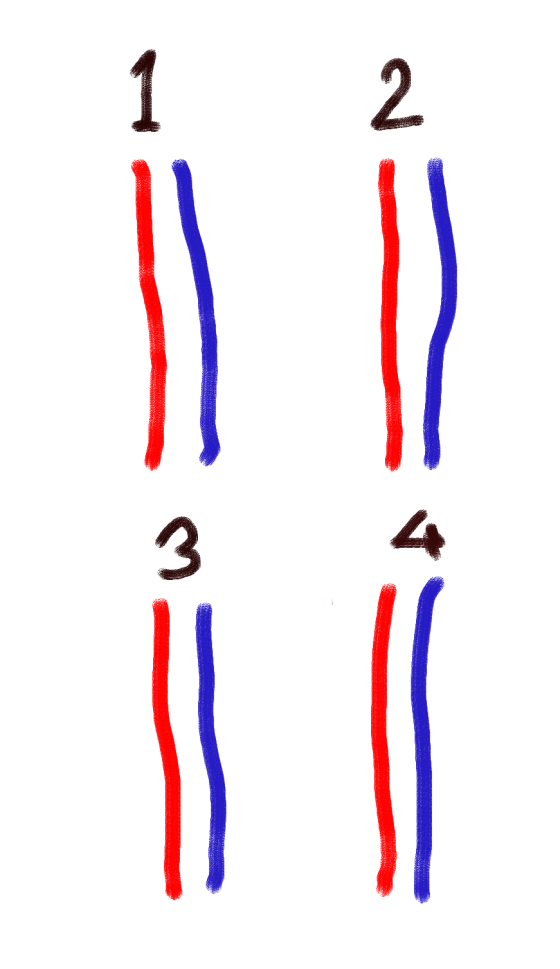
Using 1 line to represent a single strand of DNA, draw the genome of a 2n=8...
Using 1 line to represent a single strand of DNA, draw the genome of a 2n=8 individual. Label homologous pairs.
Homework Answers
2n = 8
n = 4
So the haploid cell has 4 chromosomes. Diploid cell has 8 chromosomes but 4 homologous PAIRS.
Add Answer to:
Using 1 line to represent a single strand of DNA, draw the
genome of a 2n=8...
2. (3 pts) Draw a gene! Draw only the template strand of the DNA. Do not...
2. (3 pts) Draw a gene! Draw only the template strand of the DNA. Do not draw the non-template strand. Label the 5' and 3' ends of the DNA. Label the promoter, coding region, and termination site. Draw RNA polymerase halfway through the process of transcription, and the RNA it has produced.
For a cell that is right after DNA replication, where 2n=6 a. Is this cell haploid,...
For a cell that is right after DNA replication, where 2n=6 a. Is this cell haploid, diploid, or tetraploid? b. How many molecules of DNA are there? c. Are chromosomes single stranded or double stranded? d. How many chromosomes are there e. How many homologous pairs are there f. How many unique chromosomes are there g. How many sister chromatid pairs are there Thank you very much!
draw replication bubble. ONLY IN ON SITE label the following. 1.leading strand 2.lagging strand 3.direction 5'...
draw replication bubble. ONLY IN ON SITE label the following. 1.leading strand 2.lagging strand 3.direction 5' 3' 4. DNA polymerase 5. RNA primer 6. okazaki fragments 7.binding protein 8.nucleotides 9.Sliding clamps 10. clamp loader 11.helicase 12.DNA gyrate 13.DNA helicase 14.DNA ligase DRAW COMPLETW BUBBLE AND ONLY LABEL ON ONE SITE. THANK YOU!
Use the following DNA sequence as the template strand to answer these questions. (8 points) 5’-...
Use the following DNA sequence as the template strand to answer these questions. (8 points) 5’- GAT CCT GCC TAA -3’ Draw the non-template DNA sequence, the mRNA sequence and the resulting peptide. Label the terminus of the DNA and peptide!! Draw a point mutation. Is this a transition mutation or transverse mutation? Did it change the amino acid sequence(draw out the peptide)? 4 bp insertion, and the resulting peptide. 2 bp deletion, and the resulting peptide. A copy number...
8. Draw chemical structure of a double strand DNA molecule of following DNA template S'CT3. Include...
 8. Draw chemical structure of a double strand DNA molecule of following DNA template S'CT3. Include the phosphodiester and all hydrogen bonds. (7) 9. If you cut the following double stranded DNA fragment with a restriction enzyme with restriction site of 5'GAATTC 3" and the cutting point between A and G. Draw the structure of resulting fragments. Specify and name the end of the fragments. (8) 5" ACCTTGTGAATTCTAGGCAT3 3' TGGAACACTTAAGATCCGTAS
In a test tube, a strand of double-stranded DNA can be separated into two single-stranded DNA...
 In a test tube, a strand of double-stranded DNA can be separated into two single-stranded DNA molecules by applying energy such as heat. Sequences for two different dsDNA molecules are shown below (dsDNA 1 and dsDNA 2). Which one of these two would require less energy to be separated? Explain your reason. Note: Both dsDNA are 20 base pairs long. The sequence for only one of the strands in each dsDNA are shown dsDNA 1: GCGCACGGACGGCCCGCACC dsDNA 2: TATTAGTATACTAATAAGTT
in the figure below, the dashed line represents a newly synthesized DNA strand while the solidines...
 in the figure below, the dashed line represents a newly synthesized DNA strand while the solidines represent parental/template DNA strands. The polarity for one parental strand is given the direction of the replication fork is indicated with an arrow. With respect to this replication fork, in which direction would helicase be working? A B C D Direction of replication
8. How is DNA packaged in eukaryotes? Describe the different fibers and the proteins they use....
 8. How is DNA packaged in eukaryotes? Describe the different fibers and the proteins they use. 9. Define the following: a. Helicase b. Ligase C. DNA polymerase d. Topoisomerase e. Single stranded binding proteins f. RNA primer g. Primase h. Nucleotide triphosphate I. Replication bubble - eukaryote vs prokaryote j. Nuclease k. Chromatin I. Chromosome m. Gene n. Genome o. Promoter 10. What is the function of mRNA 11. What is the mRNA strand that would be copied from this...
2 [Type text] 3. Using this strand of DNA: AATACCGATACGGGGCAACTAAA a. Create the complementary DNA strand...
 2 [Type text] 3. Using this strand of DNA: AATACCGATACGGGGCAACTAAA a. Create the complementary DNA strand (1 pts.) b. Create the complementary mRNA strand (from the original strand) (2 pts) c. Create the protein (refer to Table 1 on page 3 as needed) (2 pts.)
3. Draw the phosphodiester backbone of a strand of DNA that is three nucleotides long, (You...
 3. Draw the phosphodiester backbone of a strand of DNA that is three nucleotides long, (You don't need to draw out the bases, but be sure to show where they would be attached.) 4. Label the 5' and 3' ends of the backbone that you drew.
 8. Draw chemical structure of a double strand DNA molecule of following DNA template S'CT3. Include the phosphodiester and all hydrogen bonds. (7) 9. If you cut the following double stranded DNA fragment with a restriction enzyme with restriction site of 5'GAATTC 3" and the cutting point between A and G. Draw the structure of resulting fragments. Specify and name the end of the fragments. (8) 5" ACCTTGTGAATTCTAGGCAT3 3' TGGAACACTTAAGATCCGTAS
 In a test tube, a strand of double-stranded DNA can be separated into two single-stranded DNA molecules by applying energy such as heat. Sequences for two different dsDNA molecules are shown below (dsDNA 1 and dsDNA 2). Which one of these two would require less energy to be separated? Explain your reason. Note: Both dsDNA are 20 base pairs long. The sequence for only one of the strands in each dsDNA are shown dsDNA 1: GCGCACGGACGGCCCGCACC dsDNA 2: TATTAGTATACTAATAAGTT
 in the figure below, the dashed line represents a newly synthesized DNA strand while the solidines represent parental/template DNA strands. The polarity for one parental strand is given the direction of the replication fork is indicated with an arrow. With respect to this replication fork, in which direction would helicase be working? A B C D Direction of replication
 8. How is DNA packaged in eukaryotes? Describe the different fibers and the proteins they use. 9. Define the following: a. Helicase b. Ligase C. DNA polymerase d. Topoisomerase e. Single stranded binding proteins f. RNA primer g. Primase h. Nucleotide triphosphate I. Replication bubble - eukaryote vs prokaryote j. Nuclease k. Chromatin I. Chromosome m. Gene n. Genome o. Promoter 10. What is the function of mRNA 11. What is the mRNA strand that would be copied from this...
 2 [Type text] 3. Using this strand of DNA: AATACCGATACGGGGCAACTAAA a. Create the complementary DNA strand (1 pts.) b. Create the complementary mRNA strand (from the original strand) (2 pts) c. Create the protein (refer to Table 1 on page 3 as needed) (2 pts.)
 3. Draw the phosphodiester backbone of a strand of DNA that is three nucleotides long, (You don't need to draw out the bases, but be sure to show where they would be attached.) 4. Label the 5' and 3' ends of the backbone that you drew.
Most questions answered within 3 hours.
-
Where is the error in this code sequence?
String s1 = "Hello";
String s2 = "ello";...
asked 10 months ago -
Financial data for Joel de Paris, Inc., for last year
follow:
Joel de Paris, Inc.
Balance...
asked 10 months ago -
Consider this reaction:
Al2(SO4)3 (aq)+ BaCl3
(aq) Al2Cl6 (aq)- +
3BaSO4(s) . What is the...
asked 10 months ago -
Suppose that Savneet is considering increasing her
recent random sample from 20 car rentals to 40...
asked 10 months ago -
Trucks arrive at an unloading terminal at an average rate of 120
per hour.
Trucks arrive...
asked 10 months ago -
Why are methanol and ethanol completely soluble in water while
octanol is not very little soluble....
asked 10 months ago -
A facilities manager at a university reads in a research report
that the mean amount of...
asked 10 months ago -
When the CuSO4 is rehydrated by adding water to the anhydrous
compound, is this an endothermic...
asked 10 months ago -
A ray of sunlight is passing from diamond into crown glass; the
angle of incidence is...
asked 10 months ago -
A block of mass 0.249 kg is placed on top of a light, vertical
spring of...
asked 10 months ago -
how do the kidneys compensate in the presences of acidosis
a) trigger hyperventilate
b) reserve acid...
asked 10 months ago -
Question 501 pts
The rental rate of capital to the firm increases. Which of the
following...
asked 10 months ago