If the input to a notch filter is 100 mV, and the attenuation is 95%, the...
If the input to a notch filter is 100 mV, and the attenuation is 95%, the output is?
Homework Answers
Ans)
The output will be assuming input freqeuncy falls in the stop band of notch filter where it attenuates the input
is


Add Answer to:
If the input to a notch filter is 100 mV, and the attenuation is
95%, the...
Figure 2 shows the electrical system (band-stop or notch filter). These circuits are used to "filter...
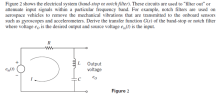 Figure 2 shows the electrical system (band-stop or notch filter). These circuits are used to "filter out" or attenuate input signals within a particular frequency band. For example, notch filters are used on aerospace vehicles to remove the mechanical vibrations that are transmitted to the onboard sensors such as gyroscopes and accelerometers. Derive the transfer function G(s) of the band-stop or notch filter where voltage eo is the desired output and source voltage ein() is the input. L Output voltage...
Which of the following are design steps for making a notch filter? Select all correct answers....
Which of the following are design steps for making a notch filter? Select all correct answers. Group of answer choices Make a Band Pass filter with twice the resonat frequency and bandwidth you need for the notch filter. Using an Non-Inverting adder circuit mix the output of the designed Band Pass filter with the orginal input signal. Using an Inverting adder circuit mix the output of the designed Band Pass filter with the orginal input signal. Using an Inverting adder...
Problem 3) (15 points) An RC filter is designed with a cutoff frequency of 100 Hz. If a low-pass first order filter is used, determine the attenuation (Attenuation %, and Attenuation(dB)) of the f...
 Problem 3) (15 points) An RC filter is designed with a cutoff frequency of 100 Hz. If a low-pass first order filter is used, determine the attenuation (Attenuation %, and Attenuation(dB)) of the filtered analog signal at 50, 75 and 200 Hz. (use k -1) o Determine the order of the filter if magnitude ratio of <0.01 is needed at 200 Hz.
Problem 3) (15 points) An RC filter is designed with a cutoff frequency of 100 Hz. If a...
Problem 3) (15 points) An RC filter is designed with a cutoff frequency of 100 Hz. If a low-pass first order filter is used, determine the attenuation (Attenuation %, and Attenuation(dB)) of the filtered analog signal at 50, 75 and 200 Hz. (use k -1) o Determine the order of the filter if magnitude ratio of <0.01 is needed at 200 Hz.
Problem 3) (15 points) An RC filter is designed with a cutoff frequency of 100 Hz. If a...
using Matlab: 1) Design an FIR notch filter using zero placement to remove power-line noise at...
using Matlab: 1) Design an FIR notch filter using zero placement to remove power-line noise at 60 Hz (use file ecg_60hz_200, fs = 200 Hz). 2) Design a LP Butterworth filter with cut-off frequency of 40 Hz to remove high-frequency noise (use file ecg_hfn.dat, fs = 1000 Hz). 3) Design an Elliptic HP filter with passband ripple of 0.01 dB and stopband attenuation of 50 dB and cut-off frequency of 0.5 Hz to remove low-frequency noise (use file ecg_lfn.dat, fs...
Design a low-pass filter (LPF) has pass-band frequency fP = 100 kHz, maximum attenuation in passband Amax = 2 dB, stop-band frequency fS = 120 kHz, minimum attenuation in stop-band Amin = 60 dB.
 Design a low-pass filter (LPF) has pass-band frequency fP = 100 kHz, maximum attenuation in passband Amax
= 2 dB, stop-band frequency fS = 120 kHz, minimum attenuation in stop-band Amin = 60 dB. a/ Calculate the minimum order N for Chebyshev filter and the corresponding minimum stop-band
attenuation? b/ Calculate the minimum order N of low-pass B
Design a low-pass filter (LPF) has pass-band frequency fP = 100 kHz, maximum attenuation in passband Amax
= 2 dB, stop-band frequency fS = 120 kHz, minimum attenuation in stop-band Amin = 60 dB. a/ Calculate the minimum order N for Chebyshev filter and the corresponding minimum stop-band
attenuation? b/ Calculate the minimum order N of low-pass B
Design an RLC Notch filter (circuit on slide 9) that will have a quality factor Q-20...
 Design an RLC Notch filter (circuit on slide 9) that will have a quality factor Q-20 (very selective filter), and will reject the 60 Hz frequency. Select C= 100 uF. b) Calculate fci, fcz, and BW
An analog notch filter is defined below where Ω° is the frequency to be removed, and...
 An analog notch filter is defined below where Ω° is the frequency to be removed, and β is the bandwidth around Ω0 And the quality factor Q is defined as .(20 Use bilinear transformation with T = 2 to design a digital notch filter to remove 60 Hzfrequeney with sampling rate 360 Hz. Use Q-5.
AC sweep Q1: What is the attenuation in dB for the RC filter at 100k Hz?...
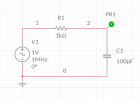 AC sweep
Q1: What is the attenuation in dB for the RC filter at 100k
Hz?
Q2: What is the phase at 100 Hz? (Read on your plot)
PR1 R1 1 N V 1kΩ V1 C1 17 1MHz 0° 100uF 0
AC sweep
Q1: What is the attenuation in dB for the RC filter at 100k
Hz?
Q2: What is the phase at 100 Hz? (Read on your plot)
PR1 R1 1 N V 1kΩ V1 C1 17 1MHz 0° 100uF 0
AC sweep Q3: What is the attenuation in dB for the RL filter at 100k Hz?...
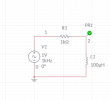 AC sweep
Q3: What is the attenuation in dB for the RL filter at 100k
Hz?
Q4: What is the phase at 100 Hz? (Read on your plot)
PR1 R1 1 V 1k2 2 V1 L1 17 1kHz 0 0° 100μΗ 4
AC sweep
Q3: What is the attenuation in dB for the RL filter at 100k
Hz?
Q4: What is the phase at 100 Hz? (Read on your plot)
PR1 R1 1 V 1k2 2 V1 L1 17 1kHz 0 0° 100μΗ 4
Using a high pass filter with a cutoff frequency of 10 kHz, we wish to achieve an attenuation gre...
Using a high pass filter with a cutoff frequency of 10 kHz, we wish to achieve an attenuation greater than 10 dB at 5 kHz. What is the minimum order of the filter required to achieve this attenuation?
 Figure 2 shows the electrical system (band-stop or notch filter). These circuits are used to "filter out" or attenuate input signals within a particular frequency band. For example, notch filters are used on aerospace vehicles to remove the mechanical vibrations that are transmitted to the onboard sensors such as gyroscopes and accelerometers. Derive the transfer function G(s) of the band-stop or notch filter where voltage eo is the desired output and source voltage ein() is the input. L Output voltage...
 Problem 3) (15 points) An RC filter is designed with a cutoff frequency of 100 Hz. If a low-pass first order filter is used, determine the attenuation (Attenuation %, and Attenuation(dB)) of the filtered analog signal at 50, 75 and 200 Hz. (use k -1) o Determine the order of the filter if magnitude ratio of <0.01 is needed at 200 Hz.
Problem 3) (15 points) An RC filter is designed with a cutoff frequency of 100 Hz. If a...
Problem 3) (15 points) An RC filter is designed with a cutoff frequency of 100 Hz. If a low-pass first order filter is used, determine the attenuation (Attenuation %, and Attenuation(dB)) of the filtered analog signal at 50, 75 and 200 Hz. (use k -1) o Determine the order of the filter if magnitude ratio of <0.01 is needed at 200 Hz.
Problem 3) (15 points) An RC filter is designed with a cutoff frequency of 100 Hz. If a...
 Design an RLC Notch filter (circuit on slide 9) that will have a quality factor Q-20 (very selective filter), and will reject the 60 Hz frequency. Select C= 100 uF. b) Calculate fci, fcz, and BW
 An analog notch filter is defined below where Ω° is the frequency to be removed, and β is the bandwidth around Ω0 And the quality factor Q is defined as .(20 Use bilinear transformation with T = 2 to design a digital notch filter to remove 60 Hzfrequeney with sampling rate 360 Hz. Use Q-5.
 AC sweep
Q1: What is the attenuation in dB for the RC filter at 100k
Hz?
Q2: What is the phase at 100 Hz? (Read on your plot)
PR1 R1 1 N V 1kΩ V1 C1 17 1MHz 0° 100uF 0
AC sweep
Q1: What is the attenuation in dB for the RC filter at 100k
Hz?
Q2: What is the phase at 100 Hz? (Read on your plot)
PR1 R1 1 N V 1kΩ V1 C1 17 1MHz 0° 100uF 0
 AC sweep
Q3: What is the attenuation in dB for the RL filter at 100k
Hz?
Q4: What is the phase at 100 Hz? (Read on your plot)
PR1 R1 1 V 1k2 2 V1 L1 17 1kHz 0 0° 100μΗ 4
AC sweep
Q3: What is the attenuation in dB for the RL filter at 100k
Hz?
Q4: What is the phase at 100 Hz? (Read on your plot)
PR1 R1 1 V 1k2 2 V1 L1 17 1kHz 0 0° 100μΗ 4
Most questions answered within 3 hours.
-
Where is the error in this code sequence?
String s1 = "Hello";
String s2 = "ello";...
asked 10 months ago -
Financial data for Joel de Paris, Inc., for last year
follow:
Joel de Paris, Inc.
Balance...
asked 10 months ago -
Consider this reaction:
Al2(SO4)3 (aq)+ BaCl3
(aq) Al2Cl6 (aq)- +
3BaSO4(s) . What is the...
asked 10 months ago -
Suppose that Savneet is considering increasing her
recent random sample from 20 car rentals to 40...
asked 10 months ago -
Trucks arrive at an unloading terminal at an average rate of 120
per hour.
Trucks arrive...
asked 10 months ago -
Why are methanol and ethanol completely soluble in water while
octanol is not very little soluble....
asked 10 months ago -
A facilities manager at a university reads in a research report
that the mean amount of...
asked 10 months ago -
When the CuSO4 is rehydrated by adding water to the anhydrous
compound, is this an endothermic...
asked 10 months ago -
A ray of sunlight is passing from diamond into crown glass; the
angle of incidence is...
asked 10 months ago -
A block of mass 0.249 kg is placed on top of a light, vertical
spring of...
asked 10 months ago -
how do the kidneys compensate in the presences of acidosis
a) trigger hyperventilate
b) reserve acid...
asked 10 months ago -
Question 501 pts
The rental rate of capital to the firm increases. Which of the
following...
asked 10 months ago