Explain two advatanges and two limitations of using PCR to detect genetic modifications of plants.
Homework Answers
·PCR stands for Polymerase Chain Reaction where multiple copies of gene of interest is amplified in vitro using two sets of DNA primers and the enzyme DNA polymerase, which are (amplified gene of interest) further can be ligated with a vector for cloning.
·GMP are the plants whose genes have been altered by manipulation.
ADVANTAGES OF USING PCR TO DETECT GMP :
1. Genetic modifications has made the crops more tolerant to abiotic stresses , like: cold, draught, heat, salinity etc.. Also helping it in reduction of losses on post harvestation. It has increased the efficiency of plants for mineral uses and prevents the early exhaustion of fertility of soil. Food produced from genetically modified crops has high nutritional value and it also has been used to make tailor made plants to supply resources to industries, such as : starch, fuels, pharmaceuticals etc..
2. It has reduced the dependencies of crops on chemical pesticides. As for example, Bt.cotton.
Ø The soil bacteria Bacillus thuringinesisproduces crystal proteins called cry proteins, that are toxic to larva of insects; like : tobacco budworm, bettles and mosquitoes.
Ø The cry proteins exists as inactive pro toxins and gets converted into activated anti toxins when ingested by the insects as the alkaline pH of the gut solubilises the crystals.
Ø The activated toxins bind to the surface of the epithelial cells of the midgut and create pores.
Ø This causes swelling and lysis of cells leading to the death of the insects.
Ø The cry genes encoding these proteins are isolated from the bacterium and incorporated into several crop plants, like : cotton, tomato, corn, rice, soyabean etc..
Ø The proteins encoded by the following cry genes control the pest given against them.
i. CryIAc and CryIIAb control cotton bollworm.
ii. CryIAb controls cotton borer.
iii. CryIIIAb controls colarad potato beetle.
iv. CryIIIBb controls corn rootworms.
LIMITATIONS :
1. As aforesaid in the advantages that it reduces the dependancies of crops on chemical pesticides that kills the insect affecting a plant. Unlikely, it can be dangerous to those insects which are profitable to the plant and carry out functions like : pollination and etc.. Insects like butterflies are not dangerous to any plant but new crop genes can be deadly to them.
2. Subsequent removal of genetically modified crops from the soil leaves unwanted residual substances thtat can remain for a longer period of time that directly affect the environment thus affecting the entire ecosystem and also leaving its impact on the crop diversity.
Add Answer to:
Explain two advatanges and two limitations of using PCR to detect
genetic modifications of plants.
EXPLAIN each answer thoroughly. There are two common goals when using PCR to amplify DNA. A....
EXPLAIN each answer thoroughly. There are two common goals when using PCR to amplify DNA. A. Make lots of copies of a specific DNA sequence to use in cloning (preparative PCR) B. Detect the presence or relative amount of a specific gene under varying conditions (analytical PCR) *Remember: PCR is very similiar to DNA replication, but uses a DNA polymerase to amplify only specific parts of DNA sequence based on the sequence of the primers. 3. For which goal (A...
6. One of the concerns about genetic modification of agricultural plants is the possibility of cross...
 6. One of the concerns about genetic modification of agricultural plants is the possibility of cross breeding between herbicide-resistant GMOs and weeds, creating "superweeds" that would be resistant to commonly used herbicides. EXPLAIN how PCR could be used to determine whether such cross-breeding had occurred. (2 points)
A genetic model suggests that 80% of plants grown from a cross between two given strains...
A genetic model suggests that 80% of plants grown from a cross between two given strains of seeds will be of the dwarf variety. After breeding a sample of of these plants, 153 were observed to be of the dwarf variety. Suppose that we do a hypothesis test to see if the sample results strongly contradict the genetic model and find the p-value to be 0.0188. What is the meaning of this p-value? (A) If the genetic model is correct,...
Some plants with genetic defects are unable to photorespire. These plants end up being damaged under...
Some plants with genetic defects are unable to photorespire. These plants end up being damaged under intense light. Researches identify this as evidence that photorespiration is a protective mechanism in plants. Why might a disabling of the photorespiratory pathway lead to cell damage and how might the process of photorespiration mitigate this damage? 3.In which stage are the sister chromatids separated? Group of answer choices Telophase Anaphase Metaphase Prometaphase (late prophase 8.Cytokinesis in plant cells is different than cytokinesis in...
II. Amplify the gene of interest using the PCR, verify the PCR products on the gel...
 II. Amplify the gene of interest using the PCR, verify the PCR products on the gel electrophoresis, analyze the gel. 4. By the next morning, the PCR amplification of all the samples is over, and you set up gel electrophoresis to check for the PCR products. Results: Lane 1 Alexandra - one band Lane 2 Olga - one band Lane 3 Tatiana - one band Lane 4 Maria - one band Lane 5 Anastasia - one band Lane 6 Alexey...
#6: (a) A genetic model suggests that 80% of plants grown from a cross between two given strains of seeds will be of th...
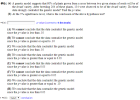 #6: (a) A genetic model suggests that 80% of plants grown from a cross between two given strains of seeds will be of the dwarf variety. After breeding 204 of these plants, 154 were observed to be of the dwarf variety. Do these data strongly contradict the genetic model? Find the p-value (b) At the 5% significance level, what is the conclusion of the above hypothesis test? #6(a) p-value (correct to 4 decimals) (A) We cannot conclude that the data...
detect two sequence at a time by using both fsm machine (mealy and more) 011 ,...
detect two sequence at a time by using both fsm machine (mealy and more) 011 , 110 these are two given sequence please do all step . explain every thing that why you go this state
A genetic theory says that a cross between two pink flowering plants will produce red flowering...
A genetic theory says that a cross between two pink flowering plants will produce red flowering plants 25% of the time. To test the theory, 100 crosses are made and 33 of them produce a red flowering plant. Is this strong evidence that the theory is wrong? Carry out the appropriate hypothesis test at the 5% significance level. The appropriate hypothesis for this test is H0: x = 0.25 vs. HA: x ≠ 0.25 H0: p̂ = 0.25 vs. HA:...
Explain the concept of genetic predisposition, using at least one example.
Explain the concept of genetic predisposition, using at least one example.
b. Compare the benefits and limitations of using model organisms to study human genes and human...
b. Compare the benefits and limitations of using model organisms to study human genes and human genetic diseases. Identify specific cases where insights from model organisms have provided crucial insights into human disease c. Defend the assertion that genetic testing will play a central role in the diagnosis and treatment of cancer in the future
 6. One of the concerns about genetic modification of agricultural plants is the possibility of cross breeding between herbicide-resistant GMOs and weeds, creating "superweeds" that would be resistant to commonly used herbicides. EXPLAIN how PCR could be used to determine whether such cross-breeding had occurred. (2 points)
 II. Amplify the gene of interest using the PCR, verify the PCR products on the gel electrophoresis, analyze the gel. 4. By the next morning, the PCR amplification of all the samples is over, and you set up gel electrophoresis to check for the PCR products. Results: Lane 1 Alexandra - one band Lane 2 Olga - one band Lane 3 Tatiana - one band Lane 4 Maria - one band Lane 5 Anastasia - one band Lane 6 Alexey...
 #6: (a) A genetic model suggests that 80% of plants grown from a cross between two given strains of seeds will be of the dwarf variety. After breeding 204 of these plants, 154 were observed to be of the dwarf variety. Do these data strongly contradict the genetic model? Find the p-value (b) At the 5% significance level, what is the conclusion of the above hypothesis test? #6(a) p-value (correct to 4 decimals) (A) We cannot conclude that the data...
Most questions answered within 3 hours.
-
Where is the error in this code sequence?
String s1 = "Hello";
String s2 = "ello";...
asked 10 months ago -
Financial data for Joel de Paris, Inc., for last year
follow:
Joel de Paris, Inc.
Balance...
asked 10 months ago -
Consider this reaction:
Al2(SO4)3 (aq)+ BaCl3
(aq) Al2Cl6 (aq)- +
3BaSO4(s) . What is the...
asked 10 months ago -
Suppose that Savneet is considering increasing her
recent random sample from 20 car rentals to 40...
asked 10 months ago -
Trucks arrive at an unloading terminal at an average rate of 120
per hour.
Trucks arrive...
asked 10 months ago -
Why are methanol and ethanol completely soluble in water while
octanol is not very little soluble....
asked 10 months ago -
A facilities manager at a university reads in a research report
that the mean amount of...
asked 10 months ago -
When the CuSO4 is rehydrated by adding water to the anhydrous
compound, is this an endothermic...
asked 10 months ago -
A ray of sunlight is passing from diamond into crown glass; the
angle of incidence is...
asked 10 months ago -
A block of mass 0.249 kg is placed on top of a light, vertical
spring of...
asked 10 months ago -
how do the kidneys compensate in the presences of acidosis
a) trigger hyperventilate
b) reserve acid...
asked 10 months ago -
Question 501 pts
The rental rate of capital to the firm increases. Which of the
following...
asked 10 months ago