Methods and material for the experiment of effect of enzyme concentration. Explain briefly.
Homework Answers
Materials:
Different labelled Test tube, different enzyme concentration sample , a particular substrate which is chromogenic , incubator, phosphate buffer solution for stabilising enzyme. Stop watch, spectrophotometer, pippete
Methods:
In this you will add all the materials in different test tubes.
Don't forget to add substrate concentration.
Then add enzyme concentration in increasing order from one test tube to others.
Then put these test tubes in incubator so that reaction will occur and look your product on the basis of colour at different time intervals.
Then look for the result, by means of colour or spectrophotometer absorbance readings, you will find that tubes which has higher concentration of enzyme in test tube, substrate will convert into product faster as compared to lower concentration of enzyme containing test tube.
Add Answer to:
Methods and material for the experiment of effect of enzyme
concentration. Explain briefly.
(a) Briefly explain three (3) methods of material selection. (3 marks) (b) With suitable example, explain...
 (a) Briefly explain three (3) methods of material selection. (3 marks) (b) With suitable example, explain three (3) types of design (6 marks)
1. a) If one were to decrease the enzyme concentration by half, how would this affect...
1. a) If one were to decrease the enzyme concentration by half, how would this affect the Vmaxvalue? Explain why this is so. What assumption are we making in regards to the relative amounts of substrate to enzyme? b) Is the turnover rate (kcat value) of an enzyme expected to change if the enzyme concentration was decreased by half? Briefly explain. c) Is the turnover rate (kcat value) of an enzyme expected to change in the presence of a competitive...
6 The graph shows the effect of substrate concentration on the rate of an enzyme- controlled...
 6 The graph shows the effect of substrate concentration on the rate of an enzyme- controlled reaction. The enzyme concentration is constant. reaction rate Which statement about the graph is correct? A Between Wand X, the substrate concentration number of enzyme molecules is limiting. Between X and Y, the number of enzyme molecules is limiting. Between X and Y, the number of substrate molecules is limiting. Between X and Y, the product concentration remains the same. Thanh in the nammanni...
1. design a follow-up experiment to investigate the enzyme peroxidase from plants. 2. investigate the effect...
1. design a follow-up experiment to investigate the enzyme peroxidase from plants. 2. investigate the effect of pH on enzyme activity.
The "four Ms" of cause-and-effect diagrams are: material, machinery/equipment, manpower, and methods. material, management, manpower, and...
The "four Ms" of cause-and-effect diagrams are: material, machinery/equipment, manpower, and methods. material, management, manpower, and motivation. mentality, motivation, management, and manpower. material, methods, men, and mental attitude. named after four quality experts.
Please explain it briefly Thanks Suppose you are assigned as a material engineer for a construction...
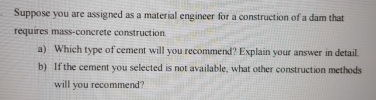 Please explain it briefly
Thanks
Suppose you are assigned as a material engineer for a construction of a dam that requires mass-concrete construction . a) Which type of cement will you recommend? Explain your answer in detail. b) If the cement you selected is not available, what other construction methods will you recommend?
Please explain it briefly
Thanks
Suppose you are assigned as a material engineer for a construction of a dam that requires mass-concrete construction . a) Which type of cement will you recommend? Explain your answer in detail. b) If the cement you selected is not available, what other construction methods will you recommend?
briefly explain the result oriented methods.5marks
briefly explain the result oriented methods.5marks
The graph below shows an enzyme- controlled reaction. The enzyme concentration is kept constant. At concentrations...
 The graph below shows an enzyme- controlled reaction. The enzyme concentration is kept constant. At concentrations of substrate greater than X, which of the following statements is true? Rate of reaction 0 Concentration of substrate X The rate of reaction is limited by enzyme concentration. The rate of reaction tends towards zero. The substrate has an inhibitory effect. The products have an inhibitory effect.
Will an enzyme from the stomach be equally effective in the small intestine? Briefly explain your...
Will an enzyme from the stomach be equally effective in the small intestine? Briefly explain your answer.
explain the induced-fit model of enzyme action, and how this differe from the "Lock-&-key" model NOA...
 explain the induced-fit model of enzyme action, and how this
differe from the "Lock-&-key" model
NOA HOJAVEN EN GENOSSO Questions to expand your mind. 1. Explain the Induced-Fit model of enzyme action, and how this differs from the Lock-&-Key" model. 2. Distinguish between catabolic and anabolie enzyme reactions 3. Define and describe 3 variables that may affect enzyme activity. 4. **Online Search Opportunity** What are the steps involved in commercial cheese making? Is this different from how organic farm cheese...
explain the induced-fit model of enzyme action, and how this
differe from the "Lock-&-key" model
NOA HOJAVEN EN GENOSSO Questions to expand your mind. 1. Explain the Induced-Fit model of enzyme action, and how this differs from the Lock-&-Key" model. 2. Distinguish between catabolic and anabolie enzyme reactions 3. Define and describe 3 variables that may affect enzyme activity. 4. **Online Search Opportunity** What are the steps involved in commercial cheese making? Is this different from how organic farm cheese...
 (a) Briefly explain three (3) methods of material selection. (3 marks) (b) With suitable example, explain three (3) types of design (6 marks)
 6 The graph shows the effect of substrate concentration on the rate of an enzyme- controlled reaction. The enzyme concentration is constant. reaction rate Which statement about the graph is correct? A Between Wand X, the substrate concentration number of enzyme molecules is limiting. Between X and Y, the number of enzyme molecules is limiting. Between X and Y, the number of substrate molecules is limiting. Between X and Y, the product concentration remains the same. Thanh in the nammanni...
 Please explain it briefly
Thanks
Suppose you are assigned as a material engineer for a construction of a dam that requires mass-concrete construction . a) Which type of cement will you recommend? Explain your answer in detail. b) If the cement you selected is not available, what other construction methods will you recommend?
Please explain it briefly
Thanks
Suppose you are assigned as a material engineer for a construction of a dam that requires mass-concrete construction . a) Which type of cement will you recommend? Explain your answer in detail. b) If the cement you selected is not available, what other construction methods will you recommend?
 The graph below shows an enzyme- controlled reaction. The enzyme concentration is kept constant. At concentrations of substrate greater than X, which of the following statements is true? Rate of reaction 0 Concentration of substrate X The rate of reaction is limited by enzyme concentration. The rate of reaction tends towards zero. The substrate has an inhibitory effect. The products have an inhibitory effect.
 explain the induced-fit model of enzyme action, and how this
differe from the "Lock-&-key" model
NOA HOJAVEN EN GENOSSO Questions to expand your mind. 1. Explain the Induced-Fit model of enzyme action, and how this differs from the Lock-&-Key" model. 2. Distinguish between catabolic and anabolie enzyme reactions 3. Define and describe 3 variables that may affect enzyme activity. 4. **Online Search Opportunity** What are the steps involved in commercial cheese making? Is this different from how organic farm cheese...
explain the induced-fit model of enzyme action, and how this
differe from the "Lock-&-key" model
NOA HOJAVEN EN GENOSSO Questions to expand your mind. 1. Explain the Induced-Fit model of enzyme action, and how this differs from the Lock-&-Key" model. 2. Distinguish between catabolic and anabolie enzyme reactions 3. Define and describe 3 variables that may affect enzyme activity. 4. **Online Search Opportunity** What are the steps involved in commercial cheese making? Is this different from how organic farm cheese...
Most questions answered within 3 hours.
-
Where is the error in this code sequence?
String s1 = "Hello";
String s2 = "ello";...
asked 10 months ago -
Financial data for Joel de Paris, Inc., for last year
follow:
Joel de Paris, Inc.
Balance...
asked 10 months ago -
Consider this reaction:
Al2(SO4)3 (aq)+ BaCl3
(aq) Al2Cl6 (aq)- +
3BaSO4(s) . What is the...
asked 10 months ago -
Suppose that Savneet is considering increasing her
recent random sample from 20 car rentals to 40...
asked 10 months ago -
Trucks arrive at an unloading terminal at an average rate of 120
per hour.
Trucks arrive...
asked 10 months ago -
Why are methanol and ethanol completely soluble in water while
octanol is not very little soluble....
asked 10 months ago -
A facilities manager at a university reads in a research report
that the mean amount of...
asked 10 months ago -
When the CuSO4 is rehydrated by adding water to the anhydrous
compound, is this an endothermic...
asked 10 months ago -
A ray of sunlight is passing from diamond into crown glass; the
angle of incidence is...
asked 10 months ago -
A block of mass 0.249 kg is placed on top of a light, vertical
spring of...
asked 10 months ago -
how do the kidneys compensate in the presences of acidosis
a) trigger hyperventilate
b) reserve acid...
asked 10 months ago -
Question 501 pts
The rental rate of capital to the firm increases. Which of the
following...
asked 10 months ago