What characteristics of DNA result in the requirement that some DNA synthesis has to be discontinuous?...
What characteristics of DNA result in the requirement that some DNA synthesis has to be discontinuous? (Why is there a “lagging strand?”)
Homework Answers
Answer:
Two strands of DNA run in the antiparallel direction. During replication, the replication fork is formed by opening up the two strands and synthesis of DNA on top of the existing strand will start in 5' to 3' by DNA polymerase. One of the strands is continuously replicated as the DNA polymerase can proceed only 5' to 3'. The other strand (lagging strand) needs to be replicated in the opposite direction. Therefore, short fragments of DNA are produced as the replication fork expands. Hence this is a discontinuous synthesis.
Add Answer to:
What characteristics of DNA result in the requirement that some
DNA synthesis has to be discontinuous?...
explain why any newly synthesized strand of DNA is the result of bith continuous and discontinuous...
explain why any newly synthesized strand of DNA is the result of bith continuous and discontinuous DNA synthesis
Can someone draw a picture explaining why the lagging strand in the DNA replication is discontinuous?
Can someone draw a picture explaining why the lagging strand in the DNA replication is discontinuous?
1. DNA is coiled around what type of proteins to form nucleosomes A. Polymerases DNA replication...
 1. DNA is coiled around what type of proteins to form nucleosomes A. Polymerases DNA replication of the lagging strand is discontinuous B. Transcription factors DNA replication of the lagging strand is continuous C. Helicases D. Histones E. DICER 2. Which of the following statements is true? A. DNA replication of the leading strand is discontinuous B. DNA replication of the lagging strand is discontinuous C. DNA replication of the leading strand is dispersive D. DNA replication of the lagging...
44. During DNA replication, the double helix is unwound, creating two single strands. One of these...
 44. During DNA replication, the double helix is unwound, creating two single strands. One of these is called the strand, on which the progress of DNA Polymerase III is – 45. The other strand is called the strand, on which the synthesis is 16. During DNA replication, synthesis of a new sequence on the Leading Strand is continuous. Why is synthesis on the Lagging Strand discontinuous? 47. Generation of Okazaki fragments proceeds in three steps. Indicate which of the following...
In DNA replication ywhat are the leading and lagging strand synthesis plus the activities of DNA...
In DNA replication ywhat are the leading and lagging strand synthesis plus the activities of DNA helicase, DNA gyrase, DNA polymerase, RNA primase and DNA ligase
How does DNA synthesis along the lagging strand differ from that of the leading strand? a....
How does DNA synthesis along the lagging strand differ from that of the leading strand? a. nucleotides are added to the 5' end instead of the 3' end b. an RNA primer is needed on the lagging strand but not on the leading strand c. ligase is the enzyme that polymerizes DNA on the lagging strand d. okazaki fragments, which each grow 5' to 3', must be joined along the lagging strand
2.5 points Save Answer Discontinuous replication refers to the fact that: O A DNA synthesis begins...
 2.5 points Save Answer Discontinuous replication refers to the fact that: O A DNA synthesis begins at multiple origins of replication OB. one of the daughter strands of a replicated piece of DNA is made in short fragments that are joined together OC DNA synthesis is not continuous with RNA synthesis OD. DNA synthesis starts and stops many times before completion
Shortly after the initiation of DNA replication at the Origin of Replication, an antibiotic has inactivated...
Shortly after the initiation of DNA replication at the Origin of Replication, an antibiotic has inactivated the RNA primate. In this condition, the synthesis of which new DNA strand at the replication fork would be interrupted? A. Leading strand B. Lagging strand C. Both strands D. None of the strands
Which of the following are needed only for lagging strand DNA synthesis? Primer DNA Ligase dNTPs...
Which of the following are needed only for lagging strand DNA synthesis? Primer DNA Ligase dNTPs DNA Polymerase Telomeres Primase ssDNA binding proteins Telomerase Helicase Chromatin is formed when a long strand of DNA is wrapped around several proteins called____. ____ is chromatin that is 'loosely' packed which allows genes to be expressed. ____ is chromatin that is 'tightly' packed blocking genes from being expressed. All of an organisms DNA together constitutes an organism's ____ Choices are: Polymerase / genome...
Draw new strand based on following template. Remember origin of replication is where DNA synthesis starts...
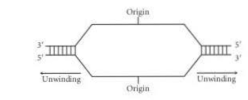 Draw new strand based on following template. Remember origin of
replication is where DNA synthesis starts and there are two
replication forks. Indicate which strand is leading and lagging
strand.
Origin Unwinding Unwinding Origin
Draw new strand based on following template. Remember origin of
replication is where DNA synthesis starts and there are two
replication forks. Indicate which strand is leading and lagging
strand.
Origin Unwinding Unwinding Origin
 1. DNA is coiled around what type of proteins to form nucleosomes A. Polymerases DNA replication of the lagging strand is discontinuous B. Transcription factors DNA replication of the lagging strand is continuous C. Helicases D. Histones E. DICER 2. Which of the following statements is true? A. DNA replication of the leading strand is discontinuous B. DNA replication of the lagging strand is discontinuous C. DNA replication of the leading strand is dispersive D. DNA replication of the lagging...
 44. During DNA replication, the double helix is unwound, creating two single strands. One of these is called the strand, on which the progress of DNA Polymerase III is – 45. The other strand is called the strand, on which the synthesis is 16. During DNA replication, synthesis of a new sequence on the Leading Strand is continuous. Why is synthesis on the Lagging Strand discontinuous? 47. Generation of Okazaki fragments proceeds in three steps. Indicate which of the following...
 2.5 points Save Answer Discontinuous replication refers to the fact that: O A DNA synthesis begins at multiple origins of replication OB. one of the daughter strands of a replicated piece of DNA is made in short fragments that are joined together OC DNA synthesis is not continuous with RNA synthesis OD. DNA synthesis starts and stops many times before completion
 Draw new strand based on following template. Remember origin of
replication is where DNA synthesis starts and there are two
replication forks. Indicate which strand is leading and lagging
strand.
Origin Unwinding Unwinding Origin
Draw new strand based on following template. Remember origin of
replication is where DNA synthesis starts and there are two
replication forks. Indicate which strand is leading and lagging
strand.
Origin Unwinding Unwinding Origin
Most questions answered within 3 hours.
-
Where is the error in this code sequence?
String s1 = "Hello";
String s2 = "ello";...
asked 11 months ago -
Financial data for Joel de Paris, Inc., for last year
follow:
Joel de Paris, Inc.
Balance...
asked 11 months ago -
Consider this reaction:
Al2(SO4)3 (aq)+ BaCl3
(aq) Al2Cl6 (aq)- +
3BaSO4(s) . What is the...
asked 11 months ago -
Suppose that Savneet is considering increasing her
recent random sample from 20 car rentals to 40...
asked 11 months ago -
Trucks arrive at an unloading terminal at an average rate of 120
per hour.
Trucks arrive...
asked 11 months ago -
Why are methanol and ethanol completely soluble in water while
octanol is not very little soluble....
asked 11 months ago -
A facilities manager at a university reads in a research report
that the mean amount of...
asked 11 months ago -
When the CuSO4 is rehydrated by adding water to the anhydrous
compound, is this an endothermic...
asked 11 months ago -
A ray of sunlight is passing from diamond into crown glass; the
angle of incidence is...
asked 11 months ago -
A block of mass 0.249 kg is placed on top of a light, vertical
spring of...
asked 11 months ago -
how do the kidneys compensate in the presences of acidosis
a) trigger hyperventilate
b) reserve acid...
asked 11 months ago -
Question 501 pts
The rental rate of capital to the firm increases. Which of the
following...
asked 11 months ago