How are air-filled bladders in brown algae advantageous to the organism?
How are air-filled bladders in brown algae advantageous to the organism?
Homework Answers
Answer
Brown algae are the exclusive seaweeds that have air bladders, brown algae are larger like kelp, leaves have air filled bladders that help them to float on the surface of water otherwise brown algae will be too heavy to float on the surface of water. As we know, brown algae are photosynthetic in nature that synthesize their own food from sunlight. So, this air filled bladders help them to float on water or and provide access to the sunlight that helps in photosynthesis process or maximizes the sunlight absorption.
Add Answer to:
How are air-filled bladders in brown algae advantageous to the
organism?
5. Refer to the image. Phylogenetic relatianships based on chloroplast genes Brown algae Diatoms Most photosynthetic...
 5. Refer to the image. Phylogenetic relatianships based on chloroplast genes Brown algae Diatoms Most photosynthetic dinoflagellates Cryptophyte algae Red algae Red algae Phylogenetic relationships based on nuclear genes Opisthokonts Amoebozoans GlaucocystophytesArchaeplastids Red algae Green algae Diatoms Brown algae -Stramenopiles Green algae Euglenids Green algae Chlorarachniophyte algae Dinoflagellates -Alveolates Chlorarachniophyte algae Green algae Green algae Green algae Green algae Land plants Glaucocystophytes Rhizarians Cryptophyte algae Euglenids - Excavates Cyanobacteria ologye How Life Work, Third Edition o 2019 Macmlan Learning Phylogenies...
Questions 14-20 14. A zygote is always: 15. Pyrenoids are structures in some algae that provide...
 Questions 14-20
14. A zygote is always: 15. Pyrenoids are structures in some algae that provide for storage of: 16. Some unicellular algae have light-sensing organelles called: 17. Diatoms are economically and ecologically significant because they produce large amounts of: 18. Organisms with many nuclei but no divisions into individual cell (such as Physarum) are called: a. haploid b. diploid c. triploid d. none of these c. amino acids d. water a. starchb. glycoprotein a. bladders b. vacuoles c. eyespots...
Questions 14-20
14. A zygote is always: 15. Pyrenoids are structures in some algae that provide for storage of: 16. Some unicellular algae have light-sensing organelles called: 17. Diatoms are economically and ecologically significant because they produce large amounts of: 18. Organisms with many nuclei but no divisions into individual cell (such as Physarum) are called: a. haploid b. diploid c. triploid d. none of these c. amino acids d. water a. starchb. glycoprotein a. bladders b. vacuoles c. eyespots...
Which type of algae consists of only multicellular organisms? A. Brown algae B. Euglenoids C. Dinoflagellates...
Which type of algae consists of only multicellular organisms? A. Brown algae B. Euglenoids C. Dinoflagellates D. Red algae E. Green algae
1. Red algae are A B. C. protists plants fungi animals prokaryotes D. Brown algae area...
 1. Red algae are A B. C. protists plants fungi animals prokaryotes D. Brown algae area A. B. C. protists plants fungi animals prokaryotes E. gave rise to the entire terrestrial plant A single species of freshwater lineage. A. B. C. red algae brown algae green algae fungus prokaryote D. E. Green algae split into 2 clades: A. B. c. D. chromalveolata and stramenopila rhizaria and cercozoa alveolata and stramenopila excavata and opisthokonta chlorophytes and charophytes 5. The green algae...
what does a phylogenetic tree of 1.cyanobacteria 2. Land plants 3. Brown algae 4. Green algae...
what does a phylogenetic tree of 1.cyanobacteria 2. Land plants 3. Brown algae 4. Green algae 5. Red algae look like
Which group of organisms is most closely related to plants? A. green algae B. brown algae C....
Which group of organisms is most closely related to plants? A. green algae B. brown algae C. red algae D.slime mold Which group of plants lacks vascular tissue? A. mosses B. ferns C. cone-bearing plants D. grasses
Explain why the coordinated regulation of isocitrate lyase and isocitrate dehydrogenase is advantageous to an organism
Explain why the coordinated regulation of isocitrate lyase and isocitrate dehydrogenase is advantageous to an organism
what molecules are responsible for the color of green, red, yellow and brown algae?
what molecules are responsible for the color of green, red, yellow and brown algae?
3. Phlorotannins commonly found in brown algae are polymers of what oligomers? Name a synthetic method...
 3. Phlorotannins commonly found in brown algae are polymers of what oligomers? Name a synthetic method used to generate large numbers of compounds around a common chemical scaffold?
Rratene and ectocarpene are sex pheromones produced by Fucose marine brown algae. What are their ...
 please i need help with both problems , thank you
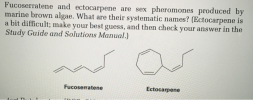
rratene and ectocarpene are sex pheromones produced by Fucose marine brown algae. What are their systematic names? (Ectocarpene is a bit difficult; make your best guess, and then check your answer in the Study Guide and Solutions Manual.) Fucoseratene Ectocarpene Sketch the transition-state structures involved in the reaction of HBr with 1-pentene (Problem 7-69). Tell whether each structure resembles reactant or product.
rratene and ectocarpene are sex pheromones produced by...
please i need help with both problems , thank you
rratene and ectocarpene are sex pheromones produced by Fucose marine brown algae. What are their systematic names? (Ectocarpene is a bit difficult; make your best guess, and then check your answer in the Study Guide and Solutions Manual.) Fucoseratene Ectocarpene Sketch the transition-state structures involved in the reaction of HBr with 1-pentene (Problem 7-69). Tell whether each structure resembles reactant or product.
rratene and ectocarpene are sex pheromones produced by...
 5. Refer to the image. Phylogenetic relatianships based on chloroplast genes Brown algae Diatoms Most photosynthetic dinoflagellates Cryptophyte algae Red algae Red algae Phylogenetic relationships based on nuclear genes Opisthokonts Amoebozoans GlaucocystophytesArchaeplastids Red algae Green algae Diatoms Brown algae -Stramenopiles Green algae Euglenids Green algae Chlorarachniophyte algae Dinoflagellates -Alveolates Chlorarachniophyte algae Green algae Green algae Green algae Green algae Land plants Glaucocystophytes Rhizarians Cryptophyte algae Euglenids - Excavates Cyanobacteria ologye How Life Work, Third Edition o 2019 Macmlan Learning Phylogenies...
 Questions 14-20
14. A zygote is always: 15. Pyrenoids are structures in some algae that provide for storage of: 16. Some unicellular algae have light-sensing organelles called: 17. Diatoms are economically and ecologically significant because they produce large amounts of: 18. Organisms with many nuclei but no divisions into individual cell (such as Physarum) are called: a. haploid b. diploid c. triploid d. none of these c. amino acids d. water a. starchb. glycoprotein a. bladders b. vacuoles c. eyespots...
Questions 14-20
14. A zygote is always: 15. Pyrenoids are structures in some algae that provide for storage of: 16. Some unicellular algae have light-sensing organelles called: 17. Diatoms are economically and ecologically significant because they produce large amounts of: 18. Organisms with many nuclei but no divisions into individual cell (such as Physarum) are called: a. haploid b. diploid c. triploid d. none of these c. amino acids d. water a. starchb. glycoprotein a. bladders b. vacuoles c. eyespots...
 1. Red algae are A B. C. protists plants fungi animals prokaryotes D. Brown algae area A. B. C. protists plants fungi animals prokaryotes E. gave rise to the entire terrestrial plant A single species of freshwater lineage. A. B. C. red algae brown algae green algae fungus prokaryote D. E. Green algae split into 2 clades: A. B. c. D. chromalveolata and stramenopila rhizaria and cercozoa alveolata and stramenopila excavata and opisthokonta chlorophytes and charophytes 5. The green algae...
 3. Phlorotannins commonly found in brown algae are polymers of what oligomers? Name a synthetic method used to generate large numbers of compounds around a common chemical scaffold?
 please i need help with both problems , thank you
rratene and ectocarpene are sex pheromones produced by Fucose marine brown algae. What are their systematic names? (Ectocarpene is a bit difficult; make your best guess, and then check your answer in the Study Guide and Solutions Manual.) Fucoseratene Ectocarpene Sketch the transition-state structures involved in the reaction of HBr with 1-pentene (Problem 7-69). Tell whether each structure resembles reactant or product.
rratene and ectocarpene are sex pheromones produced by...
please i need help with both problems , thank you
rratene and ectocarpene are sex pheromones produced by Fucose marine brown algae. What are their systematic names? (Ectocarpene is a bit difficult; make your best guess, and then check your answer in the Study Guide and Solutions Manual.) Fucoseratene Ectocarpene Sketch the transition-state structures involved in the reaction of HBr with 1-pentene (Problem 7-69). Tell whether each structure resembles reactant or product.
rratene and ectocarpene are sex pheromones produced by...
Most questions answered within 3 hours.
-
Where is the error in this code sequence?
String s1 = "Hello";
String s2 = "ello";...
asked 10 months ago -
Financial data for Joel de Paris, Inc., for last year
follow:
Joel de Paris, Inc.
Balance...
asked 10 months ago -
Consider this reaction:
Al2(SO4)3 (aq)+ BaCl3
(aq) Al2Cl6 (aq)- +
3BaSO4(s) . What is the...
asked 10 months ago -
Suppose that Savneet is considering increasing her
recent random sample from 20 car rentals to 40...
asked 10 months ago -
Trucks arrive at an unloading terminal at an average rate of 120
per hour.
Trucks arrive...
asked 10 months ago -
Why are methanol and ethanol completely soluble in water while
octanol is not very little soluble....
asked 10 months ago -
A facilities manager at a university reads in a research report
that the mean amount of...
asked 10 months ago -
When the CuSO4 is rehydrated by adding water to the anhydrous
compound, is this an endothermic...
asked 10 months ago -
A ray of sunlight is passing from diamond into crown glass; the
angle of incidence is...
asked 10 months ago -
A block of mass 0.249 kg is placed on top of a light, vertical
spring of...
asked 10 months ago -
how do the kidneys compensate in the presences of acidosis
a) trigger hyperventilate
b) reserve acid...
asked 10 months ago -
Question 501 pts
The rental rate of capital to the firm increases. Which of the
following...
asked 10 months ago