What occurs between glycolsis and krebs ? Are there any important products in this step ?...
What occurs between glycolsis and krebs ? Are there any important products in this step ? How many electron carriers are gernerated from Krebs Cycle itself, and how many ATP total ? Where are the carbon dioxide generated during Aerobic respiration and why are there two turns of Krebs Cycle ?
Homework Answers

Add Answer to:
What occurs between glycolsis and krebs ? Are there any
important products in this step ?...
Select ALL of the statements that correctly describe the Krebs cycle. A. Pyruvic acid must be...
Select ALL of the statements that correctly describe the Krebs cycle. A. Pyruvic acid must be converted to acetyl CoA prior to entering the cycle B. The molecule oxaloacetic acid picks up the acetyl group from acetylCoA, and in the last step of the cycle, oxaloacetic acid is regenerated. C. Electrons removed during oxidation steps are picked up by NAD or FAD. D. Each turn of the cycle generates one ATP molecule for a total of two per molecule of...
The process of ______________ occurs in the ______________ and is the first step in the process...
The process of ______________ occurs in the ______________ and is the first step in the process of cellular respiration where ________________ is oxidized to two molecules of ____________. This step produces a net of _________ ATP and _______ NADH. Two of these three-carbon compounds then enter the organelle named the __________________. Here they become acetyl CoA during the process of ___________________ and produce ________ NADH. Acetyl CoA then enters the __________ cycle or Krebs Cycle. This cycle generates _______NADH, _______FADH...
Drag the blocks below into their correct order: Drag the text blocks below into their correct...
 Drag the blocks below into their correct
order:
Drag the text blocks below into their correct order. Glycolysis occurs in the cytoplasm and overall generates 2 ATP. wwwwwwwwwww These molecules then bring the electrons generated by glycolysis and the Krebs cycle to the electron transport system embedded in the bacterial cell membrane The processes of aerobic and anaerobic respiration, as well as fermentation, all begin with glycolysis. In other microbes, the process of respiration continues when pyruvate is utilized in...
Drag the blocks below into their correct
order:
Drag the text blocks below into their correct order. Glycolysis occurs in the cytoplasm and overall generates 2 ATP. wwwwwwwwwww These molecules then bring the electrons generated by glycolysis and the Krebs cycle to the electron transport system embedded in the bacterial cell membrane The processes of aerobic and anaerobic respiration, as well as fermentation, all begin with glycolysis. In other microbes, the process of respiration continues when pyruvate is utilized in...
12. From the standpoint of the microorganism, what are the most important chemical produs the Krebs...
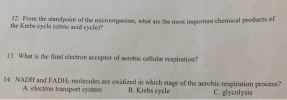 12. From the standpoint of the microorganism, what are the most important chemical produs the Krebs cycle (citric acid cycle)? 13. What is the final electron acceptor of aerobic cellular respiration? 14. NADH and FADH2 molecules are oxidized in which stage of the aerobic respiration process? A. electron transport system B. Krebs cycle C. glycolysis
The two molecules of electrons produced in glycolysis can be turned into acids and other products...
The two molecules of electrons produced in glycolysis can be turned into acids and other products through ____________ . These molecules then bring the ____________ generated by glycolysis and the Krebs cycle to the ____________ embedded in the bacterial cell ____________ . Cell that conduct ____________ respiration utilize free oxygen as a final electron acceptor in this process, while those that conduct ____________ respiration use oxygen-containing ions to create ATP molecules. The Krebs cycle produces a small amount of ATP, but also generates the reduced ____________ NADH and FADH₂. In other...
Which of the following statements is not true? Glycolysis produces most of the ATP required by...
 Which of the following statements is not true? Glycolysis produces most of the ATP required by aerobic organisms like us Glycolysis produces pyruvate, which is consumed by the Krebs cycle Glycolysis occurs in the cytosol of the cell Glycolysis is the first stage of cellular respiration • The Krebs cycle reactions Takes place in the cytoplasm Converts glucose to pyruvate Generate ATP with the help of an enzyme complex called ATP synthase Yield ATP, NADH, and FADH2 • Which of...
Cellular Respiration Worksheet 1.Where does each reaction take place? -Glycolysis -Fermentation -Acetyl CoA formation -Krebs Cycle...
Cellular Respiration Worksheet 1.Where does each reaction take place? -Glycolysis -Fermentation -Acetyl CoA formation -Krebs Cycle -ETC 2.What goes in/comes out of each reaction/name of each reaction? -Glycolysis -Fermentation -Acetyl CoA formation -Krebs Cycle -ETC 3.What are the electron carriers? Where are the electrons actually located? 4.What are the energy carrying molecules? Where is the energy actually located? 5.Where is oxygen used? Where’s CO2 released in cellular respiration? 6.Where is most of the ATP made? 7.What is the point/purpose of...
Chemoorganotrophic heterotrophs oxidize carbohydrates as their primary source of energy. Glucose is the most common energy...
Chemoorganotrophic heterotrophs oxidize carbohydrates as their primary source of energy. Glucose is the most common energy source for such organisms and energy may be extracted from glucose via respiration or fermentation. a. Explain the difference between aerobic respiration, anaerobic respiration, and fermentation. b. Identify and briefly define the metabolic pathways involved in aerobic respiration. For each metabolic pathway your response should address the forms of carbon that enter and exit, the amount of ATP produced, and the number and types...
A. Make a table comparing the three main events of aerobic cellular respiration: glycolysis, Kreb's Cycle,...
 A. Make a table comparing the three main events of aerobic cellular respiration: glycolysis, Kreb's Cycle, and electron transport chain. For each stage list the input molecule, the products (including any energized electron carriers, NADH and/or FADH), the number of ATP generated in each stage for every one glucose molecule that begins the process, and the location in the cell.
5. (5 points) Draw a diagram, chart or picture to organize what you learned about cellular...
 5. (5 points) Draw a diagram, chart or picture to organize what you learned about cellular respiration. The following information should be included: 1) the three main steps of respiration, 2) what goes into each step (reactants), 3) what the products of each step are, 4) where in the cell/organelle the steps take place. Make sure to use the following terms: glycolysis, Citric acid cycle (Krebs cycle), electron transport chain, ATP, NADH, O2 (oxygen), H20 (water), Coz (carbon dioxide), glucose....
 Drag the blocks below into their correct
order:
Drag the text blocks below into their correct order. Glycolysis occurs in the cytoplasm and overall generates 2 ATP. wwwwwwwwwww These molecules then bring the electrons generated by glycolysis and the Krebs cycle to the electron transport system embedded in the bacterial cell membrane The processes of aerobic and anaerobic respiration, as well as fermentation, all begin with glycolysis. In other microbes, the process of respiration continues when pyruvate is utilized in...
Drag the blocks below into their correct
order:
Drag the text blocks below into their correct order. Glycolysis occurs in the cytoplasm and overall generates 2 ATP. wwwwwwwwwww These molecules then bring the electrons generated by glycolysis and the Krebs cycle to the electron transport system embedded in the bacterial cell membrane The processes of aerobic and anaerobic respiration, as well as fermentation, all begin with glycolysis. In other microbes, the process of respiration continues when pyruvate is utilized in...
 12. From the standpoint of the microorganism, what are the most important chemical produs the Krebs cycle (citric acid cycle)? 13. What is the final electron acceptor of aerobic cellular respiration? 14. NADH and FADH2 molecules are oxidized in which stage of the aerobic respiration process? A. electron transport system B. Krebs cycle C. glycolysis
 Which of the following statements is not true? Glycolysis produces most of the ATP required by aerobic organisms like us Glycolysis produces pyruvate, which is consumed by the Krebs cycle Glycolysis occurs in the cytosol of the cell Glycolysis is the first stage of cellular respiration • The Krebs cycle reactions Takes place in the cytoplasm Converts glucose to pyruvate Generate ATP with the help of an enzyme complex called ATP synthase Yield ATP, NADH, and FADH2 • Which of...
 A. Make a table comparing the three main events of aerobic cellular respiration: glycolysis, Kreb's Cycle, and electron transport chain. For each stage list the input molecule, the products (including any energized electron carriers, NADH and/or FADH), the number of ATP generated in each stage for every one glucose molecule that begins the process, and the location in the cell.
 5. (5 points) Draw a diagram, chart or picture to organize what you learned about cellular respiration. The following information should be included: 1) the three main steps of respiration, 2) what goes into each step (reactants), 3) what the products of each step are, 4) where in the cell/organelle the steps take place. Make sure to use the following terms: glycolysis, Citric acid cycle (Krebs cycle), electron transport chain, ATP, NADH, O2 (oxygen), H20 (water), Coz (carbon dioxide), glucose....
Most questions answered within 3 hours.
-
Where is the error in this code sequence?
String s1 = "Hello";
String s2 = "ello";...
asked 11 months ago -
Financial data for Joel de Paris, Inc., for last year
follow:
Joel de Paris, Inc.
Balance...
asked 11 months ago -
Consider this reaction:
Al2(SO4)3 (aq)+ BaCl3
(aq) Al2Cl6 (aq)- +
3BaSO4(s) . What is the...
asked 11 months ago -
Suppose that Savneet is considering increasing her
recent random sample from 20 car rentals to 40...
asked 11 months ago -
Trucks arrive at an unloading terminal at an average rate of 120
per hour.
Trucks arrive...
asked 11 months ago -
Why are methanol and ethanol completely soluble in water while
octanol is not very little soluble....
asked 11 months ago -
A facilities manager at a university reads in a research report
that the mean amount of...
asked 11 months ago -
When the CuSO4 is rehydrated by adding water to the anhydrous
compound, is this an endothermic...
asked 11 months ago -
A ray of sunlight is passing from diamond into crown glass; the
angle of incidence is...
asked 11 months ago -
A block of mass 0.249 kg is placed on top of a light, vertical
spring of...
asked 11 months ago -
how do the kidneys compensate in the presences of acidosis
a) trigger hyperventilate
b) reserve acid...
asked 11 months ago -
Question 501 pts
The rental rate of capital to the firm increases. Which of the
following...
asked 11 months ago