The chlorination of toluene by chlorine gas is catalyzed by acid. The following data was obtained...
The chlorination of toluene by chlorine gas is catalyzed by acid. The following data was obtained by using a catalyst concentration of 0.117 mol L, and a temperature of 170 C. The initial concentration of Cl2 is 0.0775 mol L-1 in toluene.
| time (min) | 0 | 3 | 6 | 10 | 14 |
|---|---|---|---|---|---|
| [Cl2] mol L-1 | 0.0775 | 0.0565 | 0.0410 | 0.0265 | 0.0175 |
Write a general rate equation for this reaction.
Does the reaction meet the criteria for pseudo order kinetics to be applied? why?
Determine the order with respect to chlorine and the value of the relevant rate constant.
Homework Answers

Add Answer to:
The chlorination of toluene by chlorine gas is catalyzed by
acid. The following data was obtained...
An acid-catalyzed irreversible liquid-phase reaction A B is carried out adiabatically in a CSTR. The reaction is second...
 An acid-catalyzed irreversible liquid-phase reaction A B is carried out adiabatically in a CSTR. The reaction is second order in A. The feed is equimolar A and solvent (S, which contains catalyst), and enters the reactor at a total volumetric flow rate of 10 dm3/min at a concentration of A of 4 mol/L. The feed enters at 300 K. The product and reactant heat capacities are 15 cal/(mol°C), the solvent is 18 cal/(mol°C). The reaction rate constant at 300 K...
I need help as soon as possible please 1. Phosgene forms from carbon monoxide and chlorine according to the follow...
 I
need help as soon as possible please
1. Phosgene forms from carbon monoxide and chlorine according to the following reaction: CO(g) + Cl2 (g) → COCI2 (8) 2M/s Experiment Rate, Mol/L-S [CO], mol/L [Cl2], mol/L 1.30 X 10⁻²⁹ 1.33 X 10⁻³⁰ 1.30 X 10⁻²⁹ | 1.32 X 10⁻³¹ 1.000 0.100 0.100 0.100 0.100 0.100 1.00 0.0100 A. Determine the order of the reaction with respect to CO and Cl2. B. Write the rate law for the reaction. C. What...
I
need help as soon as possible please
1. Phosgene forms from carbon monoxide and chlorine according to the following reaction: CO(g) + Cl2 (g) → COCI2 (8) 2M/s Experiment Rate, Mol/L-S [CO], mol/L [Cl2], mol/L 1.30 X 10⁻²⁹ 1.33 X 10⁻³⁰ 1.30 X 10⁻²⁹ | 1.32 X 10⁻³¹ 1.000 0.100 0.100 0.100 0.100 0.100 1.00 0.0100 A. Determine the order of the reaction with respect to CO and Cl2. B. Write the rate law for the reaction. C. What...
Tap water which is commonly used in fish pond, may contain chlorine (Cl2). To allow the...
 Tap water which is commonly used in fish pond, may contain chlorine (Cl2). To allow the fish to live healthily, the chlorine can be pre-treated using sodium thiosulfate (Na2S2Os). Removal of chlorine depends on the assumed conversion in 1 m of rectangular fish tank (pond) volume. Water (H2O) is in excess state of having 4 ppm chlorine. Referring to the findings by Cao et al. (2007). the liquid-phase reaction is zero order with respect to water whilst the rests are...
The following data was obtained on the rate of hydrolysis of 14% sucrose in 0.099 mol...
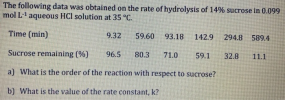 The following data was obtained on the rate of hydrolysis of 14% sucrose in 0.099 mol L aqueous HCl solution at 35 °C. Time (min) 9.32 59.60 93.18 142.9 294.8 589.4 Sucrose remaining (%) 96.5 80.3 71.0 59.1 32.8 11.1 a) What is the order of the reaction with respect to sucrose? b) What is the value of the rate constant, k?
1/ The Following data was obtained while observing a reaction between nitric oxide and hydrogen: F2(g)...
1/ The Following data was obtained while observing a reaction between nitric oxide and hydrogen: F2(g) + 2CLO2(g) -----> 2FCLO2(g) Experiment Initial(F2) Initial(CLO2) Initial rate (mol/L) (mol/L) (mol/L*s) 1/ 0.10 0.010 1.2 x 10^-3 2/ 0.10 0.040 4.8 x 10^-3 3/ 0.20 0.010 2.4 x 10^-3 A/ write the rate law for this reaction B/ calculate the rate constant for the reaction C/ what is the order of this reaction 2/ consider the reaction N2(g) + 3H2(g) ----> 2NH3(g). At...
please answer and explain.. thank you so much!! Consider the following graph, obtained using concentration and...
 please answer and explain.. thank you so much!!
Consider the following graph, obtained using concentration and time data collected in a kinetics experiment, where A is a reactant. Which of the following is not true? 2400 1/[A], L/mol y = 47.0x + 715 0 5 10 15 20 25 30 Time (hr) Answers a. The units of the rate constant are L/mol.hr Doubling the concentration of A would quadruple the reaction rate. The numerical value for the rate constant for...
please answer and explain.. thank you so much!!
Consider the following graph, obtained using concentration and time data collected in a kinetics experiment, where A is a reactant. Which of the following is not true? 2400 1/[A], L/mol y = 47.0x + 715 0 5 10 15 20 25 30 Time (hr) Answers a. The units of the rate constant are L/mol.hr Doubling the concentration of A would quadruple the reaction rate. The numerical value for the rate constant for...
Please show work! 18.0 6.18 The following data were obtained on the initial rate of isomerization...
 Please show work!
18.0 6.18 The following data were obtained on the initial rate of isomerization of a compound S catalyzed by an enzyme E: [S]./(mmol dm-) 1.00 2.00 3.00 4.00 vo/(mmol dm-'s-1) (a) 4.5 9.0 15.0 (b) 14.8 25.0 45.0 59.7 (c) 58.9 120.0 180.0 238.0 The enzyme concentrations are (a) 1.00 mmol dm-?, (b) 3.00 mol dm-3, and (c) 10.0 mmol dm-?. Find the orders of reactions with respect to S and E, and the rate constant. Hints...
Please show work!
18.0 6.18 The following data were obtained on the initial rate of isomerization of a compound S catalyzed by an enzyme E: [S]./(mmol dm-) 1.00 2.00 3.00 4.00 vo/(mmol dm-'s-1) (a) 4.5 9.0 15.0 (b) 14.8 25.0 45.0 59.7 (c) 58.9 120.0 180.0 238.0 The enzyme concentrations are (a) 1.00 mmol dm-?, (b) 3.00 mol dm-3, and (c) 10.0 mmol dm-?. Find the orders of reactions with respect to S and E, and the rate constant. Hints...
Please show your work, Thanks! 6.18 The following data were obtained on the initial rate of isomerization of a c...
 Please show your work, Thanks!
6.18 The following data were obtained on the initial rate of isomerization of a compound S catalyzed by an enzyme E: S]./(mmol dm") Va/(mmol dms) 2.00 3.00 1.00 4.00 15.0 9.0 4.5 (a) (b) 18.0 45.0 25.0 14.8 59.7 180.0 120.0 238.0 (c) 58.9 The enzyme concentrations are (a) 1.00 mmol dm, (b) 3.00 mol dm, and (c) 10.0 mmol dm Find the orders of reactions with respect to S and E, and the rate...
Please show your work, Thanks!
6.18 The following data were obtained on the initial rate of isomerization of a compound S catalyzed by an enzyme E: S]./(mmol dm") Va/(mmol dms) 2.00 3.00 1.00 4.00 15.0 9.0 4.5 (a) (b) 18.0 45.0 25.0 14.8 59.7 180.0 120.0 238.0 (c) 58.9 The enzyme concentrations are (a) 1.00 mmol dm, (b) 3.00 mol dm, and (c) 10.0 mmol dm Find the orders of reactions with respect to S and E, and the rate...
1: Consider the following set of data ccollected for a reaction of the form A -->...
1: Consider the following set of data ccollected for a reaction of the form A --> products. time (seconds) [A] (M) 0 1.000 10 0.641 20 0.472 30 0.373 40 0.309 50 0.263 A: What is the average rate of the reaction for the first 10 seconds? rate = ___ M/s B: What is the average rate of the reaction between 30 and 40 seconds? rate = ___ M/s 2: Consider the dimerization of C4H6: 2 C4H6 --> C8H12 for...
PLEASE HELP WITH ENTIRE... 2: Consider the dimerization of C4H6: 2 C4H6 --> C8H12 for which...
PLEASE HELP WITH ENTIRE... 2: Consider the dimerization of C4H6: 2 C4H6 --> C8H12 for which the following data re collected: time (sec) [C4H6] (M) 0 1.00x10⁻² 1600 5.04x10⁻³ 3200 3.37x10⁻³ 4800 2.53x10⁻³ 6200 2.08x10⁻³ A: Using empirical kinetics methods, determine the order of the reaction rate law. a 2nd order b 1st order c 0th order d The order can not be determined from this data. B: Based on the data above, calculate the concentration of C4H6 at 7,885...
 An acid-catalyzed irreversible liquid-phase reaction A B is carried out adiabatically in a CSTR. The reaction is second order in A. The feed is equimolar A and solvent (S, which contains catalyst), and enters the reactor at a total volumetric flow rate of 10 dm3/min at a concentration of A of 4 mol/L. The feed enters at 300 K. The product and reactant heat capacities are 15 cal/(mol°C), the solvent is 18 cal/(mol°C). The reaction rate constant at 300 K...
 I
need help as soon as possible please
1. Phosgene forms from carbon monoxide and chlorine according to the following reaction: CO(g) + Cl2 (g) → COCI2 (8) 2M/s Experiment Rate, Mol/L-S [CO], mol/L [Cl2], mol/L 1.30 X 10⁻²⁹ 1.33 X 10⁻³⁰ 1.30 X 10⁻²⁹ | 1.32 X 10⁻³¹ 1.000 0.100 0.100 0.100 0.100 0.100 1.00 0.0100 A. Determine the order of the reaction with respect to CO and Cl2. B. Write the rate law for the reaction. C. What...
I
need help as soon as possible please
1. Phosgene forms from carbon monoxide and chlorine according to the following reaction: CO(g) + Cl2 (g) → COCI2 (8) 2M/s Experiment Rate, Mol/L-S [CO], mol/L [Cl2], mol/L 1.30 X 10⁻²⁹ 1.33 X 10⁻³⁰ 1.30 X 10⁻²⁹ | 1.32 X 10⁻³¹ 1.000 0.100 0.100 0.100 0.100 0.100 1.00 0.0100 A. Determine the order of the reaction with respect to CO and Cl2. B. Write the rate law for the reaction. C. What...
 Tap water which is commonly used in fish pond, may contain chlorine (Cl2). To allow the fish to live healthily, the chlorine can be pre-treated using sodium thiosulfate (Na2S2Os). Removal of chlorine depends on the assumed conversion in 1 m of rectangular fish tank (pond) volume. Water (H2O) is in excess state of having 4 ppm chlorine. Referring to the findings by Cao et al. (2007). the liquid-phase reaction is zero order with respect to water whilst the rests are...
 The following data was obtained on the rate of hydrolysis of 14% sucrose in 0.099 mol L aqueous HCl solution at 35 °C. Time (min) 9.32 59.60 93.18 142.9 294.8 589.4 Sucrose remaining (%) 96.5 80.3 71.0 59.1 32.8 11.1 a) What is the order of the reaction with respect to sucrose? b) What is the value of the rate constant, k?
 please answer and explain.. thank you so much!!
Consider the following graph, obtained using concentration and time data collected in a kinetics experiment, where A is a reactant. Which of the following is not true? 2400 1/[A], L/mol y = 47.0x + 715 0 5 10 15 20 25 30 Time (hr) Answers a. The units of the rate constant are L/mol.hr Doubling the concentration of A would quadruple the reaction rate. The numerical value for the rate constant for...
please answer and explain.. thank you so much!!
Consider the following graph, obtained using concentration and time data collected in a kinetics experiment, where A is a reactant. Which of the following is not true? 2400 1/[A], L/mol y = 47.0x + 715 0 5 10 15 20 25 30 Time (hr) Answers a. The units of the rate constant are L/mol.hr Doubling the concentration of A would quadruple the reaction rate. The numerical value for the rate constant for...
 Please show work!
18.0 6.18 The following data were obtained on the initial rate of isomerization of a compound S catalyzed by an enzyme E: [S]./(mmol dm-) 1.00 2.00 3.00 4.00 vo/(mmol dm-'s-1) (a) 4.5 9.0 15.0 (b) 14.8 25.0 45.0 59.7 (c) 58.9 120.0 180.0 238.0 The enzyme concentrations are (a) 1.00 mmol dm-?, (b) 3.00 mol dm-3, and (c) 10.0 mmol dm-?. Find the orders of reactions with respect to S and E, and the rate constant. Hints...
Please show work!
18.0 6.18 The following data were obtained on the initial rate of isomerization of a compound S catalyzed by an enzyme E: [S]./(mmol dm-) 1.00 2.00 3.00 4.00 vo/(mmol dm-'s-1) (a) 4.5 9.0 15.0 (b) 14.8 25.0 45.0 59.7 (c) 58.9 120.0 180.0 238.0 The enzyme concentrations are (a) 1.00 mmol dm-?, (b) 3.00 mol dm-3, and (c) 10.0 mmol dm-?. Find the orders of reactions with respect to S and E, and the rate constant. Hints...
 Please show your work, Thanks!
6.18 The following data were obtained on the initial rate of isomerization of a compound S catalyzed by an enzyme E: S]./(mmol dm") Va/(mmol dms) 2.00 3.00 1.00 4.00 15.0 9.0 4.5 (a) (b) 18.0 45.0 25.0 14.8 59.7 180.0 120.0 238.0 (c) 58.9 The enzyme concentrations are (a) 1.00 mmol dm, (b) 3.00 mol dm, and (c) 10.0 mmol dm Find the orders of reactions with respect to S and E, and the rate...
Please show your work, Thanks!
6.18 The following data were obtained on the initial rate of isomerization of a compound S catalyzed by an enzyme E: S]./(mmol dm") Va/(mmol dms) 2.00 3.00 1.00 4.00 15.0 9.0 4.5 (a) (b) 18.0 45.0 25.0 14.8 59.7 180.0 120.0 238.0 (c) 58.9 The enzyme concentrations are (a) 1.00 mmol dm, (b) 3.00 mol dm, and (c) 10.0 mmol dm Find the orders of reactions with respect to S and E, and the rate...
Most questions answered within 3 hours.
-
Where is the error in this code sequence?
String s1 = "Hello";
String s2 = "ello";...
asked 11 months ago -
Financial data for Joel de Paris, Inc., for last year
follow:
Joel de Paris, Inc.
Balance...
asked 11 months ago -
Consider this reaction:
Al2(SO4)3 (aq)+ BaCl3
(aq) Al2Cl6 (aq)- +
3BaSO4(s) . What is the...
asked 11 months ago -
Suppose that Savneet is considering increasing her
recent random sample from 20 car rentals to 40...
asked 11 months ago -
Trucks arrive at an unloading terminal at an average rate of 120
per hour.
Trucks arrive...
asked 11 months ago -
Why are methanol and ethanol completely soluble in water while
octanol is not very little soluble....
asked 11 months ago -
A facilities manager at a university reads in a research report
that the mean amount of...
asked 11 months ago -
When the CuSO4 is rehydrated by adding water to the anhydrous
compound, is this an endothermic...
asked 11 months ago -
A ray of sunlight is passing from diamond into crown glass; the
angle of incidence is...
asked 11 months ago -
A block of mass 0.249 kg is placed on top of a light, vertical
spring of...
asked 11 months ago -
how do the kidneys compensate in the presences of acidosis
a) trigger hyperventilate
b) reserve acid...
asked 11 months ago -
Question 501 pts
The rental rate of capital to the firm increases. Which of the
following...
asked 11 months ago